



















How Can You Detect E. coli and Coliform Bacteria in Drinking Water?
Last Updated on November 15, 2026
E. coli has no colour, no smell and no taste. A glass of water can be sparkling clear, show a perfectly normal TDS reading and still carry enough faecal bacteria to make your family sick. The only reliable way to detect E. coli and coliform bacteria in drinking water is a lab culture test: a measured 100 mL sample is filtered or mixed into a growth medium that makes these bacteria show up as coloured colonies or glowing wells, and the lab counts them. That’s what microbiological water testing in Bangalore labs, or anywhere else, comes down to.
This guide explains what coliforms and E. coli actually tell you, the limits set by BIS IS 10500, the four main lab methods and how they differ, how to collect a sample so the result means something, how to read the report, and what to do if your water tests positive.
What Are Coliform Bacteria and E. coli, and Why Do Labs Test for Them?
Coliforms are a large family of bacteria that labs use as a warning signal. Labs don’t hunt for every possible germ in your water. They look for a few “indicator” bacteria whose presence tells you contamination has happened and that more dangerous organisms could be there too.
There are three groups you’ll see on a report, and they don’t mean the same thing:
- Total coliforms: a broad group. Some come from faeces, but many live naturally in soil, plants and water. Finding them in treated water tells you something got past treatment or into the pipes, tank or purifier.
- Thermotolerant (faecal) coliforms: a sub-group that can grow at about 44.5 °C, the temperature labs use to separate them out. Australia’s national drinking water guidelines on thermotolerant coliforms point out that some of them (strains of Klebsiella, Citrobacter and Enterobacter) can grow in the environment, so they aren’t always a sign of faeces.
- E. coli: the one that matters most. It lives in the gut of humans and warm-blooded animals, so finding it means faecal matter has reached your water. The WHO Guidelines for Drinking-water Quality (microbial aspects chapter) call E. coli “the more precise indicator of faecal pollution”, with thermotolerant coliforms as an acceptable alternative.
Here’s the practical difference. If your report shows total coliforms but no E. coli, you have a hygiene or treatment problem somewhere between the source and your tap. If it shows E. coli, sewage or animal waste is getting in, and the water isn’t safe to drink until the cause is fixed. That’s why most cities with ageing pipes and borewells close to soak pits, Bangalore included, need this test far more than they need another TDS check.
WHO also makes a point worth keeping in mind: in tropical climates total coliforms on their own aren’t a good measure of the sanitary quality of untreated supplies, because many harmless bacteria show up in almost all raw water. For a raw borewell or tanker, E. coli is the number to focus on. For treated or purified water, both should be zero.
What Does IS 10500 Say About E. coli and Coliforms in Drinking Water?
The short answer: none is allowed. Under BIS IS 10500:2012, Drinking Water Specification, E. coli or thermotolerant coliform bacteria must not be detectable in any 100 mL sample of water meant for drinking. Unlike TDS or hardness, there’s no “acceptable” and “permissible” range here.
| Type of water | Organism | IS 10500 requirement |
|---|---|---|
| All water intended for drinking | E. coli or thermotolerant coliforms | Not detectable in any 100 mL sample |
| Treated water entering the distribution system | E. coli or thermotolerant coliforms, and total coliforms | Not detectable in any 100 mL sample |
| Treated water in the distribution system | E. coli or thermotolerant coliforms, and total coliforms | Not detectable in any 100 mL sample |
The WHO guidelines use the same “must not be detectable in any 100 ml sample” wording and call for immediate investigation whenever E. coli is found. For a full picture of where bacteriology fits among the chemical, physical and toxic parameters, see our guide to drinking water testing parameters under IS 10500.
How Do Labs Detect E. coli and Coliforms? The Main Microbiological Water Testing Methods
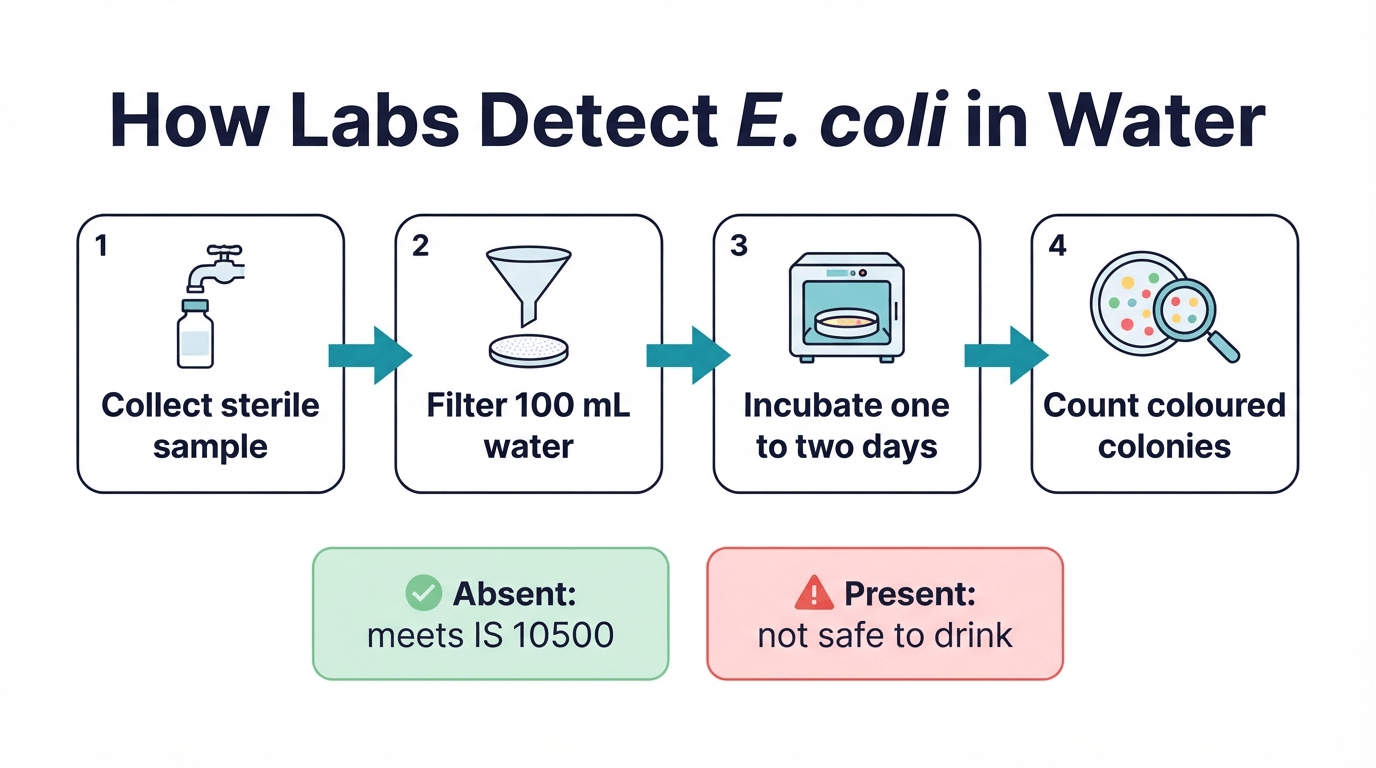
Every standard method works the same basic way: give the bacteria in a 100 mL sample the food and temperature they like, add a chemical that makes coliforms and E. coli identify themselves, and count. The methods differ in how they separate the bacteria from the water and how the result is reported.
1. Membrane filtration (IS 15185:2016 / ISO 9308-1:2014)
The lab pushes the sample through a sterile membrane filter fine enough to trap bacteria (EPA Method 1604, for example, uses a 0.45 µm membrane). The filter is placed on a chromogenic agar and incubated. Coliforms and E. coli grow into colonies of different colours, and the lab counts them, so you get a result in colony forming units per 100 mL (CFU/100 mL).
IS 15185:2016 is the Indian adoption of ISO 9308-1:2014, and IS 10500 now points to it as the reference method for bacteriological testing. It works best for clean, low-turbidity water with low bacterial numbers, which suits treated, RO and municipal water. Very cloudy water or surface water with lots of background bacteria can clog the filter or crowd out the colonies you’re trying to count.
2. Enzyme substrate MPN (IS 17819:2022 / ISO 9308-2:2012)
This is the method behind kits such as Colilert. The sample is mixed with a liquid medium containing two enzyme “baits”. Coliforms produce an enzyme called β-D-galactosidase, which turns the medium yellow. E. coli also produces β-D-glucuronidase, which breaks down a substrate called MUG and makes the well glow blue under UV light. The sample is spread across a tray of wells, and the pattern of positive wells is converted to a most probable number (MPN) per 100 mL using statistical tables.
IS 17819:2022 is identical to ISO 9308-2:2012. The big advantage is that a positive result is already confirmed, with no extra confirmation step, and turbid water is less of a problem than with filtration.
3. Multiple tube fermentation (the classic MPN method)
The older approach, described in IS 1622:1981, Methods of Sampling and Microbiological Examination of Water, sets portions of the sample into a series of tubes of lactose broth. Tubes that produce acid and gas are counted as presumptive positives, then moved to confirmation media and to the higher 44 °C temperature for faecal coliforms. The pattern of positive tubes gives an MPN per 100 mL. It’s reliable and cheap on materials, but it takes longer and needs more handling than modern chromogenic methods. BIS has been working on a second revision of IS 1622 that also covers wastewater.
4. Presence-absence testing
Sometimes you don’t need a count. You need a yes or no. A presence-absence (P-A) test incubates the full 100 mL in a single bottle of medium and reports “present” or “absent” for total coliforms and E. coli. US rules for public water systems under the Revised Total Coliform Rule (40 CFR 141.852) only require systems to establish presence or absence, not density, and the US EPA list of approved coliform methods includes multiple tube, membrane filtration and enzyme substrate methods.
| Method | Indian / ISO standard | How it reports | Best suited to |
|---|---|---|---|
| Membrane filtration on chromogenic agar | IS 15185:2016 / ISO 9308-1:2014 | CFU per 100 mL | Treated, RO, municipal and packaged water with low turbidity |
| Enzyme substrate (MPN) | IS 17819:2022 / ISO 9308-2:2012 | MPN per 100 mL, or present/absent | Most drinking water, including slightly turbid samples |
| Multiple tube fermentation | IS 1622 | MPN per 100 mL | Raw water, borewells, older compliance specifications |
| Presence-absence | Various (for example enzyme substrate in P-A format) | Present or absent in 100 mL | Routine checks where any detection is a fail |
What about rapid and PCR tests?
Molecular methods such as qPCR can give answers in hours rather than a day. The catch is sensitivity. A 2024 preprint describing a PCR assay for coliform bacteria in drinking water notes that nucleic acid methods generally struggle to detect bacteria at the very low concentrations that matter for drinking water. PCR also picks up DNA from dead cells. For a compliance or safety decision, culture methods are still the standard.
One honest limitation applies to all the enzyme based methods: a few E. coli strains, including the dangerous O157 type, don’t produce β-D-glucuronidase and won’t show up as E. coli. That’s one reason a clean indicator result is strong evidence of safety, not absolute proof. WHO also notes that the absence of E. coli doesn’t rule out chlorine resistant protozoa or viruses, which is why good treatment and storage matter as much as testing.
Can You Detect E. coli in Water at Home?
Not by looking, smelling or tasting, and not with a TDS meter. TDS measures dissolved salts, not bacteria. A reading of 50 or 500 tells you nothing about faecal contamination.
Home bacteria test kits do exist, usually a bottle or strip that changes colour after a day or two. They can be useful as a quick screen: if one turns positive, take it seriously and get a lab test. But they have real limits. You can’t easily tell whether the sample was contaminated by your hands or the bottle, they rarely separate total coliforms from E. coli reliably, and the result isn’t a report you can show a housing society committee, a tenant, a regulator or a food safety auditor. For that, you need an accredited lab result against IS 10500.
How Should You Collect a Water Sample for Microbiological Testing?
Most false positives start at the tap, not in the lab. A bacteriology sample has to be collected so that the only bacteria in the bottle are the ones in your water.
- Use the sterile bottle the lab gives you. Don’t reuse a mineral water bottle. Microbiology bottles are sterilised, and for chlorinated water they contain a small amount of sodium thiosulphate to neutralise the chlorine. Without it, chlorine keeps killing bacteria on the way to the lab and the result reads falsely clean. US federal rules require exactly this step for chlorinated samples.
- Don’t rinse the bottle and don’t touch the inside of the bottle or cap. Rinsing washes out the thiosulphate.
- Pick the right tap. Sample the point you actually drink from (the kitchen tap or the purifier outlet). If you want to know where contamination enters, sample the source, the sump or overhead tank outlet and the tap separately.
- Remove aerators and filters on the tap if you can, and wipe the spout clean. Leaky, dirty taps grow their own bacteria.
- Let the water run for 2 to 3 minutes before you fill the bottle, so you sample water from the line, not water that has been sitting in the tap.
- Fill to the mark, leave a little air space, close the cap firmly and label the bottle with the location, date and time.
- Keep it cool and get it to the lab fast. Bacteria multiply or die off with time and heat. At Prewel Labs we ask for microbiology samples to reach the lab within about 6 hours of collection. For comparison, US rules set an absolute maximum of 30 hours from collection to the start of incubation and encourage keeping samples below 10 °C in transit.
If you’re testing a borewell, the setup is slightly different, and our guide to borewell water testing in Bangalore covers where to sample and which other parameters to add.
How Do You Read a Coliform and E. coli Test Report?
Look for three things: the organism, the unit and the method. A good report lists total coliforms and E. coli separately, gives the result per 100 mL, and names the standard used (for example IS 15185 or IS 17819).
- “Absent”, “Not detected” or “<1 CFU/100 mL”: nothing grew from your 100 mL sample. This meets IS 10500. Labs write “<1” rather than “0” because no method can prove an absolute zero, only that nothing was detected in the volume tested. We explain that in more detail in why labs report less than 1 CFU instead of 0 CFU.
- Any number of CFU or MPN per 100 mL, or “Present”: the sample fails. There is no safe low count for E. coli in drinking water.
- Total coliforms present, E. coli absent: a fail for treated water, and a sign of a treatment or hygiene gap. It’s less urgent than E. coli, but it still needs action.
Many reports also include a total plate count (TPC or heterotrophic plate count). That’s a general count of bacteria that grow on standard media. It’s useful for spotting biofilm in tanks, pipes and purifiers, but it isn’t a measure of faecal contamination on its own.
What Should You Do If Your Water Tests Positive for E. coli or Coliforms?
Stop drinking it untreated, find the source, fix it, and retest. In that order.
- Switch to a safe supply straight away. Use boiled water (a rolling boil), or a known safe source for drinking, cooking, brushing teeth and making ice and baby feeds.
- Retest to confirm. A single positive can come from a bad sample. IS 10500 treats a total coliform detection as a trigger for at least a repeat sample, and if it shows up again, the cause has to be traced immediately. An E. coli result should be acted on without waiting.
- Test along the chain. Sample the source (borewell, BWSSB line or tanker), the sump, the overhead tank and the tap. The point where bacteria first appear tells you where the problem is.
- Check the usual suspects. In Bangalore buildings these are often a borewell close to a septic tank or soak pit, a cracked sump that lets in surface water during the monsoon, an uncovered or rarely cleaned overhead tank, a leaking pipe next to a drain line, a purifier whose filters or UV lamp are overdue, and tanker water of unknown origin.
- Fix, disinfect and flush. Repair the entry point, clean and disinfect the tanks, and flush the lines. Chlorinating without fixing the cause only hides the problem until the next rain.
- Retest after the fix before you go back to drinking the water untreated.
If you manage water for an apartment complex, office or hostel, a positive result affects many people at once, so keep the residents informed and keep the reports on file.
How Often Should You Test Drinking Water for Coliforms in Bangalore?
For a single household, IS 10500 doesn’t set a testing frequency. A sensible approach is to test at least once a year, and again whenever something changes. Organisations that supply water to others, such as food businesses, hospitals and packaged water units, should follow the frequency set by their own regulator or licence conditions.
Retest for E. coli and coliforms after any of these:
- Heavy monsoon rain or flooding around the sump or borewell
- A new borewell, a new tanker supplier or a change of source
- Plumbing repairs, pipe breaks or work near drainage and septic lines
- Tank cleaning (to confirm it worked)
- Stomach illness in more than one person in the house or building
- A change in taste, smell or colour of the water
Our article on drinking water testing in Bangalore covers the wider question of what to test for each source, and water testing cost in Bangalore explains how microbiology fits into the different test panels.
How Prewel Labs Can Help with Microbiological Water Testing in Bangalore
Prewel Labs runs microbiological water testing in Bangalore for homes, apartment complexes, offices, hospitals, food businesses and industry. Our microbiology panel covers total plate count, total coliforms, E. coli and pathogens, and we compare results against IS 10500, FSSAI, WHO guidelines or the pharmacopoeia your process follows. You can see the full range of drinking, borewell, RO, dialysis, process and wastewater tests on our water testing lab in Bangalore page.
We provide sterile sample bottles with collection instructions, and a sample pickup service is available. Microbiology needs 24 to 48 hours of incubation, and reports usually follow in 3 to 5 days depending on the tests, sent as a PDF. Our published prices are ₹500 to ₹2,000 for basic home panels and ₹2,000 to ₹7,000 for full chemical plus microbial panels, depending on the parameters you choose. If a result fails, the report and our team can help you work out where along the supply chain to look.
Prewel Labs is NABL accredited (National Accreditation Board for Testing and Calibration Laboratories), and we issue NABL accredited reports for the specific parameters within our scope. You can read more about why that matters in our guide to choosing an NABL accredited water testing lab in Bangalore. If you’d like to book a test or ask which panel fits your water source, send us your details below.
Frequently Asked Questions
How long does an E. coli and coliform water test take?
The bacteria need time to grow, so the incubation alone takes about 18 to 48 hours depending on the method. Enzyme substrate and chromogenic membrane methods are at the faster end. Classic multiple tube tests take longer because positive tubes need a confirmation step. Add sample logistics and reporting, and most labs issue the report within a few working days.
Is boiled water safe if it tested positive for E. coli?
Bringing water to a rolling boil kills E. coli and other bacteria, so boiled water is a safe stopgap while you find and fix the cause. It doesn’t remove chemical contaminants, and it doesn’t fix whatever let sewage into the supply. Once the source is repaired, retest before going back to untreated water.
Can RO or UV purified water contain coliform bacteria?
Yes. A purifier only works when it’s maintained. Old filters, a failed or dirty UV lamp, a contaminated storage tank inside the unit, or a dirty dispensing tap can all let bacteria through or grow them. Test the purifier outlet, ideally alongside the inlet, to see whether the unit is doing its job.
What is the difference between faecal coliforms and E. coli?
Faecal (thermotolerant) coliforms are a group that grows at the higher temperature of about 44.5 °C. E. coli is the main member of that group and the one that lives almost only in the gut. Some other thermotolerant coliforms can grow in soil and water, so E. coli is the more specific sign of faecal contamination, and it’s the organism IS 10500 and WHO put first.
Clear Water Isn’t Proof. A Lab Result Is.
Bacterial contamination rarely announces itself. It comes in after a heavy rain, through a cracked sump or a purifier that’s a few months past its service date, and the water looks exactly the same as it did the week before. A 100 mL sample, collected properly and cultured against IS 10500, replaces guesswork with a clear answer: present or absent. Once you have that answer, every next step, from fixing a tank to choosing a purifier, becomes a decision based on evidence rather than appearance.
This article is general information about drinking water testing. It doesn’t replace medical advice, or regulatory guidance specific to your facility or licence.