

















How Can I Test Borewell Water Quality in Bangalore?
Last Updated on November 1, 2026
When Karnataka’s Department of Mines and Geology analysed 2,209 groundwater samples from in and around the city, it found that 31% weren’t fit to drink, and nitrate alone was over the limit in 29% of them. Most of that water comes up through borewells, and you can’t see, smell or taste most of what goes wrong with it. So if your home, apartment or business draws on a borewell, the only way to know what’s in it is to test it.
Here’s the short answer. For reliable borewell water testing in Bangalore, collect a sample in a sterile bottle from the tap closest to the borewell (before the sump, overhead tank or purifier), and send it to a NABL-accredited lab within a few hours. Ask for a test against IS 10500, India’s drinking water standard, that covers bacteria (total coliforms and E. coli) as well as nitrate, fluoride, TDS, hardness and iron. Results usually take 3 to 5 days. This guide covers your testing options, what to test for, how to collect the sample, how often to test and what to do if your water fails.
Why Does Borewell Water in Bangalore Need Testing?
Because Bangalore’s groundwater is under pressure from two directions at once: sewage seeping down from above, and over-pumping that draws on deeper, more mineralised water. Both change your water’s quality, and both can change it without any warning sign at the tap.
The Department of Mines and Geology groundwater study (2011) is still one of the largest surveys of the city’s aquifers. Of the samples it analysed, 638 (29%) had excess nitrate, 214 (10%) had excess iron, 185 (8.5%) had excess total hardness and 14 (0.6%) had excess fluoride. The report says the cause is “more anthropogenic than being geologic”, pointing to untreated sewage entering natural drains, industrial effluent and E. coli and coliform contamination. It also noted that TDS and fluoride tend to be higher in water from deeper borewells, which matters in a city where people keep drilling deeper as water levels fall.
More recent reporting points the same way. A May 2025 Citizen Matters guide to checking water quality in Bengaluru cites a 2018 survey in which 24% of households using both borewell and Cauvery water had hardness above the 200 mg/L limit, and reports high nitrate, fluoride and iron in areas such as Yeshwanthpur, Nayandahalli and Bellandur. The same article notes that the Central Ground Water Board’s Annual Groundwater Quality Report 2024 found high fluoride and uranium in Karnataka’s groundwater, linked mainly to over-extraction. A researcher quoted there makes a point every borewell owner should hear: Bengaluru doesn’t have complete aquifer mapping, so nobody can tell you in advance whether the water under your plot is safe.
Two borewells a few hundred metres apart can give very different water. And the same borewell can change from one season to the next, especially after heavy rain. Waterborne illness isn’t a distant risk here either. The cholera cases reported in Bangalore PGs are a reminder of what contaminated water can do to a building full of people.
Where Can You Get Borewell Water Tested in Bangalore?
For a private borewell, a private NABL-accredited lab is the practical route. Government labs focus on public water sources, and home kits can’t detect bacteria or most chemicals reliably.
A private NABL-accredited lab
This is where most households, apartment associations, PGs, offices and food businesses go. An accredited lab will test whatever water you bring, compare each result with the IS 10500 limit and give you a report you can show a society committee, a tenant, an auditor or an RO service company. NABL accreditation means the lab’s methods and competence for the specific parameters on its scope have been independently assessed, so check that the tests you need are covered. If you’re not sure what that involves, here’s what NABL accreditation is and how labs get it.
The RDW&SD district laboratory
Karnataka’s Rural Drinking Water and Sanitation Department runs district water quality labs, including one in Banashankari for Bengaluru Urban and one in Doddaballapur for Bengaluru Rural. According to Citizen Matters, testing of public water sources is free, while private property tests are charged, and the department keeps a list of empanelled NABL-accredited labs for further testing. Its helpline is 8277506000. This route suits gram panchayat and community sources more than a private home borewell.
The BWSSB
The BWSSB tests the Cauvery water it supplies and responds to complaints about that supply, free of charge. It isn’t a testing service for the borewell in your compound. If your building mixes Cauvery and borewell water in one sump, the BWSSB can speak to its own supply, but not to what your borewell adds.
TDS meters and home kits
A TDS meter tells you the total dissolved salts. That’s one number. It can’t detect E. coli, can’t tell nitrate apart from harmless calcium, and says nothing about fluoride or iron. Strip kits can give a rough first look, but they won’t give you a result you can act on with confidence. Use them for quick checks between lab tests, not instead of one. For a wider comparison of these routes for all water sources, see our guide on where to get drinking water tested in Bangalore.
What Should a Borewell Water Test Include?
At a minimum, a borewell test for drinking water should cover microbiology (total coliforms and E. coli) plus the chemical parameters that most often fail in Bangalore groundwater: nitrate, fluoride, TDS, hardness and iron. Add pH, turbidity, chloride and sulphate for a fuller picture, and heavy metals such as arsenic and lead for a new borewell, a borewell near industry or one that supplies many homes.
The limits below come from IS 10500:2012, Drinking Water Specification (Bureau of Indian Standards). The standard gives an “acceptable limit” and a higher “permissible limit” that applies only when no alternate source is available. BIS recommends meeting the acceptable limit.
| Parameter | Why it matters for a borewell | Acceptable limit | Permissible limit (no alternate source) |
|---|---|---|---|
| E. coli or thermotolerant coliforms | Direct sign of faecal (sewage) contamination | Not detectable in any 100 mL sample | No relaxation |
| Total coliform bacteria | Shows bacteria are getting in; triggers investigation | Not detectable in any 100 mL sample (treated water) | No relaxation |
| Nitrate (as NO3) | Most common chemical failure in the city’s groundwater; often linked to sewage | 45 mg/L | No relaxation |
| Fluoride (as F) | Can be higher in deeper borewells; a health concern above the limit | 1.0 mg/L | 1.5 mg/L |
| Total dissolved solids (TDS) | Salty or bitter taste; tends to rise with depth | 500 mg/L | 2,000 mg/L |
| Total hardness (as CaCO3) | Scaling in geysers, pipes and RO membranes | 200 mg/L | 600 mg/L |
| Iron (as Fe) | Brown stains, metallic taste, clogged filters | 0.3 mg/L | No relaxation |
| pH | Affects taste, corrosion and how well treatment works | 6.5 to 8.5 | No relaxation |
| Turbidity | Cloudiness; can shelter bacteria | 1 NTU | 5 NTU |
| Chloride (as Cl) | Salinity; can point to pollution | 250 mg/L | 1,000 mg/L |
| Sulphate (as SO4) | Bitter taste at high levels | 200 mg/L | 400 mg/L |
| Total arsenic (as As) | Toxic heavy metal; check for new or industrial-area borewells | 0.01 mg/L | 0.05 mg/L |
| Lead (as Pb) | Toxic heavy metal; can come from industry or old fittings | 0.01 mg/L | No relaxation |
A practical way to think about it: a household that already knows its borewell history can often run a basic chemical plus microbiology panel every few months. A brand new borewell, or one that serves an apartment block or a food business, deserves a full IS 10500 panel first, so you have a baseline to compare against later. Prices depend on the panel, and our guide to water testing cost in Bangalore breaks down what each tier covers.
How Do You Collect a Borewell Water Sample?
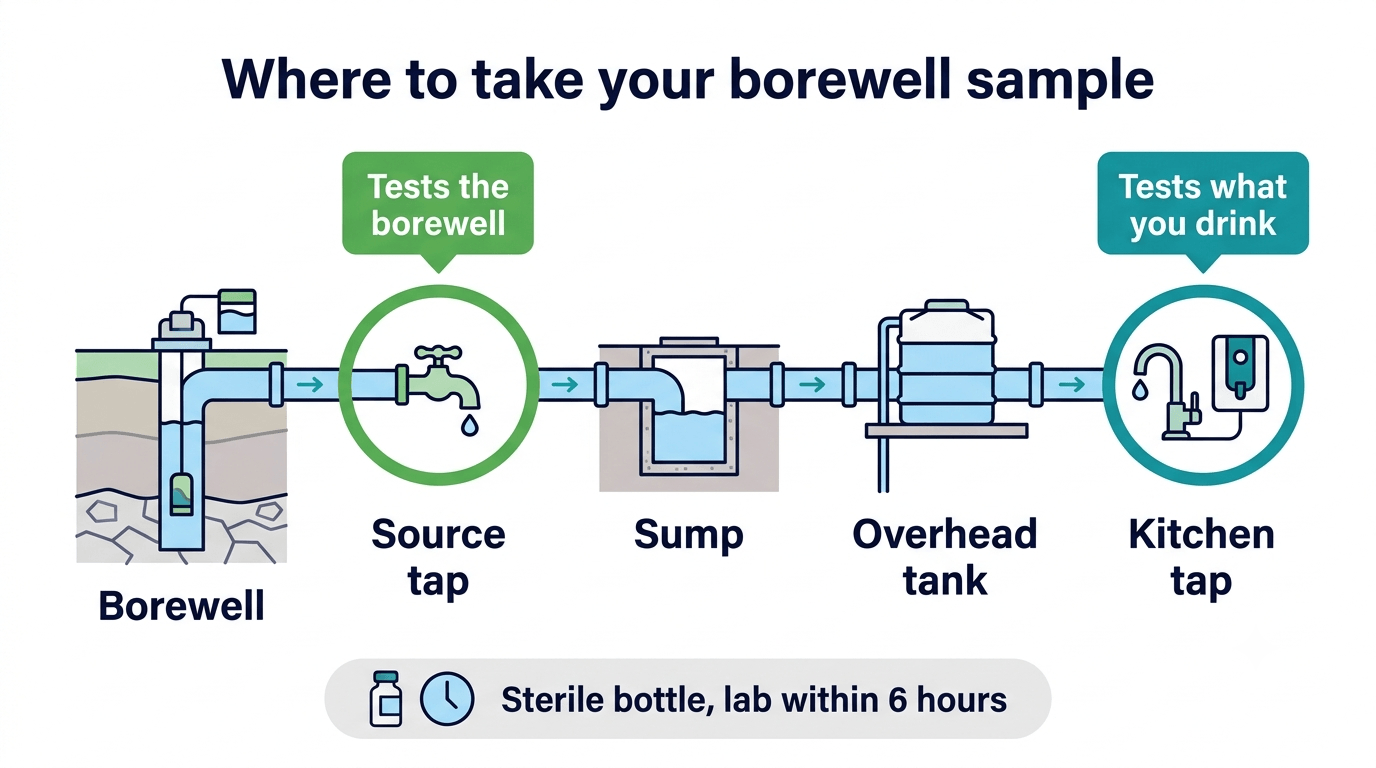
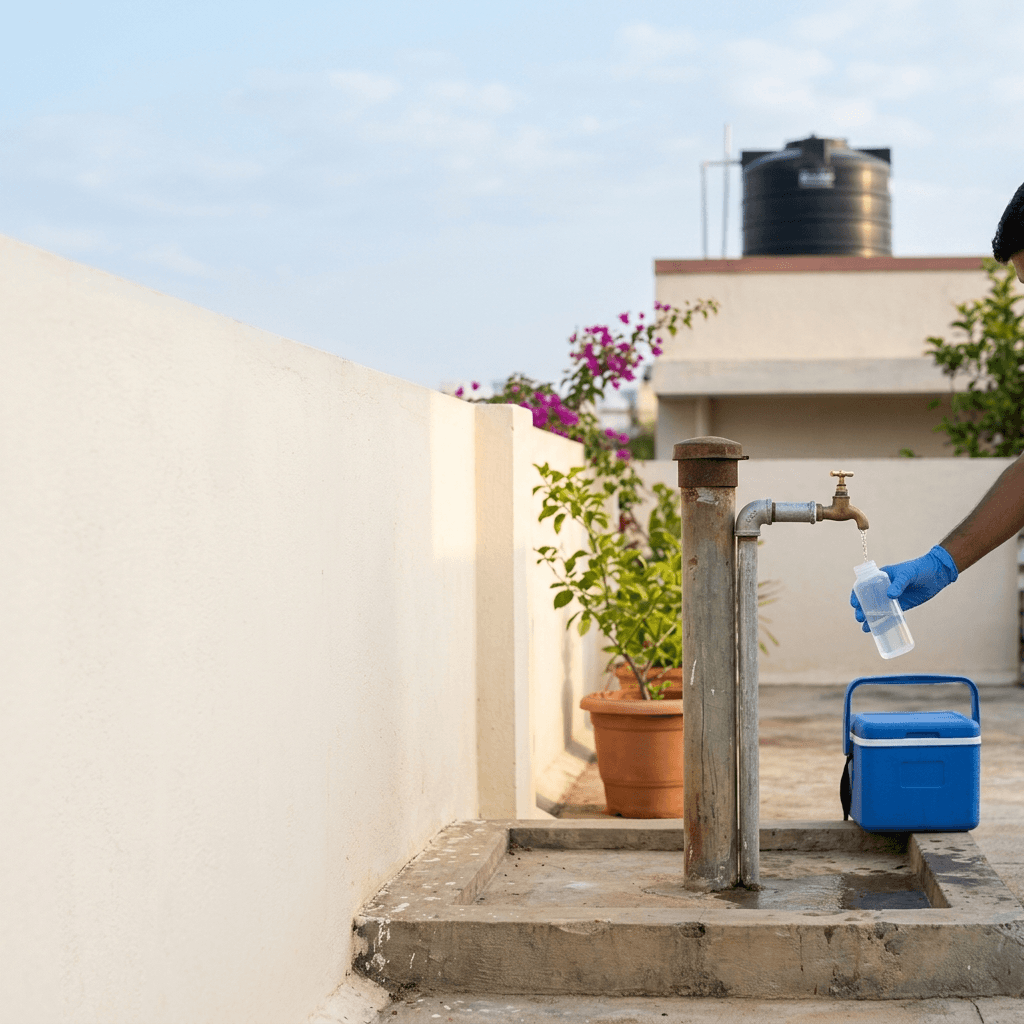
Use a sterile bottle from the lab, fill it from a tap fed directly by the borewell, and get it to the lab quickly, ideally within 6 hours for microbiology and within 24 hours for chemical tests. A badly collected sample is the most common reason a result doesn’t reflect the real water, so it’s worth getting this part right. If you’d rather not do it yourself, most labs, including ours, can send a trained technician.
- Decide what you’re testing. To judge the borewell itself, sample before the water reaches the sump, overhead tank or any purifier. To judge what people actually drink, sample at the kitchen tap or purifier outlet. If you want to find where contamination enters, test both.
- Pick the right tap. Use the outlet nearest the borewell pump, ideally a tap on the delivery line. Avoid hoses, leaking taps and taps with filters or aerators attached. Remove the aerator if you can.
- Get the right bottles. Microbiology needs a sterile bottle, usually supplied by the lab. Chemical tests need a clean bottle, and the total volume is usually 500 mL to 5 litres depending on the parameters. Don’t reuse a drinking water or soft drink bottle.
- Run the water first. Let it run for 2 to 3 minutes so you’re sampling fresh water from the borewell, not water that sat in the pipe.
- Fill without touching. Wash your hands, open the sterile bottle only at the moment of filling, don’t touch the inside of the bottle or cap, and don’t rinse a sterile bottle. Leave a small air gap at the top and close the cap tightly.
- Label it. Write the date, time, sampling point (for example “borewell delivery line” or “kitchen RO outlet”) and your name.
- Keep it cool and move fast. Put the bottles in a cool box away from sunlight and deliver them the same day.
A common mistake is to sample from the overhead tank or the RO and then treat that result as a verdict on the borewell. A clean RO result doesn’t mean the borewell is clean, and a dirty tank result doesn’t mean the borewell is the problem. Be clear about which question you’re asking before you fill the bottle.
How Often Should You Test Borewell Water?
Test a new borewell before anyone drinks from it, then test drinking water every three months, plus after every monsoon and whenever something changes. A borewell that supplies several homes, a PG or a food business should be on a fixed schedule, not tested only when someone complains.
| When | What to test | Why |
|---|---|---|
| New, deepened or repaired borewell | Full IS 10500 panel with microbiology | Sets a baseline and catches problems before anyone drinks the water |
| Every 3 months (drinking water) | Microbiology plus nitrate, TDS, hardness, fluoride, iron | Groundwater quality drifts with pumping and the seasons |
| After the monsoon | Microbiology, nitrate, turbidity | Rain carries surface and sewage contamination down into shallow aquifers |
| After flooding, sewer or drain work nearby, or sump cleaning | Microbiology | Any of these can open a new path for bacteria |
| Change in taste, smell, colour or cloudiness | Full panel | Something has changed, and a single TDS reading won’t say what |
| Before buying a purifier, and after installing one | Raw water panel, then the purifier output | So you buy treatment that matches the actual problem, and confirm it works |
The three-month interval for drinking water is Prewel’s own recommendation. For public sources, the RDW&SD says it tests at least twice a year, before and after the monsoon, which is a sensible minimum for any borewell too. There’s more on the seasonal side in our post on why water testing matters during the monsoon.
What Do Common Borewell Test Failures Mean?
Each failed parameter points to a different cause and a different fix, which is why a full report is more useful than a single pass or fail. These are the results that come up most often with Bangalore borewells and what they usually mean.
- E. coli or coliforms detected. Bacteria are getting into the water, most often from sewage. The cause can be a nearby septic tank or sewer line, a cracked or poorly sealed borewell casing, an open borewell cap, or a dirty sump or overhead tank. IS 10500 says detection should trigger immediate investigation, and for total coliforms the minimum step is a repeat sample.
- High nitrate. Usually a sign of sewage or fertiliser reaching the aquifer. Boiling won’t remove it. In fact, boiling concentrates dissolved chemicals slightly as water evaporates.
- High fluoride. More common in deeper borewells. It needs treatment that’s designed to remove fluoride, such as a properly sized RO system, and the treated water should be tested to confirm.
- High TDS or hardness. Often not an immediate health risk at moderate levels, but it causes scaling, shortens appliance life and can make water taste salty or bitter. Very high TDS can also overwork a home RO membrane.
- High iron. Shows up as brown stains, a metallic taste and clogged filters. Iron can come from the aquifer or from corroded pipes, so comparing a sample at the borewell with one at the tap helps tell them apart.
What Should You Do If Your Borewell Water Fails a Test?
Stop drinking it untreated, switch to a safe alternative source for drinking and cooking, find the cause, fix it, and then retest. Don’t skip the retest. It’s the only proof the fix worked.
If bacteria were found, start with the borewell itself. Check that the casing is intact and sealed at the top, that the cap is closed, and that no drain, septic tank or sewer line runs close by. Then clean and disinfect the sump and overhead tank, because a contaminated tank can make clean borewell water fail at the tap. A plumber or water treatment professional can disinfect the system. Boiling makes water microbiologically safer in the meantime, but it isn’t a long-term answer for a source that keeps getting contaminated.
If a chemical parameter failed, match the treatment to the problem. A softener helps with hardness but does nothing for nitrate. An iron filter won’t touch fluoride. RO can reduce TDS, nitrate and fluoride, but only if it’s sized for your raw water and maintained, so test the RO output after installation and after every service.
If you manage a building, tell residents what was found and what’s being done, keep every report on file, and put the borewell on a regular testing schedule. Repeated results over time are what show whether a problem is seasonal, getting worse or fixed.
How Prewel Labs Can Help with Borewell Water Testing in Bangalore
Prewel Labs is a water testing lab in Bangalore that tests borewell water against IS 10500, along with municipal, tanker, RO, packaged drinking, swimming pool, construction, STP and industrial water. Our borewell panels cover physical parameters (colour, odour, turbidity), chemical parameters (pH, TDS, hardness, nitrate, fluoride, iron, chloride, sulphate and heavy metals) and microbiology, including total plate count, coliforms and E. coli. Citizen Matters lists Prewel Labs among the NABL-accredited labs in the city that test borewell water for individual households.
We can send a trained technician to collect the sample, or give you sterile bottles and instructions to do it yourself. Results usually take 3 to 5 days, with 24 to 48 hours needed for microbiology incubation, and you get a PDF report by email or through our dashboard showing each result next to its IS 10500 limit. If anything exceeds the limit, we’ll explain what it means and the kind of corrective action to consider. Apartment associations, PGs and businesses can set up monthly, quarterly or custom testing packages. You’ll find the full list of water tests on our water testing lab page.
Prewel Labs is NABL accredited and ISO 9001 certified. If you’d like to test your borewell, or you aren’t sure which panel you need, send us your details below and we’ll help you pick the right test.
Frequently Asked Questions
Does the BWSSB test private borewell water?
The BWSSB tests the Cauvery water it supplies and responds to complaints about that supply. A private borewell in your home or apartment is generally your responsibility to test. For that, use a NABL-accredited lab, which can test any water you bring and report it against IS 10500.
Is borewell water safe to drink after boiling?
Boiling kills bacteria, so it helps if the only problem is microbial contamination. It doesn’t remove nitrate, fluoride, heavy metals or dissolved salts, and it can concentrate them slightly. You need a lab test to know which problem you actually have.
Can a TDS meter tell me if my borewell water is safe?
No. A TDS meter measures total dissolved solids and nothing else. Water with a “good” TDS reading can still contain E. coli or excess nitrate, and water with a high reading may be mostly harmless minerals. It’s a useful quick check between lab tests, not a safety test.
How much does borewell water testing cost in Bangalore?
At Prewel Labs, basic testing ranges from ₹500 to ₹2,000 and a full chemical and microbiological panel from ₹2,000 to ₹7,000, depending on the parameters. A new borewell or a shared building supply usually needs the fuller panel. Contact us for an exact quote for your panel.
How long do borewell water test results take?
Usually 3 to 5 days, depending on how many parameters you test. Microbiology needs 24 to 48 hours of incubation before a result is possible, so even a simple bacteria test isn’t same day.
Know Your Borewell Before You Drink From It
A borewell is a private water supply, and with that comes the job a water utility would otherwise do: knowing what’s in the water and noticing when it changes. One full test gives you a baseline. A few regular ones after that tell you how your borewell behaves through the seasons, which is information no neighbour, plumber or TDS meter can give you. Start with a proper IS 10500 test, keep the reports, and you’ll know whether your water needs treatment, which kind, and whether it’s working.
This post is general information about borewell water testing. It doesn’t replace medical advice or site-specific guidance from a qualified water professional.