
























Why Do Microbiology Reports Say <1 CFU Instead of 0 CFU?
You open the incubator. You look at the plate. Nothing is growing. Not a single colony.
So the obvious question comes up: if nothing is there, why doesn’t the report simply say 0 CFU?
This question comes up in almost every audit, training session, and quality review. The answer is not marketing. It is pure microbiology. Let’s break it down slowly.
What Does CFU Really Mean?
CFU stands for Colony Forming Unit. It does not mean a single cell. It means a living microbe that was able to grow under the test conditions you gave it.
Now ask yourself two questions:
- Can we see every microbe that entered the sample? No.
- Can we grow every microbe present in the sample? Again, no.
Some microbes are stressed. Some are injured by disinfectants. Some grow slowly. Some simply don’t like the media or the incubation temperature. A CFU count only reflects the microbes that could grow under your conditions.
What Does “No Colonies” Actually Tell You?
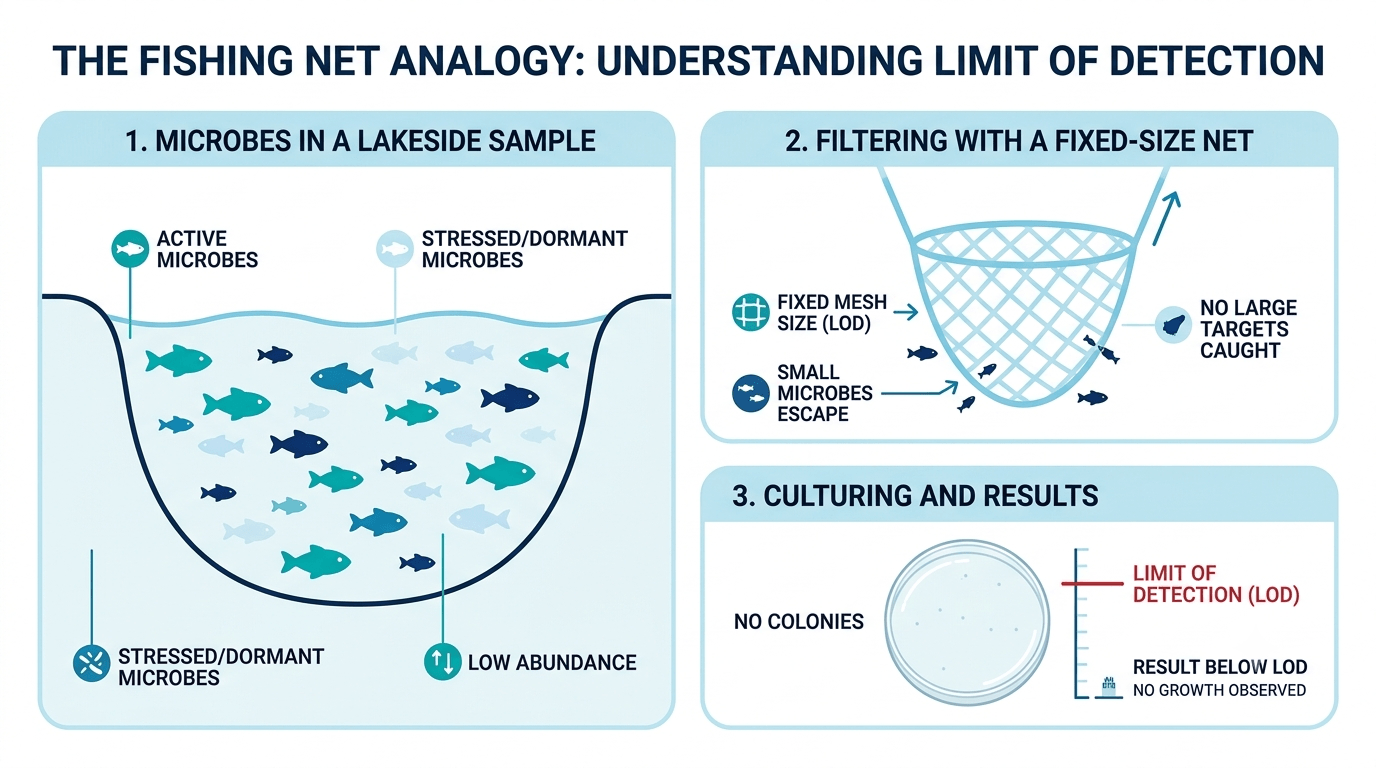
When a plate shows no colonies, it means no colonies were detected within the limits of the method. It does not mean absolute zero life.
Think of it like fishing with a net. If your net comes back empty, does that mean the lake has no fish? Or does it mean no fish were caught by that net, at that time, with that mesh size?
Microbiology works the same way. The plate is the net, and the media, temperature, incubation time, and sample volume are the mesh size.
Limit of Detection: Where “<1 CFU” Comes From
Every method has a limit of detection. If your method can detect one colony, then the smallest meaningful result you can report is less than one. That is where <1 CFU comes from.
The “<” symbol is not decoration. It tells the reader that the method looked for growth and found none, and that the true count, if any, sits below what the method can see.
One practical note: the actual limit depends on how much sample was tested and how it was diluted. Because plate results are scaled back to the original sample, a single colony can translate into a larger number per gram or per millilitre. The reported “less than” value therefore always has to be read together with the validated method behind it.
Why Not Just Write “Not Detected”?
Because regulators don’t like vague words. They want numbers linked to validated methods. USP, ISO, and GMP audits all expect results that respect method capability and statistical uncertainty.
A result such as <1 CFU is tied to a method, a limit, and a unit. “Not detected” on its own leaves the reader guessing about all three.
Why 0 CFU Would Be the Wrong Message
Reporting 0 CFU would suggest absolute certainty. In science, absolute certainty almost never exists.
That small “<” symbol is actually a sign of honesty. It tells the auditor, the QA team, and the patient that the lab understands its limitations.
Read More: Growth Promotion Test (GPT) Inoculum Size: Why Is It Set Between 10–100 CFU?
How Prewel Labs Approaches CFU Reporting
At Prewel Labs, this philosophy guides every microbiology report we issue. Whether it’s water testing, environmental monitoring, or sterility-related work, results are reported with scientific integrity, not shortcuts.
Frequently Asked Questions
What does CFU stand for in microbiology?
CFU stands for Colony Forming Unit. It represents a living microbe that was able to grow and form a colony under the specific test conditions used.
Does <1 CFU mean the sample is completely sterile?
No. It means no colonies were detected within the limits of the method. Stressed, injured, or slow-growing microbes, or those that don’t suit the media or incubation temperature, may not have grown.
What is the limit of detection in microbiology?
It is the smallest result a given method can reliably detect. If a method can detect one colony, the smallest meaningful result it can report is less than one, written as <1 CFU.
Why do auditors prefer <1 CFU over “not detected”?
Auditors expect numeric results linked to validated methods. Standards such as USP and ISO, and GMP audits, expect reporting that reflects method capability and statistical uncertainty.
Is <1 CFU a confusing result?
No. It is microbiology being careful, compliant, and truthful. It shows the lab understands what its method can and cannot see.
Final Takeaway
Next time you see <1 CFU, don’t see it as confusion. See it as microbiology being careful, compliant, and truthful. And that’s exactly how it should be.