





















How Much Does Borewell Water Testing Cost in Bangalore?
Last Updated on November 15, 2026
When Karnataka’s Department of Mines and Geology tested 2,209 groundwater samples from in and around Bangalore, nitrate was above the drinking water limit in 638 of them, about 29%. Nitrate has no taste, colour or smell, and a TDS meter won’t flag it. So if your family drinks from a borewell, a lab test is the only way to know. The good news is that it isn’t expensive. Borewell water testing cost in Bangalore at Prewel Labs ranges from ₹500 to ₹2,000 for a basic panel and ₹2,000 to ₹7,000 for a full chemical and microbiological analysis, depending on the parameters. Where you land in that range depends on your situation: a brand new bore, a well your family has used for years, an apartment with several borewells, or a retest after you’ve fixed a problem. This guide walks through each case so you pay for the test you actually need, and nothing you don’t.
How Much Does Borewell Water Testing Cost in Bangalore?
For most homes, a borewell test costs between ₹500 and ₹7,000 per sample. The lower end covers a basic panel of key parameters. The upper end covers a full chemical and microbiological analysis against IS 10500, the Bureau of Indian Standards specification for drinking water.
The price is set by the number of parameters on the panel, not by the source. A borewell sample and a tap sample with the same parameter list cost the same. Borewells just tend to need longer lists, because groundwater picks up dissolved minerals from rock and, in a city, seepage from sewers and septic tanks.
Here is how Prewel’s published price tiers map to the most common borewell situations:
| Your situation | Panel that usually fits | Prewel Labs price range |
|---|---|---|
| New borewell, before the family starts drinking from it | Full chemical and microbiological analysis against IS 10500 | ₹2,000 to ₹7,000 |
| Existing borewell with a clean past report, routine check | Basic panel: microbiology plus nitrate, fluoride, TDS and hardness | ₹500 to ₹2,000 |
| Change in taste, smell or colour, or someone at home has fallen ill | Full analysis, so you find the cause on the first attempt | ₹2,000 to ₹7,000 |
| Apartment or gated community with several borewells | Full analysis for each borewell, priced per sample | ₹2,000 to ₹7,000 per borewell, or a monthly, quarterly or custom package |
| Retest after chlorination, a new filter or an RO service | Only the parameters that failed, plus microbiology | Usually within the basic range, depending on the parameters |
These are ranges, not fixed prices. Your exact quote depends on the parameter list, so tell the lab what the water is used for and what worries you, and ask for a written list of what’s included. Our broader guide to water testing cost in Bangalore explains what each tier covers for every kind of water, from tap and tanker to industrial.
Why Does a Borewell Test Cost More Than a TDS Check?
Because the problems that matter most in Bangalore borewells are the ones a cheap reading can’t see. A TDS meter measures total dissolved salts. It says nothing about bacteria, nitrate or fluoride, and those are the results that decide whether the water is safe to drink.
Each extra parameter on a lab panel is a separate test with its own method, reagents and quality checks. IS 10500 itself lists the reference method for each one, for example IS 3025 (Part 34) for nitrate and IS 3025 (Part 60) for fluoride. A full panel is many such tests run on the same sample, which is why it costs more than a single meter reading.
Microbiology adds time as well as cost. Coliform and E. coli tests need 24 to 48 hours of incubation before there’s a result, so even a basic bacteria check isn’t a same day job. At Prewel, borewell results usually take 3 to 5 days, depending on how many parameters you test.
The local data explains why the longer list is worth it. In the same Department of Mines and Geology study, 31% of groundwater samples didn’t meet drinking water standards. Beyond nitrate, iron was high in about 10% of samples and total hardness in 8.5%. Fluoride exceeded the limit in only 0.6% of samples, but the problem was localised: one reading near Bellandur reached 5.54 mg/L, more than three times the IS 10500 permissible limit of 1.5 mg/L. A single test that skips fluoride will usually be fine, until it’s your borewell that sits in one of those pockets. If you want the background on these risks first, read whether borewell water is safe to drink in Bangalore.
Which Borewell Water Test Should You Pay For?
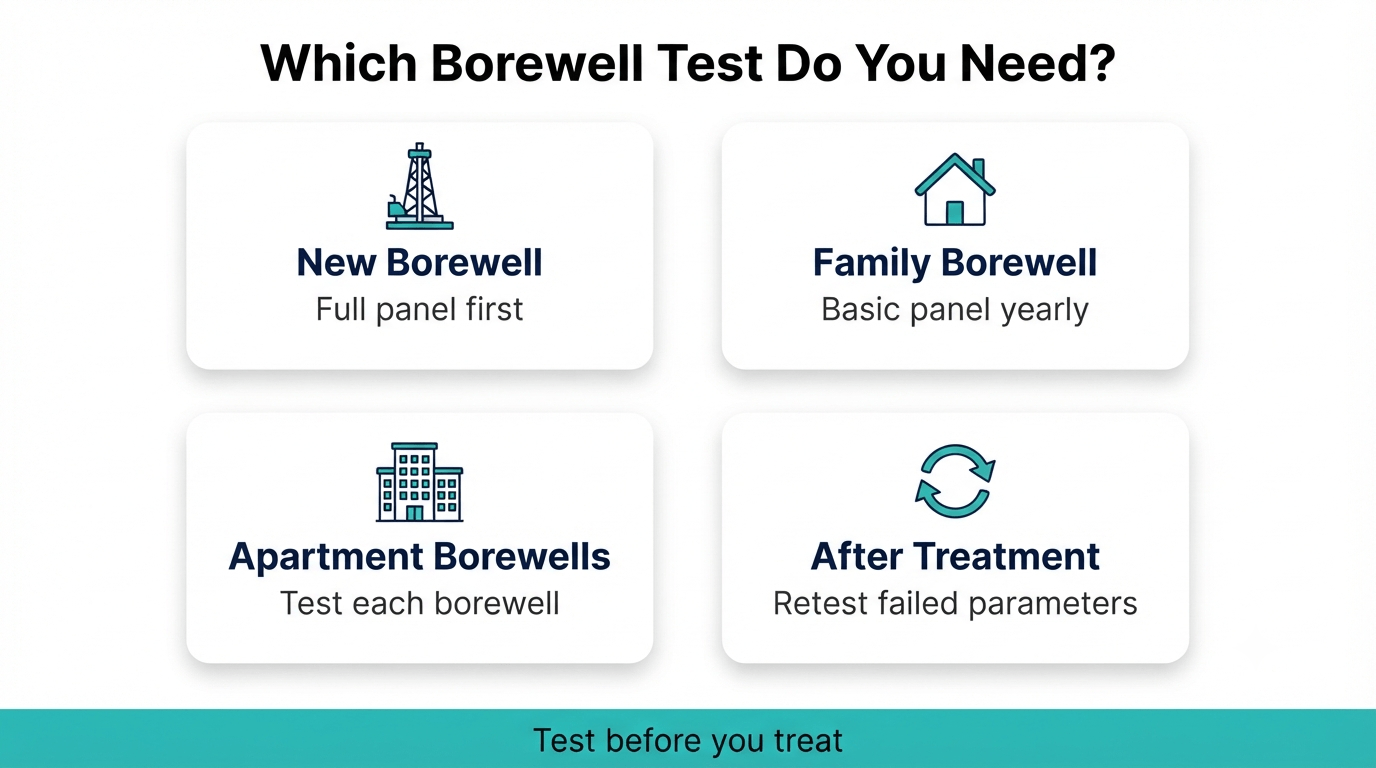
Pay for a full panel when you have no history for the water, and a basic panel when you do. The most expensive mistake is the opposite: a cheap test on a new borewell that misses a parameter, followed by a second sample and a second bill.
A new borewell before first use
A new bore is the one time a full IS 10500 analysis makes sense even if the water looks perfect. You don’t know what the aquifer holds at that depth, and the first report becomes the baseline you compare every later test against. Ask for microbiology (total coliforms and E. coli), nitrate, fluoride, TDS, total hardness, iron, pH, turbidity, chloride and sulphate. Add heavy metals such as arsenic and lead if the bore is near industry, a landfill or a lake that receives sewage.
Wait until the bore has been pumped for a while before you sample it. Water drawn right after drilling can carry silt and drilling residue that push up turbidity, which can make you pay for a retest, or for treatment the water doesn’t need.
An existing borewell your family already uses
If you already have a clean full report from the past year or two, a basic panel is usually enough for routine checks. Keep microbiology and nitrate on it every time, because both can change quickly when a nearby sewer line or septic tank starts leaking. Fluoride and hardness come from the rock and change slowly, so they matter most when you have no earlier result to rely on.
Go back to a full panel if the water changes in taste, smell or colour, if the water level drops sharply in summer, or if anyone at home gets a stomach upset you can’t explain. A narrow test in those cases often has to be repeated.
Apartments and gated communities with several borewells
This is where costs add up, and where associations most often try to save in the wrong place. Each borewell can draw from a different fracture in the rock, so one sample from the shared sump doesn’t tell you which bore is the problem. If the sump fails, you then pay again to test each borewell separately.
A better approach is to test each borewell once with a full panel to build a baseline, then test the sump and a few taps on a regular schedule. Prewel offers monthly, quarterly and custom testing packages for apartment associations, which helps when you need reports to share with residents. Our guide to apartment water testing in Bangalore covers how to plan sampling points across a building.
A retest after you’ve treated the water
After chlorination, a new filter or an RO service, you don’t need the full panel again. Retest the parameters that failed, plus microbiology if anything was done to the tank or pipes. Ask the lab to price only those parameters. That’s usually the cheapest test of the lot, and it’s the one that tells you whether the money you spent on treatment worked.
Are There Free or Cheaper Options for Borewell Testing?
There are, but each has a gap, and for a private borewell the gaps usually matter. Here’s what’s available in Bangalore, based on what the BWSSB and the Rural Drinking Water and Sanitation Department (RDW&SD) explained to Citizen Matters:
- BWSSB: free, with results in about 48 hours. But it responds to complaints about the Cauvery supply it provides. It isn’t the service to go to for testing your own borewell.
- RDW&SD district laboratories: testing of public water sources is free, while tests for private property are charged. The department also keeps a list of empanelled NABL-accredited labs.
- TDS and pH probes: Citizen Matters reports these cost ₹1,000 to ₹5,000. They’re useful for spotting a sudden change between lab tests, but they can’t detect bacteria, nitrate or fluoride.
- Home test strips and kits: fine as a rough screen, but they don’t give you a report you can show a housing society, a tenant or an RO service company.
The practical answer for most households is a mix: a lab test to know where you stand, and a cheap TDS meter at home to tell you when something has changed and it’s time to test again.
Hidden Costs That Make a Cheap Borewell Test Expensive
The sample fee is rarely the biggest cost. Repeat tests and treatment you didn’t need cost far more. These are the mistakes that most often lead to paying twice:
- Sampling from the wrong tap. Water from the kitchen tap after the sump, the overhead tank and the purifier tells you about the whole system, not the borewell. Collect from the tap closest to the borewell, before any storage or treatment, unless the purpose of the test is to check those parts.
- Using a reused bottle. A rinsed soft drink or drinking water bottle can contaminate a microbiology sample and give you a false positive. Use the sterile bottle the lab provides.
- Leaving out microbiology to save money. Bacteria are the most likely cause of illness from a borewell. A chemistry-only report that looks clean can be misleading.
- Taking too long to deliver the sample. Bacteria in the bottle can grow or die off in transit. Get the sample to the lab within a few hours, kept cool.
- Getting a report that isn’t NABL accredited for the parameters you need. If the report will go to a society committee, a buyer or an authority, check that the lab’s accreditation covers those specific tests. Here’s more on what an NABL-accredited water testing lab in Bangalore means in practice.
- Buying treatment before testing. A softener won’t fix nitrate, and chlorination won’t fix fluoride. The test result tells you which treatment to buy, so it often saves more than it costs.
For full sampling steps, see our guide to borewell water testing in Bangalore.
How Much Should You Budget for Borewell Testing Each Year?
For a single household borewell with a clean baseline, plan on one full analysis a year plus a basic check or two. For a new borewell, budget for a full analysis up front. The RDW&SD tests public water sources at least twice a year, before and after the monsoon, and that rhythm works well for private borewells too, because rain changes what seeps into the aquifer.
| Borewell type | Suggested testing plan | What to budget for |
|---|---|---|
| New household borewell | One full IS 10500 analysis before first use, then follow the plan below | One full panel |
| Household borewell with a clean past report | A full analysis once a year, plus a basic check before or after the monsoon | One full panel and one basic panel a year |
| Borewell that failed a test and was treated | A targeted retest after treatment, then a basic check after a few months | Two targeted or basic panels |
| Apartment with several borewells | A full panel for each borewell once a year, plus regular sump and tap checks | One full panel per borewell, plus a package for routine checks |
Test sooner than planned if the water changes in taste, smell or colour, after heavy flooding near the bore, or after any work on the borewell, pump or pipes.
What Will Your Borewell Report Be Checked Against?
Every result on a drinking water report is compared with a limit in IS 10500:2012, the Indian Standard for drinking water. Most chemical parameters have an acceptable limit and a higher permissible limit, which applies only when no better source is available. A few, like nitrate, have no relaxation at all.
| Parameter | Acceptable limit | Permissible limit (no alternative source) |
|---|---|---|
| Total coliforms and E. coli | Not detectable in any 100 mL sample | No relaxation |
| Nitrate (as NO3) | 45 mg/L | No relaxation |
| Fluoride (as F) | 1.0 mg/L | 1.5 mg/L |
| Total dissolved solids | 500 mg/L | 2,000 mg/L |
| Total hardness (as CaCO3) | 200 mg/L | 600 mg/L |
A result between the acceptable and permissible limits isn’t an emergency, but it’s a sign to plan treatment or find a better source. A result above the permissible limit, or any E. coli, means you should stop drinking the water untreated until the cause is fixed. For the full list of parameters and what each one means, see our guide to drinking water testing parameters under IS 10500.
How Prewel Labs Can Help with Borewell Water Testing in Bangalore
Prewel Labs tests borewell water against IS 10500 at our lab in Bangalore. Borewell panels can cover physical parameters such as colour, odour and turbidity, chemical parameters such as pH, TDS, hardness, nitrate, fluoride, iron, chloride, sulphate and heavy metals, and microbiology, including total plate count, coliforms and E. coli. We also test municipal, tanker, RO and packaged drinking water, so one lab can cover every source your home or building uses.
We can send a trained technician to collect the sample, or give you sterile bottles and instructions to collect it yourself. Results usually take 3 to 5 days, and you get a PDF report by email or through our dashboard, with each result shown next to its IS 10500 limit. If something fails, we’ll explain what it means and the kind of corrective action to consider, such as servicing an RO unit, chlorination or changing a filter. Apartment associations and businesses can set up monthly, quarterly or custom testing packages.
Prewel Labs is NABL accredited (National Accreditation Board for Testing and Calibration Laboratories) and ISO 9001 certified. Tell us what the borewell is used for and what you’ve noticed about the water, and we’ll suggest a panel and send you an exact quote. You can see the full list of water tests on our water testing lab page, or use the form below.
Frequently Asked Questions
Is borewell water testing cheaper at a government lab?
Sometimes, but not always for a private borewell. The RDW&SD tests public water sources for free and charges for private property, while the BWSSB’s free testing is meant for its own Cauvery supply. A private NABL-accredited lab will test any sample you bring and give you a report against every IS 10500 parameter you choose.
Do I need a separate test for each borewell?
Yes, if you want to know which borewell is the problem. Two bores on the same plot can draw from different fractures in the rock and give very different results. Once each borewell has a baseline, routine checks can focus on the sump and taps.
Can I test only for bacteria to save money?
You can, and it’s better than not testing at all. But in Bangalore, nitrate is one of the most common reasons borewell water fails, and you can’t see, smell or taste it. A basic panel that adds nitrate, fluoride, TDS and hardness to the bacteria test costs a little more and answers the question properly.
Does boiling or an RO purifier mean I can skip testing?
No. Boiling kills bacteria but doesn’t remove nitrate or fluoride, and it slightly concentrates dissolved salts as water evaporates. An RO purifier can remove most dissolved contaminants when it’s working well, but membranes wear out. Testing the raw borewell water and the purifier output tells you whether the system is doing its job.
A Small Bill for a Clear Answer
A borewell gives you water when the tankers are late and the Cauvery supply runs short, which is exactly why so many Bangalore homes depend on one. The cost of knowing what’s in that water is small next to what you’d spend on a purifier you don’t need, or on treating an illness the water caused. Start with the right panel for your situation, keep the report, and let each new result build on the last. Over a few years, you’ll know your borewell well enough to test less and worry less.
This article is general information about borewell water testing and doesn’t replace medical advice or advice specific to your property. If someone in your home is unwell, please see a doctor.