










How Do I Choose the Best NABL Accredited Water Testing Lab in Bangalore?
Last Updated on November 9, 2026
Two labs in Bangalore can both print the NABL logo on their website and still give you very different reports. One may be accredited for the coliform test your apartment association needs. The other may be accredited only for pH and TDS, and test everything else outside its accredited scope. You won’t see the difference until an auditor, a buyer or the pollution control board asks why half your report doesn’t carry the NABL symbol.
So here’s the short answer. To choose the best NABL accredited water testing lab in Bangalore, check the lab’s certificate number on the NABL website, confirm that the certificate is current and that its scope covers your water type and every parameter you need, and make sure the lab tests against the right standard (IS 10500 for drinking water, for example). Then look at the practical side: sterile bottles or pickup, turnaround, a report you can read, and someone who will explain it. This guide walks through each check, shows what a proper accredited report looks like, and lists the red flags worth walking away from.
What Does “NABL Accredited” Actually Mean for a Water Testing Lab?
It means an independent body has assessed the lab against ISO/IEC 17025 and found it competent to run specific tests, using specific methods. It doesn’t mean every test the lab offers is accredited.
NABL is the National Accreditation Board for Testing and Calibration Laboratories, a constituent board of the Quality Council of India. It assesses labs against ISO/IEC 17025, the international standard for testing and calibration laboratories, which covers everything from staff competence and equipment calibration to how results are checked and reported. Our explainer on what NABL is and how labs get accredited covers the background.
Three details matter most when you’re picking a lab:
- Accreditation is test by test. NABL’s FAQ defines the scope of accreditation as the list of specific tests a lab was found competent to perform, with the methods and ranges, and says that anything not listed in the scope isn’t covered by the accreditation.
- Certificates expire. According to the same FAQ, NABL accreditation is valid for four years, with surveillance assessments in between. A lab that was accredited when a friend used it two years ago may not be today.
- Labs get checked without warning. NABL says it also runs unannounced assessments, and can suspend or withdraw accreditation if it finds unethical practice.
In practice, “is this lab NABL accredited?” is the wrong question. The right one is “is this lab accredited, today, for the tests I need on the water I’m sending?”
How Do You Check a Lab’s NABL Accreditation?
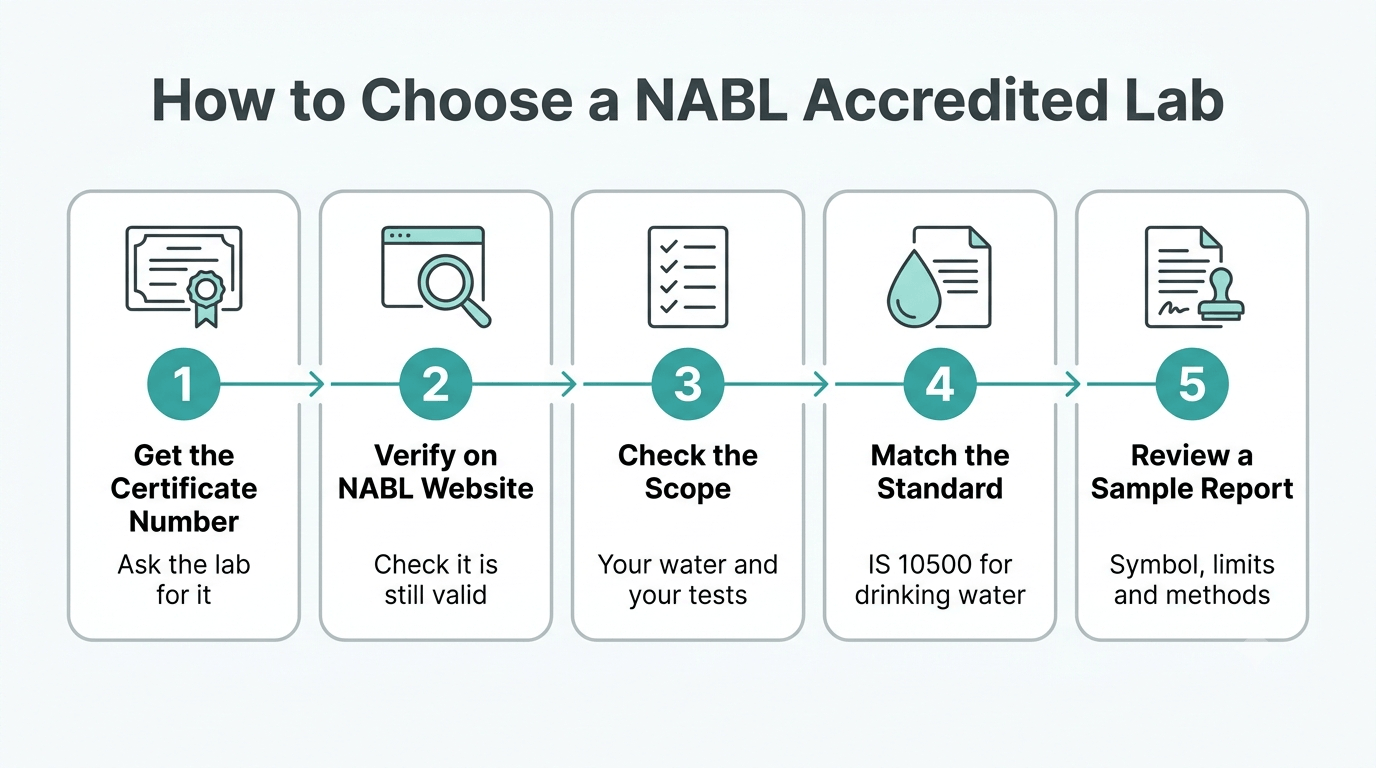
Ask the lab for its NABL certificate number, then verify it yourself on the NABL website. It takes about five minutes and it’s the single most useful check you can make.
- Get the certificate number. Testing labs have a number in the form TC followed by digits (for example TC-1234). It appears on the certificate and inside the NABL symbol on accredited reports. A lab that hesitates to share it is telling you something.
- Look it up on nabl-india.org. The site has a certificate verification tool and a search for accredited labs. NABL’s FAQ points customers to this search to check both accreditation status and scope.
- Check the validity date. Make sure the certificate hasn’t expired and the lab isn’t suspended. Don’t rely on a date shown on the lab’s own website, which may be out of date.
- Check the address. If a company has labs in several cities, or sends samples between branches, confirm that the lab listed on the certificate is the one that will actually test your sample.
- Open the scope document. This is where most of the useful information sits, so it gets its own section below.
How to read a NABL scope for water testing
The scope is usually a table. For each entry, look at four things:
- Discipline: chemical testing and biological testing are listed separately. A lab can be accredited for chemical tests on water but not for microbiology, or the other way round.
- Product or material: look for the water type you have, such as drinking water, packaged drinking water, groundwater, wastewater or purified water. Accreditation for drinking water doesn’t automatically cover effluent.
- Parameter: tick off each test you need (E. coli, fluoride, nitrate, lead, and so on).
- Method and range: the method should be a recognised one, such as an IS method or APHA’s Standard Methods, and the range should cover the limit you’re testing against. A method that can only measure down to a level above the limit can’t tell you whether you’ve passed.
If you can’t make sense of the scope, send the lab your parameter list and ask it to confirm, in writing, which parameters will be reported under NABL accreditation. A good lab will answer that directly.
Is the Lab Accredited for the Water You Need Tested?
Match the lab’s scope to your water type and the standard you have to meet. Different uses of water are judged against different specifications, and the parameter list follows from that.
| Water type | Usual reference standard | What to confirm in the lab’s scope |
|---|---|---|
| Drinking water: BWSSB supply, borewell, tanker, RO output | IS 10500:2012 | Coliforms and E. coli, plus the chemical parameters you need (fluoride, nitrate, hardness, iron, heavy metals) |
| Packaged drinking water | IS 14543 | The full parameter list the standard requires, not just a drinking water panel |
| Natural mineral water | IS 13428 | Parameters specific to mineral water |
| Water used in food processing | IS 4251 | Microbiology and chemical tests listed for processing water |
| STP and ETP water | CPCB and pollution control board norms | Wastewater parameters such as BOD, COD, TSS and coliforms, accredited for wastewater as a matrix |
| Dialysis, pharma purified water and water for injection | Dialysis water standards, IP or USP monographs | Conductivity, TOC, microbial counts and endotoxins, with methods suited to these low limits |
Bangalore’s water sources make this matter more than you might think. Many homes and apartments mix Cauvery supply with borewell and tanker water, and groundwater in parts of the city has shown high nitrate, fluoride and hardness. Our guide to borewell water testing in Bangalore explains which parameters to prioritise for groundwater, and our post on where to get drinking water tested in Bangalore compares the BWSSB, government and private lab routes.
For regulated uses, the lab also needs methods that work at very low levels. If you run a dialysis unit, our guide to RO water testing for dialysis covers what that testing involves.
Do You Need More Than NABL Accreditation?
Sometimes, yes. NABL accreditation shows technical competence, but some regulators keep their own lists of labs whose reports they’ll accept. Find out who will read your report before you book.
- Industries and STP or ETP reports in Karnataka. The Karnataka State Pollution Control Board has directed industries to get water, effluent and similar samples tested only at laboratories recognised under the Environment (Protection) Act, as described in this KSPCB report on environmental laboratories in Karnataka. The Ministry of Environment, Forest and Climate Change publishes recognised labs on its environmental labs page. Ask the lab whether it holds this recognition for your parameters, separately from NABL.
- Food businesses. FSSAI keeps its own list of notified laboratories, published in its validity orders. If your report is for an FSSAI purpose, ask your food safety officer or consultant which kind of lab report they need, and check the lab against that list.
- Housing societies, offices and PGs. Here, an NABL-accredited report against IS 10500 is usually what residents, facility managers and inspectors expect. If your apartment runs its own sewage plant, our post on STPs in Bangalore covers the treated water side.
Asking this up front saves you from the most expensive outcome: a perfectly good test from the wrong kind of lab, which you then have to repeat.
What Should a NABL Accredited Water Test Report Show?
An accredited report should carry the NABL symbol with the lab’s certificate number, a unique report number, the test method for each result, and each result next to the limit from the standard you asked for. If those are missing, the report won’t hold up well when someone else reads it.
Here’s what to look for, and why:
- The NABL symbol with the TC number. Under NABL’s policy on use of its symbol (NABL 133), a written statement such as “we are NABL accredited” doesn’t replace the symbol on a test report.
- Accredited and non-accredited results kept apart. NABL 133 says a lab must not use the NABL symbol or claim accreditation for parameters outside its scope, and calls for a separate report for non-accredited parameters. If you get one report with a mix of results and no clear split, ask which results are actually accredited.
- A ULR number. NABL requires a Unique Laboratory Report (ULR) number on reports issued within the accredited scope, so each report can be identified and checked. A June 2026 NABL clarification sets out the ULR formats and notes some exceptions, including reports on wastewater and other environmental parameters, where a ULR isn’t mandatory.
- Sample details. Where and when the sample was collected, who collected it, and when it reached the lab. For microbiology, the time between collection and testing affects the result.
- Method for each parameter. For example an IS or APHA method reference, so another lab or an auditor can see how the number was produced.
- Limits and a clear pass or fail. For drinking water, IS 10500 gives an acceptable limit and, for some parameters, a higher permissible limit that applies only when no other source is available. The report should show which limit it’s comparing against.
- How pass or fail was decided. When a result sits close to a limit, measurement uncertainty matters. ISO/IEC 17025 expects the lab to agree the decision rule with you when you ask for a statement of conformity, and to state it in the report.
- An authorised signatory. The person who approved the report, named and signed.
A quick tip: ask a lab for a sample report, with the client details removed, before you book. You’ll learn more from one page of a real report than from a brochure.
What Practical Questions Should You Ask Before Booking?
Accreditation tells you the lab can do the test properly. These questions tell you whether your sample will reach the lab in a state that’s worth testing, and whether you’ll understand what comes back.
Who supplies the bottles, and who collects the sample?
Microbiology samples need a sterile bottle from the lab. A rinsed mineral water bottle can give a false positive for bacteria. Ask whether the lab provides bottles and instructions, or sends a trained technician. For a sump, a borewell or several taps in a building, technician collection usually gives a more reliable result.
How quickly does the sample need to reach the lab?
Bacteria in a water sample can multiply or die off on the way, so microbiology samples should be kept cool and tested as soon as possible, ideally within a few hours. Chemical parameters are usually less time sensitive, but each has its own holding time. A lab that asks when and how you’ll deliver the sample is doing its job.
How long will results take?
Microbiology tests need incubation time, often 24 to 48 hours, so no honest lab can give you a full report the same day. Ask for the expected turnaround for your specific panel, not a general figure.
Will someone explain the report?
A result above the acceptable limit doesn’t always mean the water is dangerous, and a result inside it doesn’t mean it’s safe on every count. A lab that will talk you through the report, and suggest what to fix (a sump cleaning, chlorination, an RO service, a filter change), is worth more than one that just emails a PDF.
Can you test regularly?
One test is a snapshot. Apartments, food businesses and industries usually need repeat testing, so ask whether the lab offers monthly or quarterly packages, and whether past reports are kept so you can spot trends.
Red Flags When Comparing Water Testing Labs in Bangalore
Most problems with water test reports come from a handful of avoidable situations. Walk away, or at least ask more questions, if you see any of these:
- No certificate number on request, or a number that doesn’t show up on the NABL website.
- An expired or suspended certificate, even if the website still shows the logo.
- Your key parameter missing from the scope, for example E. coli for drinking water, or BOD for STP water.
- A “full water test” that is only pH, TDS and hardness. That tells you nothing about bacteria, nitrate, fluoride or heavy metals.
- No standard named on the report, or the wrong one, such as a drinking water standard used for effluent.
- A booking platform that won’t name the testing lab. Some services take your sample and send it to another lab. That can be fine, but you need to know which lab tested it so you can check that lab’s accreditation.
- Promises that sound too fast, such as a same-day microbiology result.
- A price far below everyone else’s for the same panel, with no clear list of parameters.
How Much Should You Expect to Pay?
Price depends mostly on the number of parameters and the type of analysis, so compare like with like. A five-parameter screening test and a full IS 10500 panel with microbiology answer very different questions.
Heavy metals, pesticides and regulated panels such as dialysis or pharma water cost more because they need specialised instruments and methods. Technician collection adds to the cost but cuts the risk of a bad sample. For actual numbers, our guide to water testing cost in Bangalore sets out Prewel’s published price ranges and what each level of testing covers.
The cheapest test is rarely the one with the lowest price. It’s the one you don’t have to repeat because the first lab wasn’t accredited for the parameter, or wasn’t recognised by the authority that asked for the report.
How Prewel Labs Can Help with NABL Accredited Water Testing in Bangalore
Prewel Labs runs a NABL accredited testing laboratory in J P Nagar, Bengaluru, and tests water for homes, housing societies, hotels, construction sites, food businesses, hospitals, pharma units and industry. Our water testing services cover drinking, borewell and RO water, packaged drinking water, swimming pool water, construction water, STP and ETP water, cooling tower and boiler feed water, dialysis water, and pharma purified water and water for injection.
We test against the standard that fits your water, including IS 10500 for drinking and borewell water, IS 14543 for packaged drinking water, IS 13428 for natural mineral water, IS 4251 for food processing water and CPCB guidelines for STP water, using methods from BIS and APHA. We issue NABL accredited reports for the parameters in our accredited scope, and we’re happy to tell you, before you book, which of your parameters that covers.
Prewel Labs is NABL accredited and ISO 9001 certified. You can book sample pickup by a trained technician, or collect the sample yourself using our instructions. Results usually take 3 to 5 days depending on the tests, reports come as a PDF by email or through our dashboard, and we offer monthly, quarterly and custom testing packages.
Not sure which tests you need, or which kind of report your auditor or regulator will accept? Tell us your water source and why you’re testing, and we’ll suggest the right parameters and send a clear quote.
Frequently Asked Questions
How do I know if a water testing lab in Bangalore is really NABL accredited?
Ask for its certificate number (TC followed by digits) and verify it on nabl-india.org, which shows whether the accreditation is current and what it covers. Don’t rely on a logo on a website or visiting card. Check the scope too, because accreditation applies to specific tests only.
Is every test on a NABL lab’s report accredited?
Not necessarily. A lab can be accredited for some parameters and still offer others outside its scope. NABL’s rules say the symbol can only be used for accredited parameters and that non-accredited results should go on a separate report, so check which results carry the NABL symbol.
How long is a NABL accreditation valid?
NABL says accreditation is valid for four years, with surveillance and a midcycle assessment during that period. It can also be suspended or withdrawn in between, which is why it’s worth checking the current status on the NABL website rather than trusting an old certificate copy.
Do I need an NABL accredited report for my home water test?
If the test is only for your own peace of mind, it isn’t required, though accreditation gives you more confidence in the result. If the report will go to a housing society, an auditor, a buyer, a regulator or a dispute, ask for an accredited report for the parameters that matter before you book.
Can a NABL accredited lab test STP or industrial effluent for KSPCB?
NABL accreditation alone may not be enough. KSPCB has directed industries to use laboratories recognised under the Environment (Protection) Act for effluent and similar samples, so ask the lab whether it holds that recognition for your parameters as well.
Choosing a Lab You Can Stand Behind
A water test report gets read by more people than you expect: residents at an association meeting, an auditor, a buyer, a pollution control board officer, a doctor. The right lab is the one whose report still holds up when any of them checks the certificate number, the scope and the standard. Spend five minutes on those checks before you hand over a sample, and the result you get back will be one you can act on with confidence.
This article is general information about choosing a water testing laboratory. It doesn’t replace advice from your regulator, auditor, doctor or water treatment professional.