









Where Can I Get Drinking Water Tested in Bangalore?
Last Updated on November 1, 2026
In February 2025, residents on Promenade Road in Pulakeshinagar started getting loose stools, vomiting and dehydration after drinking their tap water. When they had it tested at a medical college hospital, the lab found E. coli and Klebsiella pneumoniae, as Citizen Matters reported. Most Bangalore households never get that far. They notice a smell, a white crust on the kettle or a stomach upset, and then wonder who can actually test the water. You have three real options: the BWSSB, which checks its own Cauvery supply for free when you complain; the state’s Rural Drinking Water and Sanitation Department (RDW&SD) district labs; and a private, NABL-accredited drinking water testing lab in Bangalore, which is the route for borewells, tankers, RO purifiers and anyone who needs a formal report. This guide compares all three, explains how to pick a lab, and shows you how to collect a sample that gives a result you can trust.
Where Can You Get Drinking Water Tested in Bangalore?
It depends on where your water comes from and why you want it tested. If the problem is in the BWSSB supply, start with the Board. If you rely on a borewell, tanker or your own purifier, or you need a report for a business, a society or a regulator, go to an accredited private lab.
Here’s how the options compare.
| Option | Best for | Cost | What you get |
|---|---|---|---|
| BWSSB (Bangalore Water Supply and Sewerage Board) | Suspected contamination in the Cauvery supply inside city limits | Free, according to the Board | The Board tests its supply and fixes the fault. Results in about 48 hours |
| RDW&SD district labs (Banashankari for Bengaluru Urban, Doddaballapur for Bengaluru Rural) | Public water sources, mainly in rural and peri-urban areas | Free for public sources. Private property tests are charged | Physical, chemical and microbiological analysis. Results in 3 to 4 days for gram panchayat samples |
| Private NABL-accredited lab | Borewells, tankers, sumps, RO purifiers, apartments, offices, food businesses | Paid, depending on the parameters | A full report against IS 10500, sample bottles or pickup, and advice on what to fix |
| Home test kits and TDS meters | Quick screening between lab tests | Roughly ₹1,000 to ₹5,000 for probes | Indicative readings only. No report and no reliable bacteria result |
Testing through the BWSSB
The BWSSB tests its own supply from treatment plants, reservoirs and consumer taps. Its Public Relations Office told Citizen Matters that it runs three labs, at High Grounds, Jayanagar and OMBR Layout, plus mobile testing vans. If you suspect your Cauvery water is contaminated, you report it at your local BWSSB service station or the Assistant Executive Engineer’s (AEE) office for your area. The Quality Assurance team then collects about two litres of water, tests it and shares the result in roughly 48 hours. If the water is contaminated, the Board says it halts the supply, fixes the problem and sends tanker water in the meantime. There’s no charge.
This is the right first call when the fault is in the public network: a broken pipe near a sewer line, muddy water after road work, or a whole street falling sick. Keep in mind what it’s for. The Board is checking and fixing its own supply. It isn’t a general testing service for your borewell, your overhead tank or the tanker water your apartment buys.
Testing through the RDW&SD district labs
Karnataka’s Rural Drinking Water and Sanitation Department runs district water quality testing laboratories in Banashankari (Bengaluru Urban) and Doddaballapur (Bengaluru Rural). Field teams and village water committees screen water first, and samples that look doubtful go to the district lab for full analysis. The department tests public sources at least twice a year, before and after the monsoon.
For Bengaluru Rural, you can visit the district lab, contact the AEE or valve operator for your area, or call the RDW&SD helpline on 8277506000. Testing of public water is free. Samples from private property are charged. Procedures and fees can change, so call ahead before you take a sample in. The lab list on the Jal Jeevan Mission’s Water Quality Management Information System shows the government labs in Karnataka and the parameters they test.
Testing at a private NABL-accredited lab
A private lab is the practical choice for most households and almost every business. It will test any water you bring, whether that’s a borewell, a sump, a tanker load or the output of your RO purifier, and it gives you a report that shows each result next to the IS 10500 limit. Most labs also supply sterile bottles or send someone to collect the sample.
The main thing to check is accreditation. NABL (the National Accreditation Board for Testing and Calibration Laboratories) assesses labs against ISO/IEC 17025 for specific tests. A report from an accredited lab is what housing societies, auditors, FSSAI inspectors and builders usually expect. Our explainer on what NABL accreditation is covers how it works.
Home test kits and TDS meters
A handheld TDS meter or pH probe is handy for spotting changes, for example when your RO output suddenly jumps. It can’t tell you whether the water has E. coli, and it won’t measure fluoride, nitrate or heavy metals separately. A low TDS reading only means there’s little dissolved material. It doesn’t mean the water is safe. Use a kit to decide when to test, not instead of testing.
Which Testing Route Fits Your Water Source?
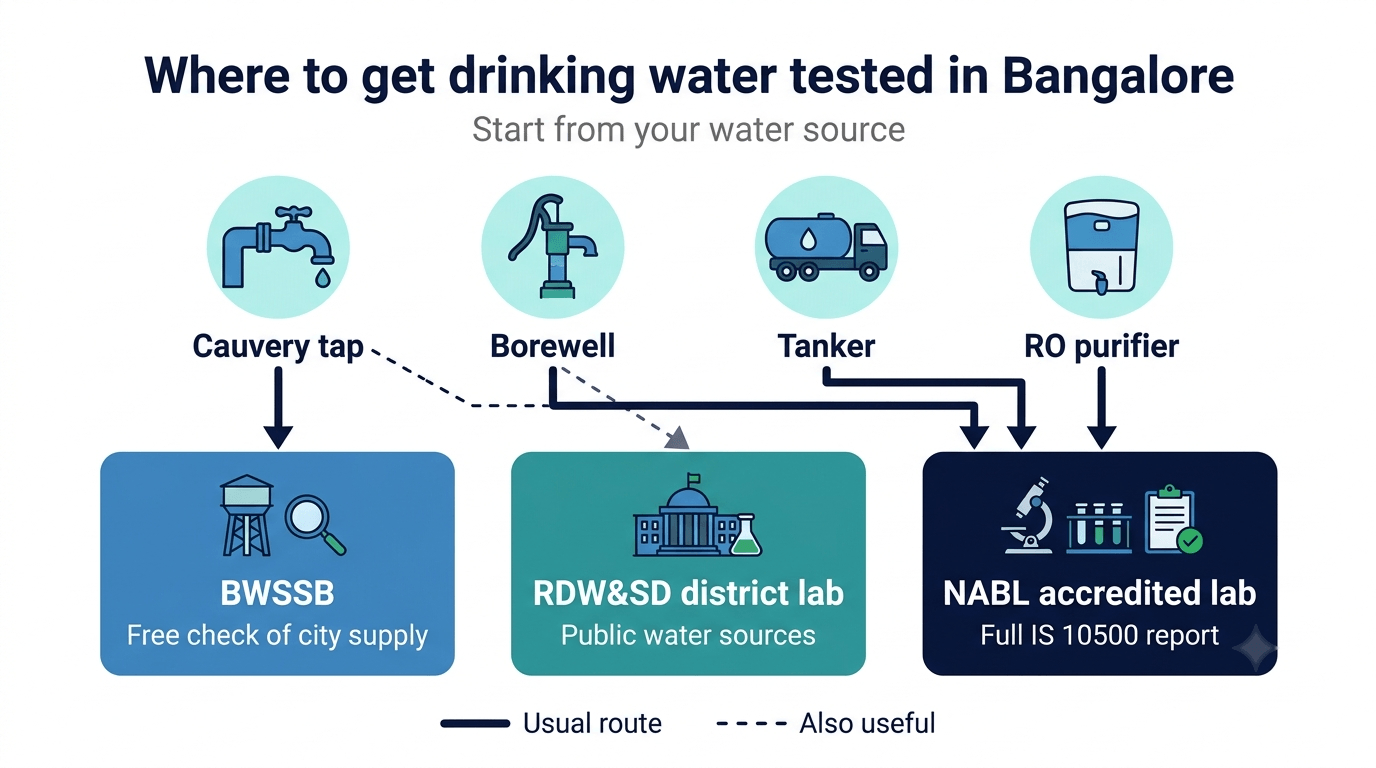
Match the route to where the water comes from. Bangalore homes often mix sources, and each one carries different risks.
Cauvery (BWSSB) supply only
Cauvery water is generally of good quality when it leaves the treatment plant. Trouble usually starts in the pipes, through leaks near sewage lines, or in your own sump and overhead tank. If many homes on your street are affected, complain to the BWSSB. If only your building has a problem, the cause is more likely your storage, so a private test of the water at your tap and in your sump will show where it’s going wrong.
Borewell water
Borewell water needs its own test, and the BWSSB route doesn’t cover your private borewell. Groundwater in parts of the city has shown high hardness, nitrate, fluoride and iron. A 2018 survey cited by Citizen Matters found that 24% of Bengaluru households using both borewell and Cauvery water had hardness above the 200 mg/L limit. Test a borewell when it’s new, after the monsoon, and whenever the taste, smell or colour changes. Our post on why water testing matters during the monsoon explains why the rains are a common trigger for contamination.
Tanker water
Tanker water can come from almost any borewell, and you rarely know which one. If your building depends on tankers, test the water as it’s delivered and again in the sump, and ask suppliers for recent lab reports. A private lab is the only realistic option here.
RO and UV purifiers at home
Test the water before and after the purifier. Comparing the two shows whether the system is doing its job and whether a membrane or UV lamp needs replacing. RO water with very low TDS can taste flat. That’s normal, and it isn’t a sign of contamination.
Apartments, PGs, offices and food businesses
Anyone supplying water to other people needs an accredited report on file, and needs to test regularly, not once. The cholera cases reported in Bangalore PGs show how quickly one contaminated source can affect dozens of residents. Restaurants and food units also need to check the water used in cooking and processing, which is tested against IS 4251.
How to Choose a Drinking Water Testing Lab in Bangalore
Pick a lab that’s accredited for the tests you need, tests against IS 10500:2012, includes microbiology and explains the result. These six checks will help you compare labs.
- Check the NABL scope, not just the logo. Accreditation covers specific tests, not the whole lab. Ask which of your parameters are accredited, or search the lab on the NABL laboratory portal. If you need a fully accredited report, say so when you book.
- Ask which standard the report uses. For drinking and borewell water in India, it should be IS 10500:2012, the Bureau of Indian Standards drinking water specification. Packaged drinking water is tested against IS 14543.
- Make sure bacteria are tested. Many cheap “water tests” only cover pH, TDS and hardness. For drinking water, you want total coliforms and E. coli as a minimum, because these show faecal contamination.
- Get sterile bottles from the lab. A used mineral water bottle can contaminate the sample and give you a false fail. A good lab provides the right bottles or sends a technician.
- Look for a report you can read. Each result should sit next to its acceptable and permissible limit, with the test method named. Ask whether someone will walk you through it.
- Ask about turnaround and pickup. Microbiology needs incubation, so results take a few days. Pickup matters because the sample has to reach the lab quickly.
Price matters too, but compare like with like. A ₹500 test of five parameters and a full IS 10500 panel answer very different questions. Our guide to water testing cost in Bangalore breaks down what each level of testing covers.
What Should a Drinking Water Test Cover?
A useful drinking water test covers physical, chemical and microbiological parameters, compared with IS 10500:2012. For most homes, a basic chemical panel plus coliforms and E. coli is the minimum. For a new borewell or a building that supplies other people, ask for a fuller panel that adds fluoride, nitrate, iron and heavy metals.
IS 10500 gives an “acceptable” limit for each parameter and, for some, a higher “permissible” limit that applies only when no better source is available. These are the parameters Bangalore readers ask about most.
| Parameter | Acceptable limit | Permissible limit (no alternative source) | Why it matters in Bangalore |
|---|---|---|---|
| pH | 6.5 to 8.5 | No relaxation | Affects taste, pipe corrosion and disinfection |
| Total dissolved solids (TDS) | 500 mg/L | 2,000 mg/L | Often high in borewell water |
| Total hardness (as CaCO3) | 200 mg/L | 600 mg/L | Causes scaling in geysers, kettles and RO membranes |
| Turbidity | 1 NTU | 5 NTU | Cloudy water can shield bacteria from chlorine |
| Fluoride | 1.0 mg/L | 1.5 mg/L | Reported in groundwater in parts of the city |
| Nitrate (as NO3) | 45 mg/L | No relaxation | Points to sewage or fertiliser reaching groundwater |
| E. coli or thermotolerant coliforms | Not detectable in any 100 mL sample | No relaxation | Shows faecal contamination |
One result outside the acceptable limit doesn’t always mean the water is unsafe to drink today. A positive E. coli result does. Treat it as urgent and switch to a safe source while you find the cause.
How to Collect a Drinking Water Sample for Testing
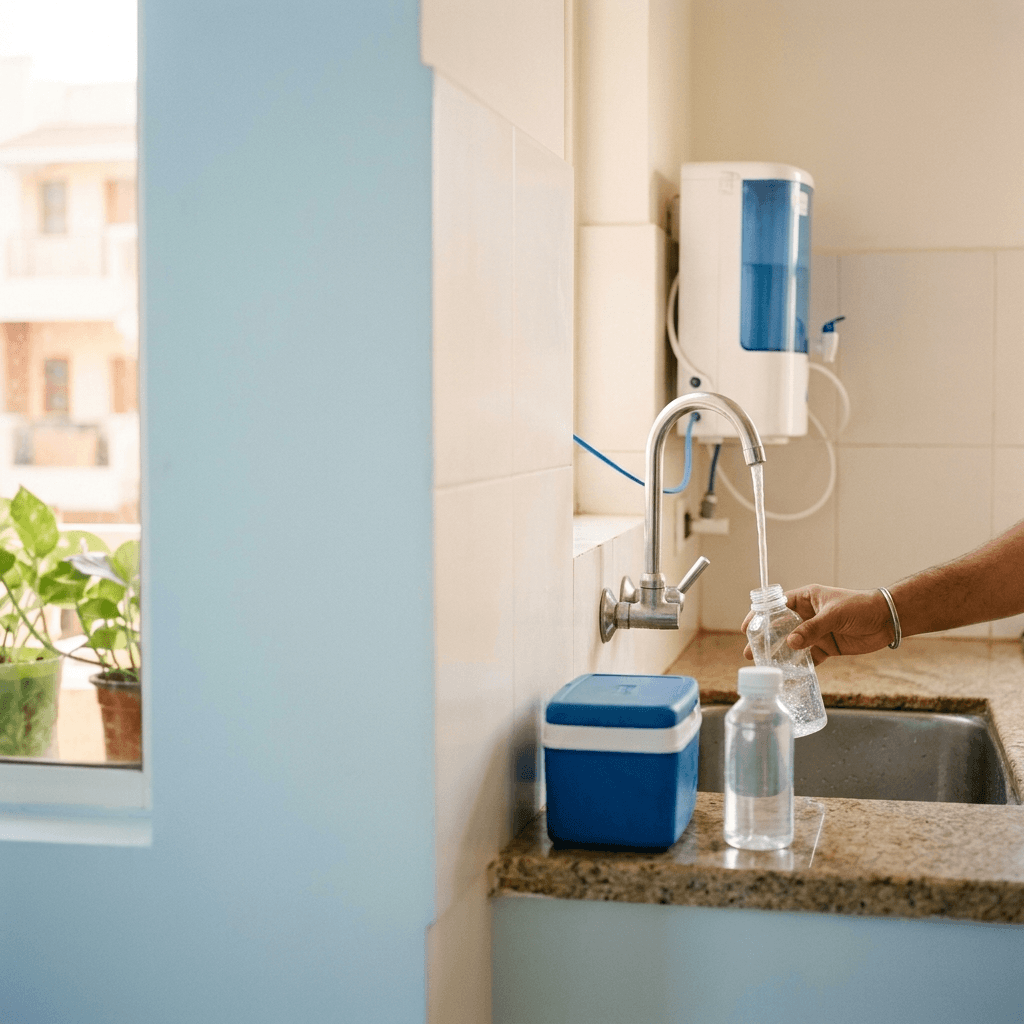
Use the lab’s sterile bottle, let the tap run first, don’t touch the inside of the bottle or cap, and get the sample to the lab quickly. Most false fails come from how the sample was taken, not from the water.
- Ask the lab what to collect. Volumes usually range from 500 mL to 5 litres depending on the parameters, and microbiology needs a separate sterile bottle.
- Pick the right tap. To check the source, sample as close to the borewell or inlet as you can. To check what you drink, sample the kitchen tap or purifier outlet. If you’re not sure where a problem starts, test both.
- Remove anything attached to the tap. Take off filters, hoses and aerators, and wipe the tap mouth.
- Let the water run for 2 to 3 minutes. This flushes water that has been sitting in the pipe.
- Fill without touching. Open the bottle only when you’re ready, keep your fingers off the rim and the inside of the cap, and close it straight away. Don’t rinse a sterile bottle.
- Label it. Write the source, the location and the date and time of collection.
- Keep it cool and move fast. Microbiology samples should ideally reach the lab within 6 hours. Many chemical tests can be done within 24 hours, depending on the parameter. Don’t freeze the sample.
If a technician collects the sample for you, you skip most of these risks, and the lab can record the collection conditions on the report.
What to Do If Your Drinking Water Fails a Test
Find out which parameter failed, stop drinking the water if it’s a microbial failure, trace the cause and retest after you fix it. The right fix depends entirely on what failed.
- E. coli or coliforms detected: switch to boiled or a known safe source for drinking and cooking. Clean and disinfect the sump and overhead tank, check for leaks near drains or septic lines, and retest after the fix. If the problem is in the BWSSB supply, report it to the Board.
- High TDS or hardness: not an immediate health emergency in most cases, but it shortens the life of appliances and purifiers. A softener or RO system may help, depending on how high the readings are.
- High fluoride or nitrate: boiling won’t remove these, and boiling can even concentrate them. You’ll need a suitable treatment system or another source for drinking water.
- Purifier output failing: service the purifier, replace the membrane, filters or UV lamp as needed, then test the output again.
A retest after any fix is the only way to know it worked. The tragedy we wrote about in the importance of safe drinking water in Karnataka is a reminder of what’s at stake when contamination goes unchecked.
How Prewel Labs Can Help with Drinking Water Testing in Bangalore
Prewel Labs is a drinking water testing lab in Bangalore that tests borewell, municipal, tanker, RO and packaged drinking water, along with swimming pool, construction, STP and industrial water. We test against IS 10500 for drinking and borewell water and IS 14543 for packaged drinking water, and our panels cover physical parameters such as colour, odour and turbidity, chemical parameters such as pH, TDS, hardness, fluoride, nitrate and heavy metals, and microbiology including total plate count, coliforms and E. coli.
You can collect the sample yourself following our instructions, or we can send a trained technician to pick it up. Results usually take 3 to 5 days depending on the tests, since microbiology needs 24 to 48 hours of incubation, and you get a PDF report by email or through our dashboard. If something fails, we’ll explain what it means and what to fix, whether that’s cleaning the sump, servicing the RO system or adding chlorination. Societies and businesses can also schedule monthly or quarterly testing. You’ll find the full list of water types and parameters on our water testing lab page.
Prewel Labs is NABL accredited and ISO 9001 certified, and we provide NABL-accredited reports for the specific parameters within our scope. If you’re not sure which test you need, tell us where your water comes from and what you’ve noticed, and we’ll suggest a panel that fits.
Frequently Asked Questions
Can I get my water tested for free in Bangalore?
Yes, in some cases. The BWSSB says it tests its own supply free of charge when you report a problem at your service station or AEE office, and RDW&SD tests public water sources for free. Tests of private sources such as your own borewell, tanker water or purifier are usually paid.
Is a TDS meter enough to check if my water is safe to drink?
No. A TDS meter only measures the total amount of dissolved material. It can’t detect bacteria such as E. coli, and it doesn’t tell you how much fluoride, nitrate or any metal is in the water. Only a lab test can tell you whether water meets IS 10500.
How often should I test drinking water at home?
We recommend testing drinking water every three months, and more often for a borewell that supplies several homes. Test again after the monsoon, after any plumbing or tank work, and whenever the water’s taste, smell or colour changes.
How long does a drinking water test take?
Chemical results can come back quickly, but microbiology needs time to grow cultures, typically 24 to 48 hours of incubation. At Prewel Labs, a complete report usually takes 3 to 5 days depending on the parameters you choose.
Know What’s in Your Glass
Bangalore’s water comes from the Cauvery, deep borewells, tankers and rooftop tanks, often all in the same building, and each source changes with the season. One test gives you a baseline. Regular testing tells you when something shifts, before anyone gets sick. Whether you start with a free BWSSB check or an accredited lab report, the aim is the same: to know your water is safe to drink.
This article is general information and doesn’t replace advice from a doctor, your water utility or a qualified professional about your specific situation.