


















What Are the Critical Drinking Water Testing Parameters According to BIS IS 10500?
Last Updated on November 14, 2026
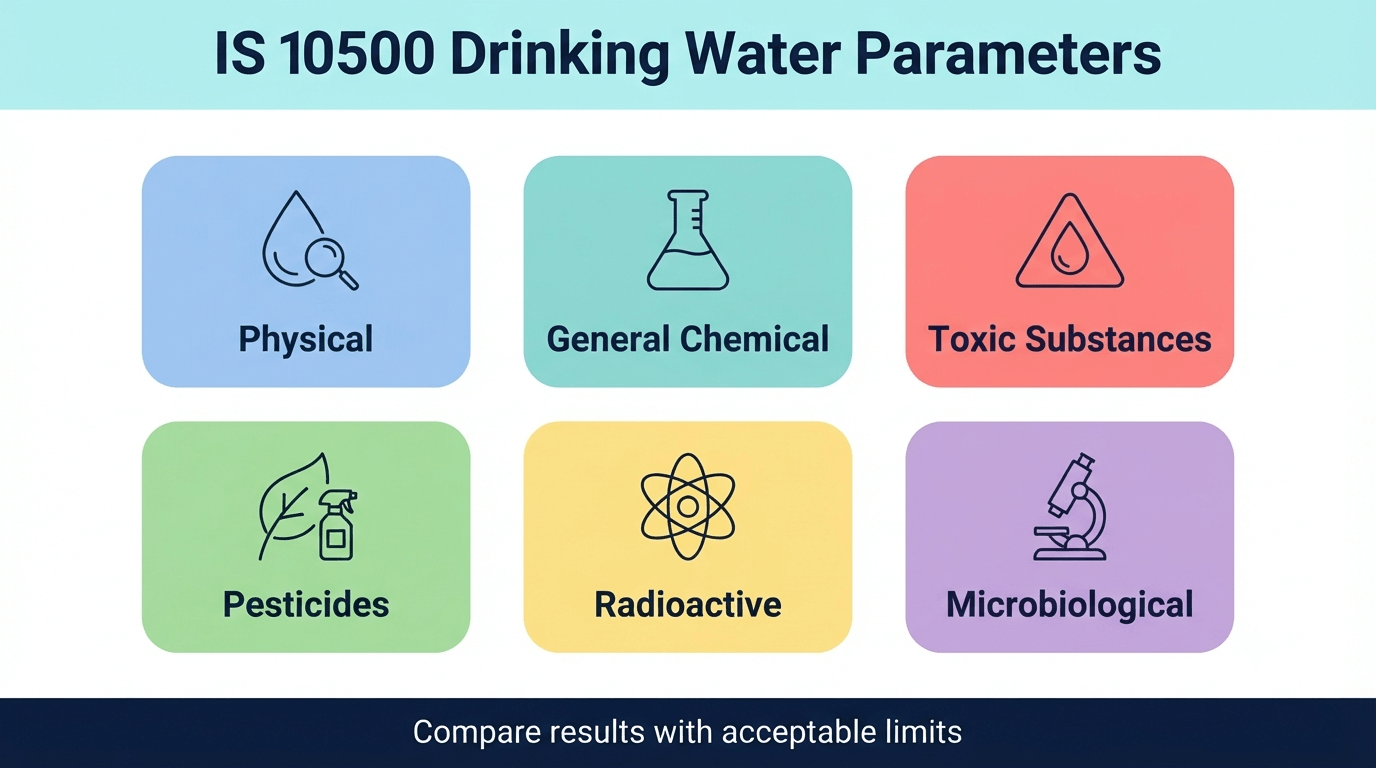
Water can be clear, smell fine, show a TDS reading of 180 and still carry E. coli. It can also look slightly cloudy and be perfectly safe. That gap between how water looks and what’s in it is why India has a national standard. The essential drinking water testing parameters under BIS IS 10500:2012 fall into five groups: physical and taste parameters (such as pH, turbidity and TDS), general chemical parameters (such as hardness, fluoride, nitrate and iron), toxic substances (such as arsenic, lead and mercury), radioactive substances, and microbiological quality, where E. coli and coliform bacteria must not be detectable in any 100 mL sample.
This guide lists every group with its limits as published by the Bureau of Indian Standards, explains what “acceptable” and “permissible” really mean, and shows which parameters you actually need for a borewell, a municipal supply, an RO purifier or a building that supplies water to other people.
What Is IS 10500 and Who Does It Apply To?
IS 10500:2012, “Drinking Water: Specification (Second Revision)”, is the Bureau of Indian Standards (BIS) specification for water meant for drinking and cooking. It sets the limits a lab compares your results against, names the test method for each parameter, and points to the sampling standards to follow.
The standard defines drinking water as water “intended for human consumption for drinking and cooking purposes from any source”, treated or untreated. So it covers your borewell, the municipal tap, tanker water, a sump, an overhead tank and the output of your RO purifier. It doesn’t cover bottled water, which has its own standards: IS 14543 for packaged drinking water and IS 13428 for packaged natural mineral water.
The 2012 edition was the second revision of a standard first published in 1983. According to its foreword, it was updated to line up with the WHO Guidelines for Drinking Water Quality, the EU drinking water directive and US EPA standards. It added limits for ammonia, chloramines, barium, molybdenum, silver, sulphide, nickel, PCBs and trihalomethanes, and introduced virus, Cryptosporidium and Giardia testing for the first time. You can read the BIS text of IS 10500:2012 with Amendment No. 2 on the National Consumer Helpline site.
BIS has amended the standard since 2012. The BIS Know Your Standards listing for IS 10500:2012 shows four amendments. Amendment No. 2 (September 2018), for example, raised the permissible limit for boron from 1.0 to 2.4 mg/L. When you get a report, check that the lab compares your results against the current amended version.
Acceptable Limit vs Permissible Limit: What’s the Difference?
The acceptable limit is the value your water should meet. The permissible limit is a higher ceiling that can be tolerated only when no better water source is available. If a result goes past the permissible limit, IS 10500 says the source has to be rejected.
The standard puts it plainly. It recommends that the acceptable limit is the one to implement, because values above it “render the water not suitable”. Many parameters, including pH, iron, nitrate, lead and every toxic metal, have “no relaxation” in the permissible column. For those, the acceptable limit is the only limit.
In practice this means you shouldn’t read a report that says “within permissible limit” as a clean pass. If you have a choice of sources, or the option to treat the water, aim for the acceptable limit. A borewell with 1.3 mg/L fluoride is inside the permissible 1.5 mg/L, but it’s above the acceptable 1.0 mg/L, and if your family drinks it for years, treatment is worth considering.
Drinking Water Testing Parameters Under IS 10500, Group by Group
IS 10500 sets limits for more than 60 characteristics across six tables, plus separate clauses for viruses and biological organisms. The tables below give the limits exactly as BIS publishes them, with the boron change from Amendment No. 2. All values are in mg/L unless stated otherwise.
1. Physical and organoleptic parameters (Table 1)
“Organoleptic” means what you can see, smell and taste. These are the parameters people notice first, and they often hint at a deeper problem.
| Parameter | Acceptable limit | Permissible limit (no alternate source) | What it tells you |
|---|---|---|---|
| Colour (Hazen units) | 5 | 15 | Iron, manganese, organic matter or silt |
| Odour | Agreeable | Agreeable | Sewage, algae, sulphide or chemical contamination |
| Taste | Agreeable | Agreeable | Tested only after the water is known to be safe |
| pH | 6.5 to 8.5 | No relaxation | Corrosive or scale-forming water, and how well chlorine works |
| Turbidity (NTU) | 1 | 5 | Suspended particles that can shield bacteria from disinfection |
| Total dissolved solids (TDS) | 500 | 2,000 | Overall mineral load, often high in groundwater |
TDS is the parameter most people already know because of home meters. It’s a useful number, but it only tells you how much is dissolved, not what. Water at 300 mg/L TDS can still have too much fluoride or nitrate, and it can still contain bacteria.
2. General chemical parameters (Table 2)
These are “substances undesirable in excessive amounts”. Most aren’t acutely toxic at the levels found in Indian water, but they affect health over time, taste, plumbing and appliances.
| Parameter | Acceptable limit | Permissible limit (no alternate source) |
|---|---|---|
| Aluminium (as Al) | 0.03 | 0.2 |
| Ammonia (as total ammonia-N) | 0.5 | No relaxation |
| Anionic detergents (as MBAS) | 0.2 | 1.0 |
| Barium (as Ba) | 0.7 | No relaxation |
| Boron (as B) | 0.5 | 2.4 (raised from 1.0 by Amendment No. 2) |
| Calcium (as Ca) | 75 | 200 |
| Chloramines (as Cl2) | 4.0 | No relaxation |
| Chloride (as Cl) | 250 | 1,000 |
| Copper (as Cu) | 0.05 | 1.5 |
| Fluoride (as F) | 1.0 | 1.5 |
| Free residual chlorine (minimum) | 0.2 | 1 |
| Iron (as Fe) | 0.3 | No relaxation |
| Magnesium (as Mg) | 30 | 100 |
| Manganese (as Mn) | 0.1 | 0.3 |
| Mineral oil | 0.5 | No relaxation |
| Nitrate (as NO3) | 45 | No relaxation |
| Phenolic compounds (as C6H5OH) | 0.001 | 0.002 |
| Selenium (as Se) | 0.01 | No relaxation |
| Silver (as Ag) | 0.1 | No relaxation |
| Sulphate (as SO4) | 200 | 400 |
| Sulphide (as H2S) | 0.05 | No relaxation |
| Total alkalinity (as CaCO3) | 200 | 600 |
| Total hardness (as CaCO3) | 200 | 600 |
| Zinc (as Zn) | 5 | 15 |
A few notes from the standard that change how you read these results:
- Free residual chlorine is a minimum, not a maximum. It applies only when the water is chlorinated, and it’s measured at the consumer end. If your municipal water reaches the tap with less than 0.2 mg/L, there may not be enough chlorine left to deal with contamination picked up in the pipes. Where protection against viruses is needed, the standard asks for at least 0.5 mg/L.
- Iron and manganese are judged together. Their combined concentration must not exceed 0.3 mg/L, even if each one is under its own limit.
- Sulphate can go up to 400 mg/L only if magnesium stays at or below 30 mg/L.
Fluoride and nitrate deserve special attention for groundwater. Long-term fluoride exposure above the limit is linked to dental and skeletal fluorosis, and nitrate above 45 mg/L often points to sewage or fertiliser reaching the aquifer. Neither shows up on a TDS meter or changes the taste.
3. Toxic substances (Table 3)
This is the group where “no relaxation” is the rule. Heavy metals and organic toxins build up in the body, so there’s no higher tolerance for them when another source isn’t available.
| Parameter | Acceptable limit | Permissible limit (no alternate source) |
|---|---|---|
| Cadmium (as Cd) | 0.003 | No relaxation |
| Cyanide (as CN) | 0.05 | No relaxation |
| Lead (as Pb) | 0.01 | No relaxation |
| Mercury (as Hg) | 0.001 | No relaxation |
| Molybdenum (as Mo) | 0.07 | No relaxation |
| Nickel (as Ni) | 0.02 | No relaxation |
| Total arsenic (as As) | 0.01 | 0.05 in the 2012 text (see note below) |
| Total chromium (as Cr) | 0.05 | No relaxation |
| Polychlorinated biphenyls (PCBs) | 0.0005 | No relaxation |
| Polynuclear aromatic hydrocarbons (PAH) | 0.0001 | No relaxation |
| Trihalomethanes: bromoform | 0.1 | No relaxation |
| Trihalomethanes: dibromochloromethane | 0.1 | No relaxation |
| Trihalomethanes: bromodichloromethane | 0.06 | No relaxation |
| Trihalomethanes: chloroform | 0.2 | No relaxation |
| Pesticides | As listed in Table 5 | No relaxation |
On arsenic: the 2012 text allows up to 0.05 mg/L when no other source exists, but the acceptable limit of 0.01 mg/L matches the WHO provisional guideline value for arsenic, and long-term exposure is linked to cancer and skin lesions. Treat 0.01 mg/L as your target, and ask your lab which amended version of the standard its report uses.
Trihalomethanes form when chlorine reacts with organic matter in the water. They matter most for treated municipal supplies and for buildings that chlorinate their own sumps or tanks, especially if the water was dirty to begin with.
4. Pesticide residues (Table 5)
IS 10500 lists 18 pesticides with their own limits in micrograms per litre (µg/L). They include alachlor (20 µg/L), atrazine (2), aldrin and dieldrin combined (0.03), chlorpyriphos (30), DDT and its breakdown products (1), endosulfan (0.4), lindane (2), malathion (190), methyl parathion (0.3), monocrotophos (1) and phorate (2). The standard says pesticide analysis must be done by a recognised laboratory using internationally established methods, such as US EPA methods, that can reach these limits.
You don’t need a pesticide panel for every sample. It’s worth adding for borewells near farmland or orchards, for a new source, and for water used in food production.
5. Radioactive substances (Table 4)
The standard sets gross alpha activity at 0.1 Bq/L and gross beta activity at 1.0 Bq/L, both with no relaxation. These tests are specialised and rarely needed for household water. They’re relevant for some deep groundwater sources and for regulatory or project-level surveys.
6. Bacteriological quality (Table 6)
This is the most important group for everyday safety, and the one cheap tests most often leave out. Under IS 10500, E. coli or thermotolerant coliform bacteria must not be detectable in any 100 mL sample of water intended for drinking. For treated water entering or moving through a distribution system, total coliform bacteria must also be undetectable in any 100 mL sample.
| Water | Organism | Requirement |
|---|---|---|
| All water intended for drinking | E. coli or thermotolerant coliforms | Not detectable in any 100 mL sample |
| Treated water entering the distribution system | E. coli or thermotolerant coliforms, and total coliforms | Not detectable in any 100 mL sample |
| Treated water in the distribution system | E. coli or thermotolerant coliforms, and total coliforms | Not detectable in any 100 mL sample |
E. coli lives in the gut of humans and warm-blooded animals, so finding it means faecal matter has reached the water. Total coliforms are a broader group. The standard asks for immediate investigation if either is found. For total coliforms, the minimum action is a repeat sample. If they show up again, the cause has to be traced straight away.
Amendment No. 2 changed the reference method for this bacteriological testing to IS 15185, in place of IS 1622.
7. Virological and biological requirements
The 2012 revision added three requirements that many guides skip:
- Viruses: MS2 phage, an indicator of viral contamination, must be absent in 1 litre of water when tested by US EPA method 1602. If it’s detected, the water goes on to PCR testing for viruses.
- Cryptosporidium and Giardia: both must be absent in 10 litres of water. These parasites resist chlorine at normal doses, which is why the standard calls them out.
- Microscopic organisms: drinking water should be free from algae, zooplankton, flagellates, parasites and toxin-producing organisms.
These tests need large sample volumes and specialised methods. They’re usually reserved for treatment plants, outbreak investigations and surface water sources, not routine home checks.
Which Drinking Water Testing Parameters Do You Actually Need?
You don’t have to test all 60-plus parameters every time. Pick a panel based on where the water comes from and who drinks it. A full IS 10500 analysis makes sense for a new source or a compliance report. Routine checks can focus on the parameters most likely to fail for that source.
| Water source or situation | Core parameters to test | Add when relevant |
|---|---|---|
| Home tap on a municipal supply | pH, turbidity, TDS, free residual chlorine, total coliforms, E. coli | Iron, lead and copper if pipes are old |
| Borewell or open well | pH, TDS, hardness, fluoride, nitrate, iron, chloride, total coliforms, E. coli | Arsenic, manganese, heavy metals, pesticides near farmland |
| Tanker water or sump storage | Turbidity, TDS, total coliforms, E. coli, free residual chlorine if chlorinated | Hardness, nitrate, iron |
| RO or UV purifier output | TDS, pH, total coliforms, E. coli (before and after the purifier) | Heavy metals to confirm removal |
| Apartments, PGs, schools, offices and food businesses | Full physical, chemical and microbiological panel against IS 10500 | Toxic metals, pesticides and trihalomethanes on a schedule |
| New borewell, new building or a compliance report | Complete IS 10500 analysis | Radioactivity and parasites if the authority or project asks |
Two habits make this work better. First, test before and after any treatment step, so you know whether the RO, softener or chlorinator is doing its job. Second, when a parameter fails once, keep it in your routine panel until you’ve seen several clean results in a row. Our guide to borewell water testing covers the groundwater side in more detail, and the post on why apartments need regular water testing explains the shared-supply risks.
How Should a Water Sample Be Collected for IS 10500 Testing?
IS 10500 says representative samples should be drawn as prescribed in IS 1622 (sampling and microbiological examination) and IS 3025 Part 1 (sampling for physical and chemical tests). In plain terms: use the lab’s bottles, keep microbiology samples sterile, and get them to the lab quickly.
- Use separate bottles. Microbiology needs a sterile bottle. Chemical tests need clean bottles, sometimes with a preservative for metals. Don’t reuse a mineral water bottle.
- Choose the right point. Sample at the source (borewell outlet or inlet) to judge the source, and at the kitchen tap or purifier outlet to judge what you drink.
- Flush the tap. Remove filters, hoses and aerators, then let the water run for 2 to 3 minutes before you fill the bottle.
- Don’t touch the inside of the bottle or cap, and don’t rinse a sterile bottle.
- Keep it cool and move fast. Microbiology samples should ideally reach the lab within 6 hours. Many chemical tests can wait up to 24 hours, depending on the parameter. Don’t freeze the sample.
- Label everything: source, location, date and time.
Most surprise bacteria failures trace back to sampling, not to the water. If the result matters, for example for a building or a business, having a trained technician collect the sample is the simplest way to rule that out.
How Do You Read an IS 10500 Water Test Report?
A good report lists each parameter, your result, its unit, the acceptable limit, the permissible limit and the test method. Read it in three passes.
- Microbiology first. Any E. coli or thermotolerant coliform result means the water isn’t fit to drink right now. Switch to a safe source, boil or disinfect drinking water, and find the cause before retesting.
- Toxic metals and “no relaxation” parameters next. Arsenic, lead, mercury, cadmium, chromium, nitrate and iron above their limits need action, either treatment or a different source.
- Then the rest. Results between acceptable and permissible, such as hardness of 350 mg/L or TDS of 900 mg/L, aren’t an emergency, but they tell you something. They’re often the reason behind scaling, bad taste or fast RO membrane wear.
Check that the report names IS 10500:2012 as the reference and that the methods are listed, usually parts of IS 3025 for chemistry. If the report is for a housing society, an auditor or a regulator, also check which tests fall under the lab’s NABL scope. Our explainer on choosing a NABL-accredited water testing lab covers what to ask.
What Should You Do If a Parameter Fails?
Match the fix to the parameter that failed. A failed result is information, and most problems have a known cause and a known fix.
| Failed parameter | Likely cause | Typical next step |
|---|---|---|
| E. coli or coliforms | Sewage ingress, dirty tank or sump, broken pipe, poor sampling | Stop drinking it untreated, clean and disinfect storage, find leaks, retest |
| Low free residual chlorine | Long pipe runs, storage time, chlorine demand from dirt | Report to the supplier, review in-building chlorination |
| Hardness, TDS, chloride | Natural groundwater minerals | Softener or RO, depending on the level and use |
| Fluoride | Natural geology | Defluoridation or an RO system rated for fluoride, or another source |
| Nitrate | Sewage or fertiliser reaching groundwater | Find the source of pollution, consider RO or another source |
| Iron or manganese | Groundwater chemistry, corroded pipes | Aeration and filtration, pipe inspection |
| Arsenic or other heavy metals | Geology, industrial discharge, old plumbing | Switch source for drinking, then treatment designed for that metal |
After any fix, retest the parameter that failed. One clean result after a change is a good sign. Two or three clean results over a few months is what you want before you relax.
How Often Should Drinking Water Be Tested?
IS 10500 sets limits, not a testing calendar for households. As a practical guide, we recommend testing drinking water every three months, and more often for a borewell or any supply that serves many people.
Test again after the monsoon, after plumbing or tank work, when you switch sources, and whenever taste, smell or colour changes. Rain is a common trigger for contamination, which is why we’ve written separately about water testing during the monsoon. A full IS 10500 analysis once a year, with shorter routine panels in between, is a sensible pattern for most buildings.
How Prewel Labs Can Help with Drinking Water Testing
Prewel Labs tests drinking and borewell water against IS 10500, along with RO water, tanker and sump water, and the water used by apartments, offices, hospitals and food businesses. Our panels cover microbiology (total plate count, coliforms, E. coli and pathogens), chemistry (pH, TDS, hardness, fluoride, nitrate, chloride, sulphate, alkalinity, residual free chlorine, iron and heavy metals) and physical parameters (colour, odour and turbidity), with advanced tests such as pesticides and VOCs when you need them.
Tell us where the water comes from and why you’re testing, and we’ll suggest a panel that fits, from a basic home check to a full IS 10500 report. We can send a trained technician to collect the sample, and every report sets your results next to the IS 10500 limits. If something fails, we’ll explain what it means and the usual corrective steps. You can see the full list of water types and parameters on our water testing lab page, and indicative prices in our guide to water testing cost in Bangalore.
Prewel Labs is NABL accredited and ISO 9001 certified. If you’re based in Bangalore and want to know where else you can get water tested, our guide to drinking water testing in Bangalore compares the options. When you’re ready, send us your details below and we’ll get back to you.
Frequently Asked Questions
How many parameters are there in IS 10500?
IS 10500:2012 sets limits for more than 60 characteristics across six tables: physical, general chemical, toxic, radioactive, pesticide residues and bacteriological. It also has separate requirements for viruses, Cryptosporidium, Giardia and other microscopic organisms. A routine test usually covers a selected subset, while a “complete” IS 10500 report covers the full list.
What is the TDS limit for drinking water as per BIS?
The acceptable limit for total dissolved solids is 500 mg/L. Up to 2,000 mg/L is permissible only when no alternative source is available. Very low TDS, as from some RO purifiers, isn’t a safety failure under IS 10500, though the water may taste flat.
Is IS 10500 mandatory?
IS 10500 is the national reference that labs, water utilities and many regulators use to judge drinking water quality. Whether you’re legally required to test against it depends on who you are and which authority or contract applies to you, so check with your regulator or customer. For households, there’s no legal requirement, but it’s the benchmark to use.
What is the difference between IS 10500 and IS 14543?
IS 10500 covers drinking water from any source, such as taps, borewells, tankers and purifiers. IS 14543 is the BIS standard for packaged drinking water sold in bottles and cans. A packaged water manufacturer tests against IS 14543. A home, building or business tests its own supply against IS 10500.
Can a home test kit check all IS 10500 parameters?
No. Home kits and TDS meters give rough readings for a few parameters like pH, TDS or chlorine. They can’t measure metals such as arsenic or lead at the low levels the standard sets, and they can’t give a reliable E. coli result. For a result you can act on, you need a lab test.
Testing for What Matters in Your Water
IS 10500 can look like a long list of chemicals, but it really asks three simple questions: is the water free of faecal contamination, is it free of toxic substances, and is it pleasant and practical to use every day? Once you know where your water comes from, you can pick the handful of parameters that answer those questions for your source, test them regularly, and keep the full analysis for when something changes. That’s how a test report turns into water you can trust.
This article is general information based on IS 10500:2012 and its published amendment. It doesn’t replace medical advice, or regulatory or site-specific guidance for your facility.