






















Why Is Regular Water Quality Testing Important for Apartments in Bangalore?
Last Updated on November 10, 2026
In October 2021, heavy rain flooded the basement of a 979-unit apartment complex in Yemalur, East Bengaluru. Sewage appears to have reached the freshwater sump, and within days about 340 residents, many of them children, were sick. Tests later showed coliform bacteria above 1,800 against a permissible limit of 10. That is why apartment water testing in Bangalore can’t be a once-a-year formality. In a gated community, one sump, one borewell or one tanker load feeds hundreds of homes, so a single fault becomes a building-wide outbreak within hours. Regular testing is the only way to catch it before residents do.
This guide is written for resident welfare associations, apartment owners’ associations, facility managers and the residents who keep asking “is our water safe?” It covers where contamination gets into an apartment’s water system, which tests to run under IS 10500, how often to test, where to take samples and what to do when a result fails.
Why Do Apartments in Bangalore Need Regular Water Testing?
Because most Bangalore apartments don’t run on a single, treated water source. They mix BWSSB Cauvery water, their own borewells and tanker loads, store all of it in shared sumps and overhead tanks, and then pump it through kilometres of internal pipes. Every one of those steps can let contamination in, and none of them is checked by anyone else on your behalf.
The supply gap is real. A June 2025 Deccan Herald report notes that piped Kaveri water reaches only about 60 per cent of residents, and that outer areas like Whitefield, Sarjapur and Electronic City rely heavily on private tankers. Many of those tankers draw from borewells that are unregulated. If your complex sits outside the BWSSB network, the water your residents drink may come from three or four different places in a single week.
Shared infrastructure also means shared risk. In an independent house, a bad borewell affects one family. In a 400-flat complex, the same problem reaches every tap, including the homes of infants, elderly residents and anyone with a weak immune system. Home RO purifiers help, but they aren’t a guarantee. Residents still bathe, brush their teeth and wash vegetables with tap water, and a purifier that hasn’t been serviced can’t handle a heavy bacterial load.
What went wrong at two Bangalore apartment complexes
Two reported cases show how quickly things move once contamination gets in:
- Prestige Kew Gardens, Yemalur (2021). According to Deccan Herald, about 80 mm of rain on 23 October flooded a basement where the freshwater sump sat next to the sewage sump. Around 140 people fell ill within hours, and the count reached about 340. After pipes were cleaned and sumps chlorinated, new cases appeared again on 2 November, which residents took as a sign that the root cause hadn’t been fixed. Nitrate was also above limits in two of the four borewells.
- Mahaveer Ranches, near Parappana Agrahara (2023). Deccan Herald reported that around 140 residents developed gastroenteritis. The complex used four borewells and private tankers, and the BBMP’s chief health officer said symptoms followed a private tanker purchase on 5 June, in two of the eight blocks.
Look at what both cases have in common. The problem started at a point inside the apartment’s own system (a sump, a tanker load), the first warning sign was sick residents, and the testing happened after the fact. A routine testing schedule flips that order. It also gives the committee something concrete to point to when residents ask what’s being done.
Where Does Contamination Enter an Apartment’s Water System?
Contamination can enter at the source, during storage or in the distribution pipes. Knowing which stage is at risk tells you where to sample and which tests to run.
At the source
- BWSSB Cauvery water is treated and chlorinated before it leaves the plant, but it can pick up contamination from leaking or damaged pipes before it reaches your inlet.
- Borewell water is untreated groundwater. In Bangalore, the common problems are nitrate and bacteria from sewage seepage, along with hardness, TDS and sometimes iron or fluoride. Our guide on whether borewell water is safe to drink in Bangalore covers this in detail.
- Tanker water is only as good as the borewell it was filled from and the tank it travelled in. Private tankers in the city have historically faced little quality oversight.
In storage
- Underground sumps are the weak point. Cracks, poorly sealed lids, nearby drains or a sewage line running alongside (as at Yemalur) let surface water and sewage in, especially during the monsoon.
- Overhead tanks collect sediment and biofilm over time. Water that sits for days loses its residual chlorine, which gives bacteria room to grow.
In distribution and treatment
- Internal pipelines can draw in contamination through leaks when pressure drops, and old galvanised iron pipes can add rust.
- Common RO or softener plants need regular membrane and filter maintenance. A neglected plant can grow bacteria rather than remove them.
- Dual plumbing carries treated STP water to flushes and gardens. A wrong connection between the flushing line and the drinking line is rare, but when it happens, it affects every flat on that line.
What Should Apartment Water Testing in Bangalore Cover?
For drinking and domestic water, test against IS 10500:2012, the Bureau of Indian Standards drinking water specification. At a minimum, every routine test should include microbiology (total coliforms and E. coli), plus the chemical parameters most likely to fail in your source.
IS 10500 gives two numbers for many parameters. The acceptable limit is the target. The permissible limit applies only when no alternate source is available. Where it says “no relaxation”, the acceptable limit is the only limit.
| Parameter | Why it matters in an apartment | Acceptable limit | Permissible limit (no alternate source) |
|---|---|---|---|
| E. coli or thermotolerant coliforms | Direct sign of sewage contamination in a sump, borewell or tanker | Not detectable in any 100 mL sample | No relaxation |
| Total coliform bacteria | Shows bacteria are getting into the system somewhere | Not detectable in any 100 mL sample | No relaxation |
| Free residual chlorine | Tells you whether chlorinated water still has protection left by the time it reaches the tap | Minimum 0.2 mg/L | 1 mg/L |
| Nitrate (as NO3) | The most common chemical failure in Bangalore borewells, often linked to sewage | 45 mg/L | No relaxation |
| Total dissolved solids (TDS) | Taste, and a quick sign that a tanker or borewell source has changed | 500 mg/L | 2,000 mg/L |
| Total hardness (as CaCO3) | Scaling in geysers, pipes, washing machines and RO membranes | 200 mg/L | 600 mg/L |
| pH | Affects pipe corrosion and how well chlorination works | 6.5 to 8.5 | No relaxation |
| Turbidity | Cloudy water can shelter bacteria; often rises after rain or tank disturbance | 1 NTU | 5 NTU |
| Iron (as Fe) | Brown stains, metallic taste, clogged filters | 0.3 mg/L | No relaxation |
| Fluoride (as F) | Can be higher in deeper borewells | 1.0 mg/L | 1.5 mg/L |
Two notes on chlorine. IS 10500 applies the residual chlorine limit only when the water has been chlorinated, and it’s measured at the consumer end, which means the tap, not the sump. Where protection against viral infection is needed, the standard asks for a residual of at least 0.5 mg/L. If your complex chlorinates its sump, a residual chlorine check at a top-floor tap is one of the cheapest and most useful tests you can run.
Beyond this core list, a full IS 10500 panel adds parameters like chloride, sulphate, alkalinity and heavy metals such as lead and arsenic. Run the full panel when a borewell is new or repaired, when you change tanker suppliers, and at least once a year. For borewell-specific parameters, see our borewell water testing guide for Bangalore.
How Often Should an Apartment Test Its Water?
For drinking water, Prewel Labs recommends testing every three months, with extra tests whenever something changes in the system. For a common RO plant, test monthly or after any maintenance. Microbiology should be part of every round, because bacterial contamination can appear and disappear quickly.
| When | What to test | Why |
|---|---|---|
| Every 3 months | Microbiology, residual chlorine, TDS, hardness, pH, nitrate (for borewell sources) | Catches gradual changes in sources and slow problems in tanks and pipes |
| Once a year | Full IS 10500 panel at each source | Gives a complete baseline, including heavy metals and parameters you don’t check every quarter |
| Monthly, and after maintenance | Common RO or treatment plant output | Membranes and filters can foul or grow bacteria between services |
| After the monsoon, or any basement flooding | Microbiology and turbidity at sumps and taps | Floodwater is the classic route for sewage into a sump |
| After sump or tank cleaning, pipe repairs or a new borewell | Microbiology, plus a full panel for a new borewell | Confirms the work didn’t introduce contamination and that disinfection worked |
| New tanker supplier | Microbiology and TDS on the first loads | Each supplier fills from a different source |
| Residents report illness, smell, colour or taste changes | Microbiology plus a full chemical panel, straight away | Complaints are often the first sign of a fault |
The monsoon deserves special attention. Both reported outbreaks above involved either rain or a fresh source, and our post on why water testing matters during the monsoon explains why rainy months raise the risk for shallow groundwater and underground storage.
Cost is usually the first objection in a committee meeting, so do the maths per flat. Prewel’s published price range for a full chemical and microbial panel is ₹2,000 to ₹7,000, depending on the parameters. Spread across a 200-flat complex, even the top of that range works out to ₹35 per flat for a test. There’s more on panels and pricing in our guide to water testing cost in Bangalore.
Where Should You Collect Samples in an Apartment Complex?
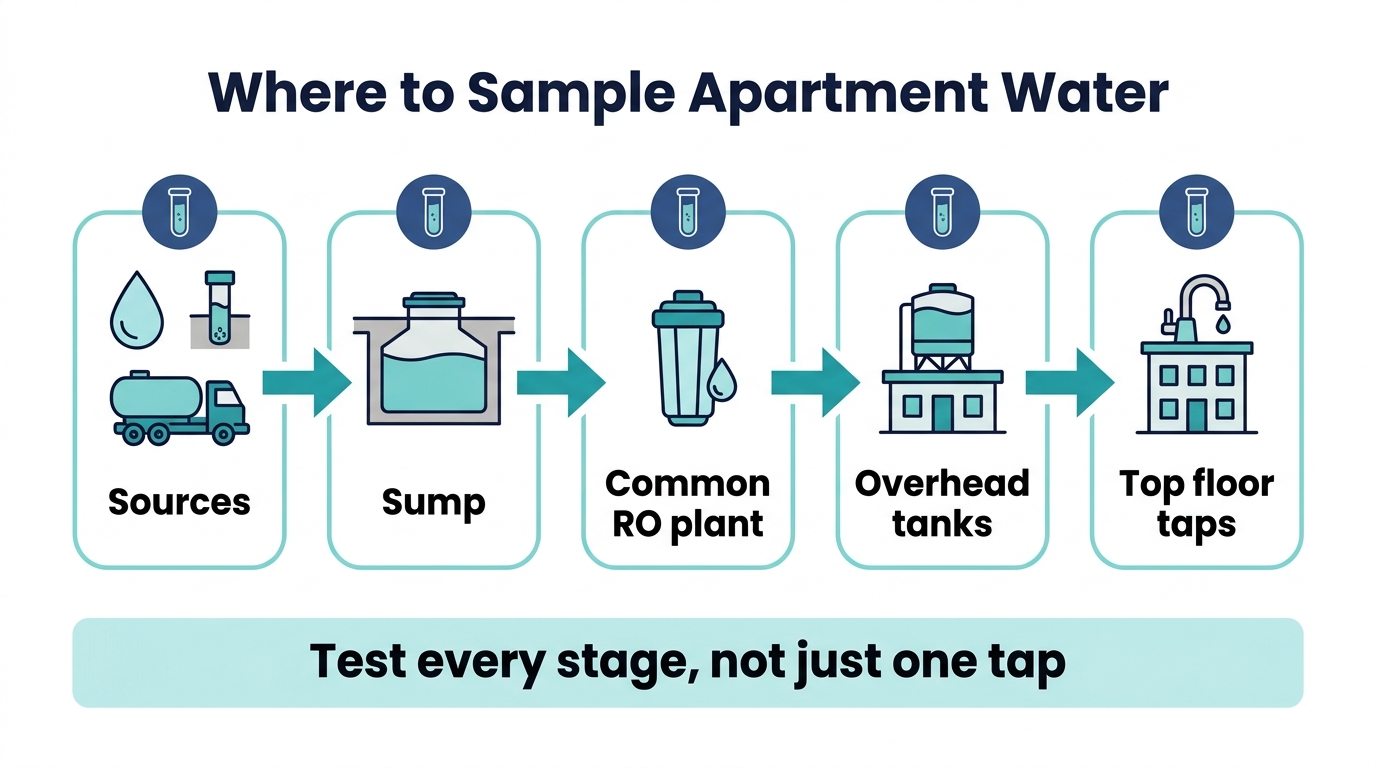
Sample at each stage of the system, not just one tap. If you test only a kitchen tap and it fails, you won’t know whether the fault is in the borewell, the sump, the tank or the pipes. Testing several points tells you exactly where to fix.
A practical sampling plan for most complexes:
- Each source: every borewell in use, the BWSSB inlet, and a tanker load at the time of delivery.
- The sump outlet, after all sources have mixed.
- The common RO or treatment plant outlet, if you have one.
- Each overhead tank outlet, one per block or tower.
- Taps at the far end of the system: a top-floor flat and the flat furthest from the tank in each block. This is where residual chlorine runs lowest and pipe problems show up.
- Clubhouse, crèche and kitchen taps, because these serve children and large groups.
Rotate the tap locations each quarter so that, over a year, you cover more of the building. Keep the same source and sump points every time so you can compare results.
Sampling tips that protect your results
- Use the sterile bottles supplied by the lab for microbiology. Don’t reuse mineral water bottles.
- Let the tap run for 2 to 3 minutes before you fill the bottle, and don’t touch the inside of the bottle or the cap.
- Get microbiology samples to the lab ideally within 6 hours. Chemical samples can usually wait up to 24 hours, depending on the parameter.
- Label each bottle with the exact point (for example “Block C, 14th floor, kitchen tap”), the date and the time.
- Don’t sample right after chlorinating the sump if you want to know the condition of the untreated source. Sample the source separately.
If the facility team isn’t comfortable doing this, ask the lab to send a technician. Prewel offers sample pickup for this reason.
Can You Trust the Tanker Supplier’s Water Report?
Treat a supplier’s report as a starting point, not proof. A report on file tells you about one sample, from one day, from one source. It says nothing about the load that reached your sump this morning.
BWSSB’s own tanker scheme is the better documented option. Under the Sanchari Kaveri service, tankers fill at BWSSB Kaveri connection centres, and the Board told Deccan Herald that samples from all supply centres are tested every morning at its NABL-accredited lab. Apartments can place bulk bookings at the nearest BWSSB office. That still doesn’t cover what happens after the water leaves the tanker and enters your sump.
Private tankers are harder to judge. Reporting by Citizen Matters and Down To Earth has described gaps in licensing and quality checks for private tankers in the city. If you rely on them:
- Ask each supplier where they fill and for a recent report from an accredited lab, and check that the report’s date and source match.
- Test the first few loads from any new supplier, then test tanker water as part of every quarterly round.
- Keep a log of which tanker, from which supplier, went into which sump on which day. When the Mahaveer Ranches residents fell ill, the timing of a single tanker purchase was the key clue.
- Check TDS on delivery with a handheld meter. A sudden jump means the source has changed, and it’s a cheap first screen (though it tells you nothing about bacteria).
Does the Apartment STP Need Water Testing Too?
Yes. Most large Bangalore complexes are required to treat and reuse their sewage on site, and the treated water ends up in flushes, gardens and sometimes car washes, so it needs regular checks too.
According to a September 2026 Citizen Matters report, Bangalore apartments with more than 120 units, or generating more than 80 kilolitres of sewage a day, must treat and reuse it under the city’s Zero Liquid Discharge norm, introduced in 2016. The same report cites WELL Labs’ estimate of at least 4,000 registered apartment STPs, of which about 2,500 are operational, and a BWSSB official saying the Pollution Control Board has very limited manpower to monitor them. In one Yelahanka complex described in the report, testing recorded coliform bacteria, BOD and COD above permissible limits.
In practice, that means the association is the first line of monitoring for its own STP. Treated water testing usually covers BOD, COD, TSS, pH and coliforms, against the norms in your STP’s consent conditions. Regular results also protect the committee if a complaint ever reaches the KSPCB. For more on how these plants work, read our article on STPs in Bangalore.
Keep STP sampling and drinking water sampling separate, with separate bottles, gloves and labels, so there’s no chance of cross-contaminating a drinking water sample.
What Should the Committee Do If a Water Test Fails?
Act on bacterial failures the same day, and investigate chemical failures over days or weeks. A positive E. coli result means sewage has reached the water, and every hour counts. A slightly high hardness or TDS reading is a comfort and maintenance problem, not an emergency.
If E. coli or coliforms are found
- Tell residents straight away. Advise them to boil drinking water or use a safe alternate source until a clean retest comes back. Hiding a result to avoid panic usually backfires.
- Isolate the likely source. Use your sampling points to narrow it down: if the source is clean but the sump fails, the sump is the problem.
- Find the cause before you disinfect. Check sump lids, cracks, nearby drains and sewage lines, recent flooding and recent tanker loads. At Yemalur, cases came back after chlorination because the root cause hadn’t been fixed.
- Clean and disinfect the affected sump, tanks and lines, using a professional tank-cleaning service if needed.
- Retest at the same points, and don’t declare the water safe until the retest is clean.
If a chemical parameter fails
- Nitrate: almost always points to sewage reaching the borewell. Take the borewell out of the drinking supply and investigate nearby sewage lines and soak pits.
- Hardness or TDS: look at the source mix. Blending with BWSSB water, servicing the softener or RO plant, or changing tanker suppliers often fixes it.
- Low residual chlorine: review your chlorination dose and how long water sits in tanks.
- Iron or turbidity: check for rusting pipes, disturbed sediment in tanks or a borewell problem.
Whatever the result, share the report with residents. Posting each quarter’s results on the notice board or the community app builds trust faster than any assurance from the committee.
How Prewel Labs Can Help with Apartment Water Testing in Bangalore
Prewel Labs is a water testing laboratory in J P Nagar, Bengaluru, that works with housing societies on drinking water and swimming pool water safety. We test drinking water against IS 10500, covering microbiology (total plate count, coliforms, E. coli), chemical parameters (pH, hardness, TDS, nitrate, chloride, fluoride, residual free chlorine, iron and heavy metals) and physical parameters such as colour, odour and turbidity. We also test STP water for BOD, COD, TSS, coliforms, nitrates and phosphates.
For apartment complexes, that means one lab can cover your borewells, tanker loads, sumps, overhead tanks, taps, common RO plant, swimming pool and STP. We offer sample pickup by a trained technician, monthly, quarterly or custom testing packages, and PDF reports by email or through our digital dashboard, which makes it easier to keep a running record for residents and audits. If a result exceeds the limits, we’ll explain what it means and suggest corrective steps. You can see the full list of tests on our water testing lab page.
Prewel Labs is NABL accredited (National Accreditation Board for Testing and Calibration Laboratories) and ISO 9001 certified.
If your committee is setting up a testing schedule, or you need a test after a complaint, share your complex’s size and water sources in the form below and we’ll suggest a plan that fits.
Frequently Asked Questions
Is BWSSB Cauvery water safe enough that we don’t need to test it?
Cauvery water is treated and chlorinated before it enters the network, but your residents don’t drink it at the BWSSB inlet. They drink it after it has sat in your sump and overhead tank and travelled through your internal pipes. Test it at the tap, and check residual chlorine, which tells you whether the disinfection has lasted the journey. Our post on where to get drinking water tested in Bangalore explains how BWSSB’s own free testing works.
Our flats all have RO purifiers. Do we still need to test the common supply?
Yes. Residents still use tap water for bathing, brushing teeth, washing vegetables and cooking, and not every flat services its purifier on time. A heavy bacterial load can also overwhelm a purifier. At Yemalur, one resident reported falling ill despite drinking only filtered water.
Who is responsible for water testing in an apartment complex?
Day to day, it falls to whoever manages the common water system: usually the resident welfare association or owners’ association, through its facility management team. Before handover, it’s typically the builder’s maintenance team. Whoever it is, make sure the testing schedule, reports and corrective actions are recorded and visible to residents.
Can we test the water ourselves with a TDS meter or test kit?
A TDS meter is useful for spotting a sudden change in source, such as a new tanker load. It can’t detect bacteria, nitrate or heavy metals, and a low TDS reading doesn’t mean the water is safe. Use home kits as a screen between lab tests, not as a replacement.
Make Water Testing Part of the Building’s Routine
Apartments already have schedules for lift servicing, fire safety drills and generator maintenance. Water deserves the same place on the calendar. A quarterly test, a sampling plan that covers every stage of the system and a habit of sharing results turns water safety from a worry into a routine, and it gives your committee early warning instead of a hospital list. If your complex hasn’t tested its water this season, the end of the rainy season is a good time to start.
This post is general information. It doesn’t replace advice from your doctor, the local health authority or a qualified water treatment professional for your specific building.