






















Is Borewell Water Safe for Drinking in Bangalore?
Last Updated on November 10, 2026
When Karnataka’s Department of Mines and Geology analysed 2,209 groundwater samples from in and around Bangalore, it classed 31% of the city’s groundwater as unfit to drink. Nitrate alone was over the limit in 29% of the samples. That’s the water many homes, apartments and PGs pull up from their borewells every day, and most of what was wrong with it can’t be seen, smelled or tasted. So if you’re asking about borewell water quality in Bangalore, the honest starting point is this: you can’t judge a borewell by how its water looks.
Here’s the short answer. Borewell water in Bangalore is not automatically safe to drink. Some borewells give perfectly good water, and many don’t, often because of sewage seeping into the ground or minerals like fluoride and uranium in the rock. Boiling kills germs but does nothing about chemicals, and an RO purifier only helps if it’s actually removing what’s in your water. The only way to know is a lab test against IS 10500, India’s drinking water standard. This post explains what’s in the city’s groundwater, who is most at risk, which treatment fixes which problem and what to do if your water fails.
Is Borewell Water Safe to Drink in Bangalore? The Short Answer
It depends entirely on your borewell, and nobody can tell you without testing it. Two borewells on the same street can give very different water, because the depth, the rock they pass through and how close they sit to a leaking sewer line all change what comes out of the tap.
A researcher quoted in a May 2025 Citizen Matters guide to checking water quality in Bengaluru made the point plainly: the city doesn’t have complete aquifer mapping, so there’s no map you can look up to see whether the water under your plot is safe. That puts the decision in your hands. Treat untested borewell water as unsafe for drinking until a report says otherwise.
That doesn’t mean you need to panic. Plenty of households drink borewell water safely, because they test it, treat it for the problems it actually has and re-test it on a schedule. The risk sits with borewells that have never been tested, or were tested once years ago and are assumed to still be fine.
What Does Research Say About Borewell Water Quality in Bangalore?
The studies that exist point the same way: a large share of Bangalore’s groundwater fails at least one drinking water limit, and human activity is the main cause. Nitrate and bacteria are the most common problems, with fluoride, uranium, iron and hardness showing up in particular areas.
The state groundwater study
The Department of Mines and Geology groundwater study (2011) collected over 3,000 samples across about 800 square kilometres and analysed 2,209 of them. Of those, 638 (29%) had excess nitrate, 214 (10%) had excess iron, 185 (8.5%) had excess total hardness and 14 (0.6%) had excess fluoride. It rated 31% of the city’s groundwater as non potable, down from 50% in an earlier 2003 study. The report concluded that the cause of pollution is “more anthropogenic than being geologic”, in other words people rather than rocks, and it reported E. coli and coliform bacteria linked to untreated sewage.
The Central Ground Water Board’s 2024 report
Nationally, the Central Ground Water Board’s Annual Ground Water Quality Report 2024 was based on 15,259 groundwater samples collected in May 2023. As Mongabay India’s summary of the CGWB report sets out, 19.8% of samples exceeded the nitrate limit, 9.04% exceeded the fluoride limit and 6.60% had uranium above 30 ppb (parts per billion). Karnataka was named among the states where more than 40% of samples exceeded the nitrate limit, and among the states with localised pockets of uranium above the limit, which the report attributes to geogenic (natural, rock-related) causes in Karnataka.
Local reports from Bengaluru
Closer to home, the same Citizen Matters article reports high nitrate, fluoride and iron in borewell and Cauvery water in areas such as Yeshwanthpur, Nayandahalli and Bellandur. It also notes that the CGWB report found high fluoride and uranium contamination in Karnataka’s groundwater. None of this tells you about your specific borewell. What it does tell you is that a failed test is common enough in Bangalore that skipping the test is the bigger gamble.
What Makes Borewell Water Unsafe? The Main Contaminants
Borewell water usually becomes unsafe for one of two reasons: something gets in from the surface (sewage, bacteria, nitrate), or something dissolves out of the rock (fluoride, uranium, iron, salts). The first kind can change quickly, especially in the monsoon. The second kind tends to stay put and often gets worse as borewells go deeper.
Bacteria from sewage
This is the problem that makes people sick fastest. When a sewer line, septic tank or soak pit leaks near a borewell, faecal bacteria can reach the water. E. coli in a test result is a direct sign of faecal contamination. The WHO fact sheet on drinking water estimates that microbiologically contaminated drinking water causes about 505,000 diarrhoeal deaths a year worldwide, and links contaminated water with diarrhoea, cholera, dysentery, typhoid, polio and hepatitis A. Bangalore has seen this risk first hand, including the cholera cases reported in Bangalore PGs.
Nitrate
Nitrate is the most common chemical failure in Bangalore’s groundwater, and it often travels with sewage. It has no colour, smell or taste. The CGWB report, as summarised by Mongabay, warns that high nitrate in drinking water can cause methemoglobinemia in infants, a potentially fatal condition known as “blue baby syndrome”. IS 10500 sets the limit at 45 mg/L with no relaxation.
Fluoride
Fluoride comes from the rock itself, and the state study noted that TDS and fluoride tend to be higher in deeper borewells. The WHO page on excess fluoride says long-term exposure to high levels may lead to dental fluorosis or crippling skeletal fluorosis. IS 10500 sets an acceptable limit of 1.0 mg/L and a permissible limit of 1.5 mg/L when no other source is available.
Uranium
Uranium is a newer concern for Karnataka. The CGWB report uses 30 ppb as the safe limit and, per Mongabay, links uranium in drinking water with cancer and kidney damage. The copy of IS 10500:2012 (Bureau of Indian Standards) we checked doesn’t list a uranium limit, so it isn’t part of every standard drinking water panel. If your borewell is deep, or your area has reported uranium, ask the lab for it by name.
Hardness, TDS and iron
These are the problems you’re most likely to notice: scale in the kettle and geyser, a salty or metallic taste, brown stains on buckets and tiles. They’re mostly about taste, appliances and pipes rather than acute illness. They matter for another reason too. Very hard or iron-rich water wears out RO membranes and filters faster, which can quietly leave you drinking poorly treated water.
The table below puts the main contaminants side by side, with limits from IS 10500:2012.
| Contaminant | Can you see, smell or taste it? | Main concern | IS 10500 acceptable limit | Does boiling fix it? |
|---|---|---|---|---|
| E. coli and coliform bacteria | No | Diarrhoea, cholera, typhoid | Not detectable in 100 mL | Yes, a rolling boil kills them |
| Nitrate (as NO3) | No | Blue baby syndrome in infants | 45 mg/L | No |
| Fluoride (as F) | No | Dental and skeletal fluorosis | 1.0 mg/L (1.5 mg/L permissible) | No |
| Uranium | No | Kidney damage, cancer risk | Not listed (CGWB uses 30 ppb) | No |
| Total dissolved solids (TDS) | Sometimes, as a salty taste | Taste, scaling | 500 mg/L (2,000 mg/L permissible) | No |
| Total hardness (as CaCO3) | Yes, as scale | Scaling, appliance damage | 200 mg/L (600 mg/L permissible) | No |
| Iron (as Fe) | Yes, as brown stains | Taste, stains, clogged filters | 0.3 mg/L | No |
Look at the second column. The contaminants with the most serious health effects are exactly the ones you can’t detect yourself. For the full list of parameters a borewell test should include, see our guide to borewell water testing in Bangalore.
Who Is Most at Risk from Unsafe Borewell Water?
Everyone who drinks contaminated water is exposed, but some people carry more of the risk. Infants fed formula made with borewell water are the clearest case, because of nitrate. A baby drinks a lot of water for their body weight, and boiling the water for formula, which most parents do, does nothing to lower nitrate.
Beyond infants, think about who relies on the borewell and how many of them there are:
- Apartments and gated communities on shared borewells, where one contaminated source reaches hundreds of people at once.
- PGs and hostels, where residents rarely know where the water comes from and outbreaks spread quickly.
- Homes in fast-growing areas on the city’s edges, where new construction, septic tanks and borewells often sit close together.
- Small food businesses, cafes and offices that use borewell water for drinking, cooking or ice.
Long-term exposure matters too. Fluoride and uranium don’t make you sick after one glass. The harm builds over years, which is why a family that has used the same borewell for a decade without a test has more reason to check, not less.
Does Boiling, RO or UV Make Borewell Water Safe?
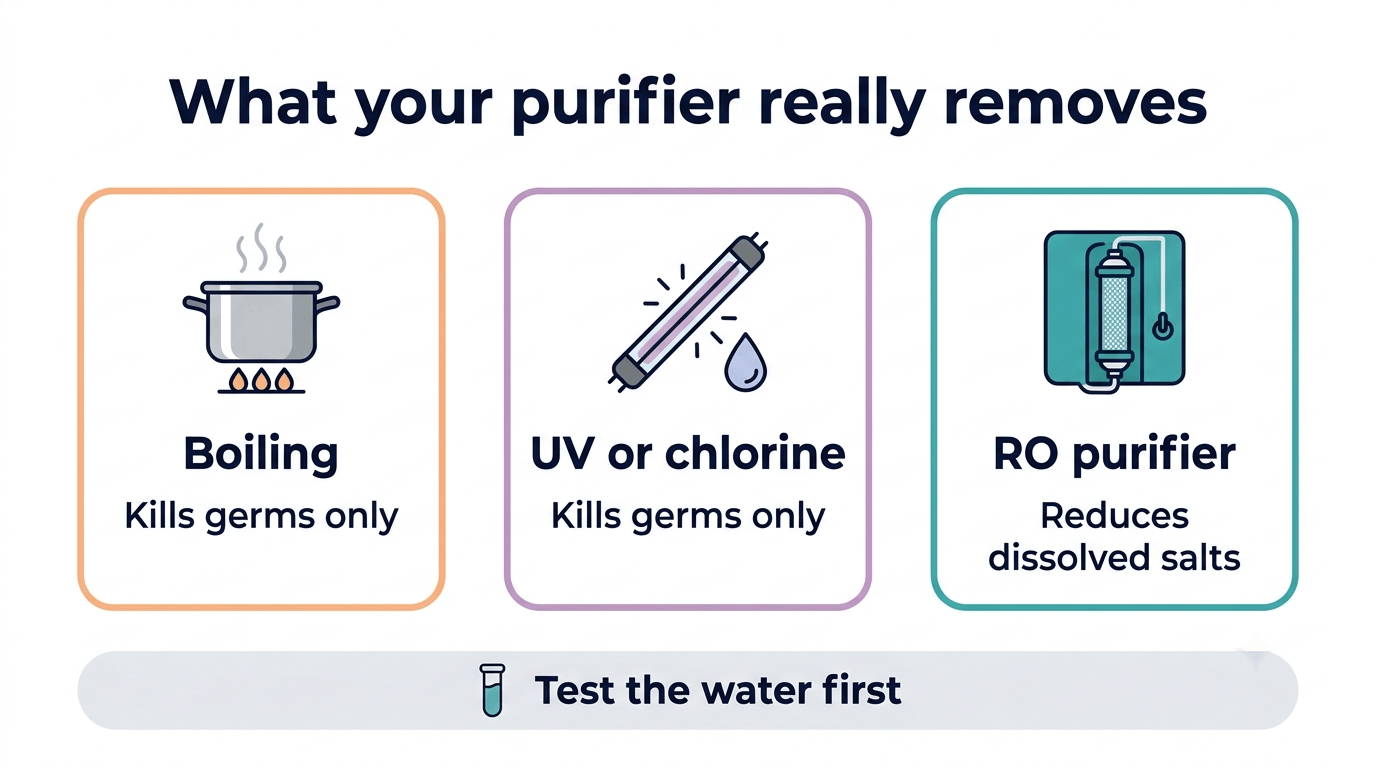
Each treatment fixes some problems and not others. Boiling, UV and chlorination deal with germs. They don’t remove dissolved chemicals like nitrate, fluoride or uranium. RO systems are built to reduce dissolved salts, but whether yours brings your water under the limits is something only a test of the purified water can confirm.
Boiling
The CDC’s guidance on making water safe in an emergency says to bring clear water to a rolling boil for 1 minute. That kills disease-causing bacteria, viruses and parasites. The same guidance is equally clear on the limits: you cannot make water containing fuel, toxic chemicals or radioactive materials safe by boiling it. So if your borewell’s problem is nitrate, fluoride or uranium, a boiled glass is no safer than an unboiled one.
UV and chlorination
UV purifiers and chlorination target microbes. Like boiling, they leave dissolved chemicals in place.
RO purifiers
RO (reverse osmosis) is the most common answer in Bangalore homes, because it’s designed to reduce dissolved salts that boiling and UV can’t touch. But an RO unit is only as good as its condition. Membranes wear out, filters clog faster on hard or iron-rich borewell water, and a poorly maintained unit can grow bacteria inside it. Many households install an RO and never check its output again. If you want to know whether your RO is working, test the water from the RO tap, not just the borewell.
| Treatment | Main target | Leaves behind | How to confirm it works |
|---|---|---|---|
| Boiling (1 minute rolling boil) | Bacteria, viruses, parasites | Nitrate, fluoride, uranium, salts | Not needed for germs; chemicals need a raw water test |
| UV purifier | Bacteria, viruses | All dissolved chemicals | Microbiology test of treated water |
| Chlorination | Bacteria, viruses | All dissolved chemicals | Microbiology test and residual chlorine check |
| RO purifier | Dissolved salts (TDS) | Depends on the unit and its condition | Chemical and microbiology test of RO output |
The practical takeaway: pick the treatment after you know what’s in the water, not before. A household with only a bacteria problem doesn’t need RO, and a household with high nitrate gets nothing from boiling.
Signs Your Borewell Water May Not Be Safe
Some warning signs are worth acting on straight away, but a borewell can look perfect and still fail a test. Treat these signs as a reason to test sooner, never as proof that water without them is fine.
- A change in smell, colour or taste, especially a sewage or rotten egg smell, or water that turns cloudy after rain.
- Stomach upsets in the household, particularly several people at once or guests who fall ill after visiting.
- The monsoon or flooding, when surface water and sewage are most likely to seep down. Our post on why water testing matters during the monsoon covers this in more detail.
- New digging nearby, such as a sewer line, a new septic tank or construction that disturbs the ground close to the borewell.
- A deepened or newly drilled borewell, since deeper water can carry more fluoride and dissolved salts.
- Brown stains or heavy scale, which point to iron and hardness and often mean your filters are working harder than they should.
A note on TDS meters: they’re cheap and popular, but a TDS reading is a single number for total dissolved salts. It can’t detect bacteria, can’t tell nitrate apart from harmless calcium and says nothing about fluoride or uranium. A low TDS reading doesn’t mean the water is safe.
How Can You Find Out If Your Borewell Water Is Safe?
Get a lab test against IS 10500 that covers both microbiology (total coliforms and E. coli) and chemistry (at least nitrate, fluoride, TDS, hardness, iron and pH). For a borewell, it’s worth testing at two points: the tap closest to the borewell, which tells you about the source, and the tap you actually drink from, which tells you whether your treatment is working.
A few practical points make the result more useful:
- Use a NABL-accredited lab, so the report carries weight if you need to show it to an association, tenant or inspector. Our guide to a NABL-accredited water testing lab in Bangalore explains what that accreditation covers.
- Collect the sample in the sterile bottle the lab provides, and get it to the lab quickly. Microbiology samples are best tested within about 6 hours.
- Ask for uranium and heavy metals by name if your borewell is deep, new or near industry, since they aren’t always in a basic panel.
- Re-test on a schedule. For drinking water, testing every 3 months is a sensible routine, plus an extra test after the monsoon or any repair.
Our step-by-step guide to testing borewell water in Bangalore walks through sampling in detail. If you’re comparing options, our post on water testing cost in Bangalore explains what different panels cost and what they include.
What Should You Do If Your Borewell Water Fails a Test?
Stop drinking it untreated, then match the fix to the failure. The right next step depends on whether the problem is bacteria, a health-related chemical or a nuisance mineral.
If bacteria or E. coli are found
Switch to a safe alternative for drinking and cooking straight away, such as boiled water or a tested supply. Then look for the source. E. coli in borewell water usually means sewage is getting in, through a cracked casing, a poorly sealed borewell head, a nearby septic tank or a leaking sewer line. Get the borewell and storage tanks cleaned and disinfected by a professional, fix the entry point and re-test before you go back to drinking it. Disinfection without fixing the source only helps until the next leak.
If nitrate, fluoride or uranium is over the limit
Boiling won’t help here, so don’t rely on it. You’ll need either a treatment system that actually reduces the contaminant, confirmed by testing the treated water, or a different drinking water source. Be extra careful with formula for infants if nitrate is high. If you already have an RO, test its output to see whether it’s bringing the level under the limit.
If hardness, TDS or iron is high
These are usually a comfort and maintenance problem rather than an urgent health one. A softener, iron removal filter or RO can help, depending on the levels. Fixing them also protects whatever treatment you rely on for safety, since scale and iron make RO membranes and filters work harder.
Whatever the failure, re-test after the fix. A second report is the only way to know the problem is actually solved.
Frequently Asked Questions
Can I drink borewell water after RO treatment?
Often yes, if the RO is suited to your water and well maintained. The catch is that you won’t know without testing the RO output itself. Membranes wear out and units can harbour bacteria, so test the purified water along with the raw borewell water, especially if your borewell is very hard or high in iron.
Is borewell water safer than Cauvery water in Bangalore?
Not by default. Cauvery water supplied by BWSSB is treated and routinely tested by the Board, while a private borewell is only as safe as its last test. That said, local reports have found problems in both sources in some areas, including contamination in supply lines. Whichever source you use, testing at your own tap is what tells you what you’re drinking.
Is borewell water safe for making baby formula?
Only if a recent test shows it meets IS 10500, with nitrate below 45 mg/L and no bacteria. Boiling makes it safe from germs but leaves nitrate untouched, and nitrate is the main concern for bottle-fed infants. If you’re not sure, use a tested source for formula until you have a report.
If my borewell water was fine last year, is it still safe?
Not necessarily. Bacteria and nitrate levels can change with the monsoon, new construction or a leak nearby, and falling water levels can change the chemistry of what’s pumped up. A single old report is a snapshot, so re-test every few months for drinking water and after any change around the borewell.
How Prewel Labs Can Help with Borewell Water Safety in Bangalore
Prewel Labs tests borewell water in Bangalore against IS 10500, covering the microbiology and chemistry that decide whether your water is safe to drink: coliforms and E. coli, nitrate, fluoride, TDS, hardness, iron, pH and heavy metals, with other parameters on request. We can test both your raw borewell water and the water coming out of your RO or purifier, so you know whether the problem is the source, the treatment or both.
We offer sample collection pickup, and reports come with interpretation. If a parameter is over the limit, we’ll point you to the corrective steps that fit the result, whether that’s chlorination, RO servicing, flushing or a filter change. For apartments, PGs and businesses, monthly, quarterly or custom testing packages are available. You’ll find the full list of water types and standards on our water testing lab page.
Prewel Labs is a NABL-accredited and ISO 9001 certified testing laboratory, recognised as a startup by the Government of India. If you’d like your borewell checked, or you’re not sure which tests you need, send us your details below and we’ll help you pick the right panel.
Know What’s in Your Borewell Before Your Family Drinks It
Bangalore’s groundwater will keep changing as the city grows, water tables drop and borewells go deeper. That’s out of your hands. What you can control is whether you’re guessing or know. A borewell that’s tested, treated for its actual problems and re-checked a few times a year can be a perfectly good source of drinking water. One that’s never been tested is a question nobody in the house can answer, and a lab report is the simplest way to answer it.
This post is general information about drinking water quality. It doesn’t replace medical advice or a site-specific assessment of your water supply.