



















What Are the Common Water Contaminants Found in Bangalore’s Borewell Water?
Last Updated on November 23, 2026
When the state’s Department of Mines and Geology tested 2,209 groundwater samples from across Bangalore, almost one in three failed the nitrate limit, and nitrate turned up in every part of the city. So if you’re wondering what’s actually in your borewell, the honest answer is that the most common borewell water contaminants in Bangalore are sewage bacteria and nitrate from above, fluoride, uranium, iron and hardness from the rock below, and heavy metals near industrial areas. Newer studies have also found PFAS and pharmaceutical residues in the city’s water. This guide goes through each contaminant: where it comes from, the IS 10500 limit, which parts of Bangalore have reported it, and how to find out if it’s in your water.
What Are the Most Common Borewell Water Contaminants in Bangalore?
Bacteria from sewage and nitrate are the two problems Bangalore borewells fail on most often. Behind them come hardness, high TDS and iron, which are very common but mostly cause nuisance rather than illness, and then fluoride, uranium and heavy metals, which are less widespread but more serious where they occur.
The table below sums up what the published studies show. The limits are from IS 10500:2012, the Bureau of Indian Standards drinking water specification. “Acceptable” is the limit the standard recommends. “Permissible” is the higher value tolerated only when no other source exists, and “no relaxation” means the acceptable limit is the only limit.
| Contaminant | Main source in Bangalore | Why it matters | IS 10500:2012 limit |
|---|---|---|---|
| E. coli and total coliforms | Leaking sewers, septic tanks, soak pits, damaged borewell casing | Diarrhoea, gastroenteritis, cholera and typhoid risk | Not detectable in any 100 mL sample |
| Nitrate (as NO3) | Sewage and wastewater seeping into groundwater | Methemoglobinemia (“blue baby syndrome”) in infants | 45 mg/L, no relaxation |
| Fluoride | Natural minerals in granite and gneiss rock | Dental and skeletal fluorosis with long-term use | 1.0 mg/L acceptable, 1.5 mg/L permissible |
| Uranium | Natural, from granitic rock | Linked to kidney damage and cancer risk | Not listed in IS 10500:2012 (CGWB and WHO use 30 µg/L) |
| Total dissolved solids (TDS) | Dissolved salts from rock, often higher in deep borewells | Taste, scaling, load on RO membranes | 500 mg/L acceptable, 2,000 mg/L permissible |
| Total hardness (as CaCO3) | Calcium and magnesium from rock | Scale on geysers, taps and RO units | 200 mg/L acceptable, 600 mg/L permissible |
| Iron and manganese | Groundwater chemistry, corroded casings and pipes | Brown or black stains, metallic taste | Iron 0.3 mg/L, no relaxation. Manganese 0.1 mg/L acceptable, 0.3 mg/L permissible. Combined iron and manganese not above 0.3 mg/L |
| Chromium, lead, cadmium, nickel | Industrial discharge in and around industrial areas | Toxic substances with long-term health effects | Chromium 0.05, lead 0.01, cadmium 0.003, nickel 0.02 mg/L, all no relaxation |
| PFAS and pharmaceutical residues | Sewage, lakes and wastewater | Emerging concern, long-term effects still being studied | No IS 10500:2012 limit |
If you want the full list of parameters and how they’re grouped, our guide to drinking water testing parameters under IS 10500 sets out every table in the standard.
Why Does Bangalore Borewell Water Pick Up So Many Contaminants?
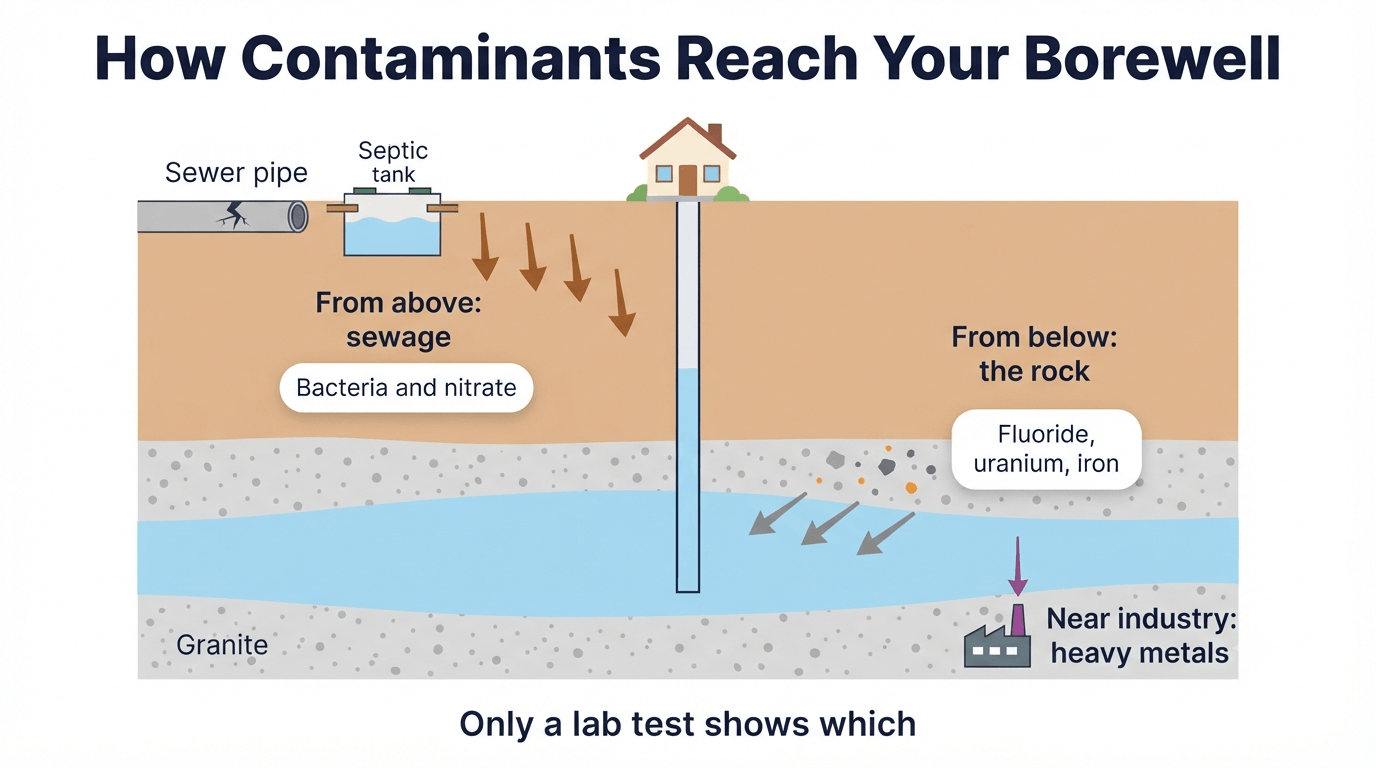
Contaminants reach a Bangalore borewell by two routes: they seep down from the surface, or they dissolve out of the rock the water sits in. Knowing which route a contaminant takes tells you a lot about how it behaves and how to deal with it.
The surface route carries sewage bacteria and nitrate. Bangalore has a dense network of sewer lines, storm drains, septic tanks and soak pits, often within a few metres of a borewell. A cracked sewer, a badly sealed borewell head or a soak pit uphill of the borewell is enough. These problems can appear suddenly and tend to get worse in the monsoon, when rainwater carries surface pollution down faster.
The rock route carries fluoride, uranium, iron, hardness and dissolved salts. Bangalore sits on hard granite and gneiss, and water that stays in contact with that rock for a long time picks up whatever minerals it holds. These contaminants don’t come and go with the weather. They tend to be steady for a given borewell, and they can change when a borewell is deepened or when the water table drops.
Pressure on the aquifer makes both routes worse. India Water Portal’s review of the 2011 Mines and Geology report notes that the city was drawing about twice its renewable groundwater, with 105,501 borewells registered by January 2010. When you pump harder and deeper, you pull water from further away and from deeper rock, and both can change what comes out of the tap.
Bacteria and Sewage: The Contaminant That Makes People Sick Fastest
Faecal bacteria are the most urgent borewell contaminant because they cause illness within days. IS 10500 allows zero: E. coli and total coliform bacteria must not be detectable in any 100 mL sample, and the standard calls for immediate investigation if either is found.
E. coli is the indicator labs look for because it lives in the gut and its presence points directly to faecal contamination. If E. coli is in your water, other gut pathogens may be too. Total coliforms are a broader group. They don’t always mean sewage, but they do mean something is getting into the system that shouldn’t be.
Bangalore has seen what this looks like at scale. In one reported case at an apartment complex near Electronics City, close to 140 residents developed gastroenteritis, and Deccan Herald reported that BBMP tests linked it to one polluted borewell. The complex had two working borewells, and only one failed. Officials suspected sewage had leaked into that borewell’s pipeline. That detail matters. Two borewells on the same property can give completely different results, so a clean report from one tells you nothing about the other.
Bacterial contamination doesn’t always change how water looks or smells. Our guide on how to detect E. coli in drinking water explains the lab methods and why a home TDS meter or strip kit won’t catch it.
Nitrate: The Most Common Chemical Failure in Bangalore Borewells
Nitrate is the chemical that Bangalore borewells fail on most often. The 2011 Mines and Geology study found nitrate above 45 mg/L in 29% of samples, spread fairly evenly across the city, which means no part of Bangalore can assume it’s safe from it.
The national picture is similar. The Central Ground Water Board’s Annual Ground Water Quality Report 2024 analysed 15,259 groundwater samples collected in May 2023. As Mongabay India’s summary of the CGWB report sets out, 19.8% of samples nationally exceeded the nitrate limit, and Karnataka was one of the states where more than 40% of samples did.
In a city, the main source is sewage and wastewater. Nitrate has no colour, smell or taste, so you can’t tell it’s there. The health concern the CGWB report highlights is methemoglobinemia in infants, a condition that reduces the blood’s ability to carry oxygen and is commonly called “blue baby syndrome”. Bottle-fed babies are the group most at risk, because they drink a lot of water for their body weight.
Here’s the part many families miss: boiling doesn’t remove nitrate. It kills bacteria, but nitrate stays in the water, and as water evaporates it becomes slightly more concentrated. If your borewell has high nitrate, you need treatment that’s shown to reduce it (often a well-maintained RO system, confirmed by testing its output) or a different drinking water source.
Because nitrate usually travels with sewage, a high nitrate result is also a warning sign. It suggests wastewater is reaching your borewell, so it’s worth testing for bacteria at the same time if you haven’t.
Fluoride and Uranium: Contaminants That Come From the Rock
Fluoride and uranium aren’t caused by pollution. They dissolve naturally out of the granite and gneiss under Bangalore, so they don’t change with the seasons and can’t be fixed by cleaning a tank or sealing a borewell. They are also invisible, tasteless and harmful only over years of drinking, which is why they’re easy to ignore.
Fluoride
IS 10500 sets fluoride at 1.0 mg/L acceptable and 1.5 mg/L permissible where no other source exists. Across Bangalore, fluoride exceedances are not common: the 2011 study found only 0.6% of samples above the limit. But they cluster. The same review singles out Bellandur as an area where borewell water is worth testing for fluoride. Long-term exposure to high fluoride can cause fluorosis, which shows up first as mottled teeth and, at higher doses over many years, can affect bones and joints.
Uranium
Uranium is the contaminant most Bangalore households have never heard of, and the research on it is fairly recent. A 2021 study in Applied Geochemistry, “Elevated uranium in drinking water sources in basement aquifers of southern India” by Lapworth and colleagues, tested 130 water samples from three catchments in the region, including one in Bengaluru. It found uranium above the WHO guideline of 30 µg/L in 30% of samples overall, with values as high as 589 µg/L. The Bengaluru catchment had a mean of 68 µg/L, more than twice the guideline, and the authors linked the uranium to the local granitic geology.
The CGWB 2024 report also found uranium above 30 ppb (the same as 30 µg/L) in localised pockets of Karnataka and attributes it to geogenic, meaning natural, causes. Mongabay’s summary notes that uranium in drinking water can lead to kidney damage and cancer.
There’s a practical catch. IS 10500:2012 doesn’t include a uranium limit, so uranium isn’t part of a standard drinking water panel. If your borewell is deep, newly drilled, or in an area where uranium has been reported, you’ll need to ask a lab for it specifically.
Hardness, TDS, Iron and Manganese: The Everyday Problems
These are the contaminants most Bangalore borewell owners notice first: white scale on taps and geysers, brown stains in buckets, water that tastes salty or metallic. They’re very common, but at the levels usually found they cause more damage to plumbing and appliances than to health.
Hardness and TDS
Hardness comes from calcium and magnesium, and TDS (total dissolved solids) is the total of all salts and minerals dissolved in the water. The 2011 study found that 68% of samples had TDS between 500 and 2,000 mg/L, above the IS 10500 acceptable limit but within the permissible one, and 8.5% failed the hardness limit. Citizen Matters’ guide to checking water quality in Bengaluru cites a 2018 survey in which 24% of households getting both borewell and Cauvery water had hardness above 200 mg/L.
Hard water isn’t a health hazard at these levels, but it shortens the life of geysers, washing machines and RO membranes. High TDS also makes RO units work harder and waste more water.
Iron and manganese
Iron exceeded the limit in 10% of the 2011 samples. It usually shows up as reddish brown staining, a metallic taste or water that turns cloudy after standing. Manganese causes darker, almost black stains. IS 10500 sets iron at 0.3 mg/L with no relaxation and manganese at 0.1 mg/L acceptable, and the combined total of the two must not exceed 0.3 mg/L. Old or corroded borewell casings and GI pipes can add iron on top of what’s naturally in the groundwater.
One common mistake is treating a TDS meter reading as a safety check. A TDS meter gives you a single number for dissolved salts. It can’t detect bacteria, can’t tell nitrate apart from harmless calcium, and says nothing about fluoride or uranium. Low TDS water can still fail a lab test.
Heavy Metals Near Bangalore’s Industrial Areas
Heavy metals aren’t a citywide problem, but around Bangalore’s older industrial areas they’re a real one. Chromium is the metal most often reported, particularly around Peenya.
The 2011 Mines and Geology study ran special tests in industrial areas and found metals “much above drinking water standard” in several places, as summarised by India Water Portal:
- Chromium: Peenya 2nd Stage and 3rd Phase, Hegganahalli (Srigandhanagar), Yelahanka New Town and Rajajinagar Industrial Town.
- Manganese: Peenya Industrial Area, Hegganahalli, Hosapalya, Rajajinagar Industrial Town, Agrahara Dasarahalli and the Old Madras Road industrial area (Virgonagar).
- Zinc: Gollahalli (Bommanahalli), Hosapalya, Somasundarapalya (HSR 2nd Sector), ITI Layout and parts of Rajajinagar.
A later study of 30 groundwater stations in Peenya, B. S. Shankar’s 2019 heavy metal pollution index assessment in Environmental Monitoring and Assessment, found a mean pollution index of 146.32 against a critical value of 100, with 63.33% of samples above that value. The metals ranked chromium, then iron, lead, copper, nickel and cadmium, and the author concluded the groundwater was unacceptable for drinking.
IS 10500 lists these metals among toxic substances with no relaxation: total chromium 0.05 mg/L, lead 0.01 mg/L, cadmium 0.003 mg/L and nickel 0.02 mg/L. If your borewell is in or near an industrial area, or downstream of one, a heavy metals panel belongs in your first test, not as an afterthought.
Emerging Contaminants: PFAS, Pharmaceuticals and Antimicrobial Resistance
The newest research on Bangalore’s water looks beyond the standard list. A March 2025 study led by the British Geological Survey with the Indian Institute of Science and the UK Centre for Ecology and Hydrology screened Bengaluru’s water for emerging organic contaminants and antimicrobial resistance for the first time.
According to the BGS summary of the study, the team screened 25 samples of groundwater, surface water and tap water for around 1,500 pollutants and identified 125. Medical and veterinary compounds, including antimicrobials, were the most common, appearing in around 60% of samples. PFAS (a family of long-lasting industrial chemicals sometimes called “forever chemicals”) were found at high levels, with the sum of selected PFAS above the EU Drinking Water Directive threshold of 0.1 µg/L in every water type except tap water. Some sources also carried antimicrobial resistance genes at levels similar to polluted environments.
This was a small study, and it doesn’t tell you anything about a specific borewell. What it does show is that sewage reaching groundwater brings more than bacteria and nitrate. IS 10500:2012 has no limits for PFAS or pharmaceuticals, and they aren’t part of routine drinking water testing. For most households, the practical takeaway is to stop sewage reaching the borewell in the first place, because that’s the route these chemicals take too.
Which Borewell Contaminants Should You Test For?
Every borewell used for drinking needs bacteria and the core chemical parameters tested. What you add on top depends on where the borewell is and how deep it goes.
| Your situation | Test at minimum | Add these |
|---|---|---|
| Any borewell used for drinking or cooking | Total coliforms, E. coli, nitrate, fluoride, TDS, hardness, iron, pH, turbidity | Chloride and sulphate if the water tastes salty |
| Near a sewer line, septic tank, soak pit, drain or polluted lake | Total coliforms, E. coli, nitrate | Ammonia, and retest after every monsoon |
| Deep or newly drilled borewell in granite | Fluoride, TDS, hardness, iron | Ask for uranium by name |
| In or near an industrial area such as Peenya | The core panel above | Heavy metals: chromium, lead, cadmium, nickel, manganese, zinc |
| Brown, black or cloudy water, or stains | Iron, manganese, turbidity | Bacteria, since a change in appearance can mean a new entry point |
| Shared borewell in an apartment, PG or office | Full IS 10500 physical, chemical and microbiological panel | Heavy metals and testing at the drinking tap as well as the borewell |
Test at the right point, too. A sample from the delivery line closest to the borewell tells you about the source. A sample from the kitchen tap or purifier outlet tells you what people actually drink. Our step-by-step guide to borewell water testing in Bangalore covers sampling, bottles and timing in detail.
Bacteria and nitrate can shift with the seasons, so a single test is a snapshot. Rock-related contaminants like fluoride and uranium are steadier, but deepening a borewell can change them. Our post on why water testing matters during the monsoon explains why the post-monsoon test is the one not to skip.
Can You Tell If Borewell Water Is Contaminated by Looking at It?
Sometimes you get a clue, but you can never get the all-clear by looking. The contaminants with the biggest health risks, including nitrate, fluoride, uranium, lead and often bacteria, have no colour, smell or taste at all.
What you can do is treat these signs as a reason to test sooner, and use them to guess where to look:
| What you notice | Possible cause | What to test |
|---|---|---|
| Sewage or musty smell, cloudiness after rain | Surface or sewage water getting in | Total coliforms, E. coli, nitrate, turbidity |
| Rotten egg smell | Hydrogen sulphide, sometimes bacterial activity | Sulphide, bacteria |
| Reddish brown stains or metallic taste | Iron, from groundwater or corroded pipes | Iron, manganese |
| Black stains | Manganese | Manganese, iron |
| White scale on taps and geysers | Hardness | Hardness, TDS |
| Salty or brackish taste | High TDS, chloride or sulphate | TDS, chloride, sulphate |
| Stomach upsets in the household | Bacterial contamination | Total coliforms, E. coli, straight away |
| Nothing unusual at all | Could still contain nitrate, fluoride, uranium or metals | A full panel, then a regular schedule |
If a test does fail, what you do next depends on which contaminant failed. We’ve covered that step by step in our guide to whether borewell water is safe to drink in Bangalore, including what boiling, UV and RO can and can’t fix.
Frequently Asked Questions
What is the most common contaminant in Bangalore borewell water?
Nitrate is the most common chemical failure, found above the 45 mg/L limit in 29% of samples in the 2011 Mines and Geology study. Bacterial contamination from sewage is the most common cause of illness. The two often go together, because both usually come from wastewater reaching the borewell.
Does an RO purifier remove all borewell contaminants?
A well-maintained RO can reduce many dissolved contaminants, including TDS, hardness, nitrate and fluoride, but how much it removes depends on the unit and the raw water. Membranes wear out and units can grow bacteria if they’re not serviced. The only way to know your RO is working is to test the purified water, ideally alongside the raw borewell water.
Is uranium included in a standard borewell water test?
Usually not. IS 10500:2012 doesn’t set a uranium limit, so it isn’t part of a standard drinking water panel. If your borewell is deep, in granite, or in an area where uranium has been reported, ask the lab specifically whether they can test for it.
Is Bangalore borewell water worse than Cauvery water?
Not automatically. Cauvery water from BWSSB is treated before supply, while a borewell is untreated groundwater, so a borewell carries more risk of rock-related contaminants like fluoride and hardness. But supply lines and storage tanks can also be contaminated. Testing at your own tap is the only way to know what you’re drinking.
How often should I test my borewell for contaminants?
Test a new or deepened borewell with a full panel before anyone drinks from it. After that, testing drinking water every 3 months is a sensible routine, with an extra test after the monsoon and after any nearby digging, sewer work or change in the water’s taste, smell or colour.
How Prewel Labs Can Help with Borewell Water Contaminant Testing in Bangalore
Prewel Labs tests borewell, drinking and RO water in Bangalore against IS 10500. Our water testing lab in Bangalore covers the contaminants in this guide: microbiology (total plate count, coliforms, E. coli and pathogens), the core chemistry (pH, TDS, hardness, nitrate, fluoride, chloride, sulphate, iron and more) and advanced tests including heavy metals, pesticides and VOCs. If you’re not sure which panel fits your borewell, tell us where it is and how deep it goes, and we’ll suggest one.
Prewel Labs is NABL accredited (National Accreditation Board for Testing and Calibration Laboratories) and ISO 9001 certified, and we provide NABL accredited reports for the parameters on our scope. That gives you a report you can show an apartment association, a tenant or an RO service company with confidence.
We can send a trained technician to collect samples, or guide you through collecting them yourself. Results usually take 3 to 5 days, depending on the tests. Basic and home panels typically cost ₹500 to ₹2,000 and a full chemical and microbiological panel ₹2,000 to ₹7,000, depending on the parameters. Our post on borewell water testing cost in Bangalore breaks this down further. For apartments and businesses, we also offer monthly, quarterly or custom testing schedules.
If you’d like a quote or help choosing the right tests, send us your details below and our team will get back to you.
Know What Your Borewell Holds
No two borewells in Bangalore are quite alike. One can sit on a rock seam rich in fluoride or uranium, while another a few streets away is clean at the source but takes in sewage through a cracked casing. The studies tell you which contaminants to watch for. Only a test of your own water tells you which ones you’re actually dealing with, and once you know, the fix is usually straightforward. Start with a full panel, retest on a schedule, and you’ll know your water rather than hoping it’s fine.
This article is general information about borewell water quality in Bangalore. It doesn’t replace medical advice or a site-specific assessment of your water supply.