























Why 0.45 Micron Filters Are Preferred for Bioburden Testing and MLT (vs. 0.22 Micron)
You’re in the lab, about to start bioburden testing. Results need to be accurate and on time, and you’re holding two boxes of membrane filters: 0.45 micron and 0.22 micron. Which one goes on the manifold?
For microbial limits testing (MLT) and bioburden testing, the answer is usually the 0.45 micron filter. This article explains why, and where the common assumption that “smaller pores are safer” stops applying.
Bioburden Testing Is About Counting, Not Sterilizing
A 0.22 micron filter is built to remove nearly all bacteria from a liquid. That is exactly what you want when the goal is a sterile product.
Bioburden and MLT testing have a different goal. You capture the microorganisms on the membrane, place the membrane on culture medium, and count the colonies that grow. The filter is a growth surface as well as a capture device. So the question is not “which filter traps the most?” It is “which filter retains enough organisms and lets them grow and be counted most reliably?”
Why Not 0.22 Micron Filters for MLT?
It is tempting to assume a tighter filter gives a more accurate count. In practice, the extra retention buys very little for enumeration, and it can cost you in other ways.
- Retention is not the bottleneck. In a manufacturer’s application study, 0.45 micron membranes did not let through B. diminuta, the organism used to challenge 0.22 micron sterilizing-grade filters, under typical filtration conditions.
- Recovery is not better, and is often lower. Across 12 organism and media combinations, 0.45 micron filters gave acceptable recovery in every system. 0.22 micron filters were acceptable in some but had lower average recovery overall. Lower recovery means under-counting, which can hide the true bioburden level.
- Stressed cells favor 0.45 micron. The same work found 0.22 and 0.45 micron filters performed similarly for non-stressed cells, while 0.45 micron had the advantage for stressed cells.
- Growth conditions matter. Industry experts note that organisms on very fine membranes can grow less well because access to nutrients in the medium may be restricted. One industry article also suggests that vacuum filtration through 0.22 micron membranes may damage some cells and that not every sample filters through them easily.
The Speed Advantage of 0.45 Micron Filters
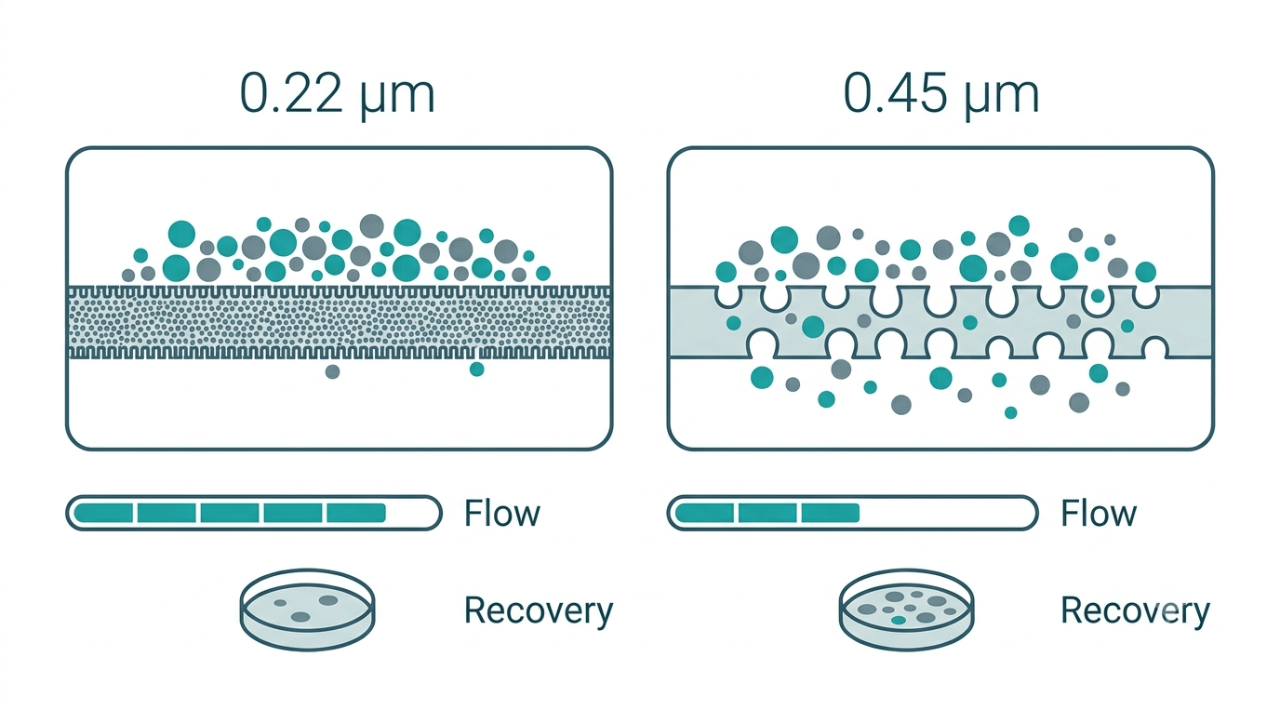
Smaller pores mean lower flow rates. When you’re processing multiple samples, that adds up. Filtering a large volume through a finer membrane is slower and can create bottlenecks in a busy lab.
Typical flow rates reported for one manufacturer’s mixed cellulose ester membranes:
| Pore size | Typical flow rate (seconds per 500 mL) |
|---|---|
| 0.22 µm | 40 to 60 |
| 0.45 µm | 25 to 50 |
Actual flow depends on membrane material, sample type, and vacuum, but the direction is consistent. 0.45 micron filters generally give better throughput without giving up retention or recovery.
Balancing Accuracy and Preservation of the Sample
Recovery depends on more than pore size. Species, cell condition, growth medium, membrane chemistry, and incubation conditions all play a part. That is why filter selection should aim for a representative, culturable count, not maximum capture.
In the study above, the lowest recoveries came from the extremes of the pore-size range, including 0.22 micron, while 0.45 micron performed consistently. That consistency is why it is the standard choice for preserving the right microbial population for an accurate count.
Efficiency for Routine, High-Volume Testing
For routine MLT and bioburden work, a sterilizing-grade filter is not needed. The 0.45 micron membrane is the long-established standard for microbial recovery and enumeration, so methods, suitability studies, and lab habits are already built around it. That makes it the practical choice for high-volume testing.
Regulatory Compliance: What USP <61> Says
USP <61> (Microbial Enumeration Tests) directs that membrane filtration use filters with a nominal pore size not greater than 0.45 µm. Equivalent harmonized chapters, including Ph. Eur. 2.6.12, ChP 1105, and JP 4.05, carry the same wording. USP <62> (Tests for Specified Microorganisms) is the companion chapter for detecting specific organisms. It draws on <61> for elements such as sample preparation.
Note that “not greater than 0.45 µm” is a ceiling, and 0.45 micron is the standard that labs and filter manufacturers converge on. Whatever you use, the method must be shown suitable for your product through growth promotion and method suitability testing. If you depart from 0.45 micron, validate on your own samples and media and compare against it.
Read More: Why Disinfectant Efficacy Testing Uses 10⁶ CFU/mL
When Might a Different Pore Size Make Sense?
Larger pore sizes are sometimes used for specific organisms, such as yeasts or fecal coliforms, or for samples that are hard to filter. They are generally less suited to total counts. A few microorganisms may call for 0.2 micron membranes. In every case, document retention and recovery for the target organisms.
Key Takeaways
- Bioburden testing counts organisms, so recovery matters more than maximum retention.
- 0.45 micron filters retain the relevant organisms and give consistent recovery.
- They offer better flow and throughput than 0.22 micron membranes.
- USP <61> specifies a nominal pore size not greater than 0.45 µm for membrane filtration.
Frequently Asked Questions
Can I use a 0.22 micron filter for bioburden testing?
USP <61> sets a maximum pore size, so a smaller pore is not excluded on paper. But 0.22 micron filters flow more slowly and showed lower average recovery in comparative testing, so 0.45 micron is the standard choice. If you use 0.22 micron, validate it for your product and compare it to 0.45 micron.
Does a 0.45 micron filter retain enough bacteria for accurate counts?
Yes. Studies show 0.45 micron membranes retain even the small challenge organism used for sterilizing-grade filter validation under typical conditions, and they recover organisms consistently across a wide range of systems.
What does USP <61> measure?
USP <61> covers microbial enumeration of non-sterile products. With membrane filtration, one membrane is placed on Soybean-Casein Digest Agar for total aerobic microbial count and another on Sabouraud Dextrose Agar for total yeast and mold count.
How do USP <61> and USP <62> differ?
USP <61> counts total microorganisms (bacteria, yeasts, and molds). USP <62> checks for the presence or absence of specified organisms.
If you have any testing requirements related to Pharmaceuticals, Medical Devices, Gases, Food, Water, or Air, feel free to reach out to Prewel Labs.