






















Why Disinfectant Efficacy Testing Uses 10⁶ CFU/mL
If you’ve ever read a disinfectant validation report and stopped on the number 10⁶ CFU/mL, you’re not alone. To someone outside the cleanroom and pharmaceutical world, testing a disinfectant against one million microbes per milliliter can look excessive almost theatrical. But in regulated environments, that number isn’t chosen for drama. It’s chosen because it’s the only way to actually prove a disinfectant works when it matters most.
This article breaks down where the 10⁶ CFU/mL benchmark comes from, why real-world contamination levels don’t need to be that high for the test to still make sense, what “log reduction” actually means, and what all of this adds up to for patient and product safety.
Where Does the 10⁶ CFU/mL Standard Come From?
The 10⁶ CFU/mL challenge load isn’t an arbitrary industry habit it’s a figure grounded in recognized testing frameworks, including USP <1072>, ASTM, EPA, and EN standards for disinfectant and antiseptic efficacy. These frameworks recommend high challenge inoculums precisely because they set a demanding bar for what counts as “effective.”
Disinfectant validation studies referencing USP <1072> commonly work with challenge loads in the range of 10⁶ to 10⁷ colony-forming units, testing standard strains such as Staphylococcus aureus and Escherichia coli under controlled use-dilution protocols. The logic is straightforward: a disinfectant that can be proven effective under a worst-case microbial load can be trusted under normal, far lower conditions.
Think of it like testing a parachute by jumping from a plane rather than off a couch. If it works under the toughest realistic conditions, you can trust it under everyday ones.
Read More: Growth Promotion Test (GPT) Inoculum Size: Why Is It Set Between 10–100 CFU?
Do Real Cleanroom Surfaces Actually Have a Million Microbes?
Usually not. Routine environmental monitoring in a well-controlled cleanroom rarely turns up anything close to 10⁶ CFU/mL of contamination. So why test at that level at all?
Because the goal of disinfectant efficacy testing isn’t to simulate a “typical” day it’s to establish a margin of safety. By challenging a disinfectant against 10⁶ CFU/mL, testers confirm it can handle contamination well beyond what’s expected, not just what’s average.
Consider what’s at stake in a pharmaceutical setting: if a disinfectant were only validated against a much smaller load say, 10³ CFU and an unexpected spike in bioburden occurred during, for example, vaccine preparation, there would be no data confirming the product could still perform. Testing against the higher benchmark closes that gap. It gives quality teams confidence that the disinfectant won’t fail exactly when it’s needed most.
What Does “Log Reduction” Actually Mean?
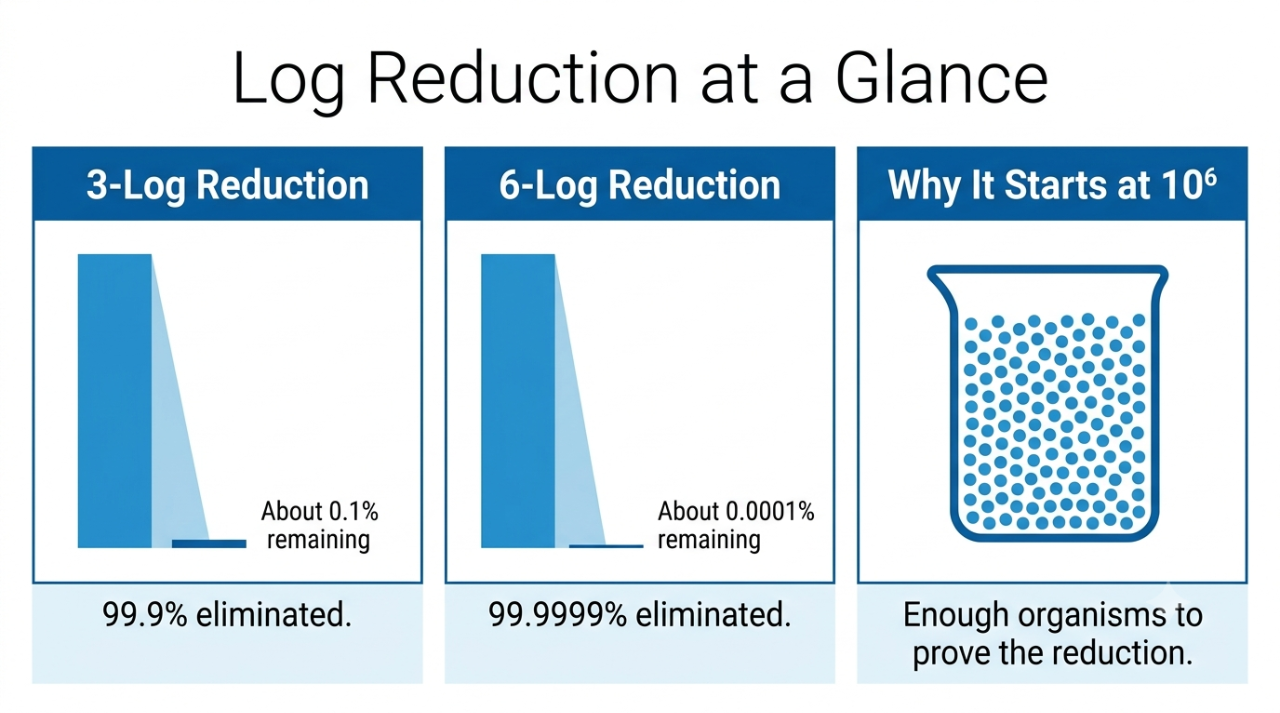
“Log reduction” is the language used to describe how much of the microbial population a disinfectant eliminates, expressed on a logarithmic (base-10) scale rather than a simple percentage. It sounds technical, but the underlying idea is simple once you break it down:
- A 3-log reduction means 99.9% of the microbial population has been eliminated typically the benchmark for vegetative bacteria.
- A 6-log reduction means 99.9999% has been eliminated the benchmark typically expected for more resistant organisms, such as bacterial spores.
Here’s the part that connects directly back to the 10⁶ CFU/mL question: you cannot demonstrate a 6-log reduction unless you start with at least 10⁶ organisms in the first place. If you begin with a small inoculum, there simply aren’t enough organisms present to mathematically demonstrate that level of kill.
It’s a bit like trying to prove you lost 6 kilograms you need to have started with at least 6 kilograms to lose. The starting challenge load and the reduction claim are directly tied together; one can’t be validated without the other.
What This Means for Real-World Safety
When a disinfectant is shown to eliminate a million microbes under controlled lab conditions, that result translates into a meaningful safety margin for the environments where it’s actually used. For pharmaceutical manufacturing, medical device production, and other regulated spaces, that margin is what stands between routine cleaning and a genuine contamination risk to drugs, devices, and ultimately patients.
This is why disinfectant efficacy testing at the 10⁶ CFU/mL level isn’t viewed as excessive within the industry it’s viewed as the baseline for a credible validation. A disinfectant that passes at this challenge load has demonstrated something real: that it performs reliably even under conditions well beyond what a cleanroom would normally see.
FAQ: Disinfectant Efficacy Testing and CFU/mL Standards
Why is 10⁶ CFU/mL specifically used instead of a lower number?
A 10⁶ CFU/mL challenge load allows testers to demonstrate higher log reductions (such as 6-log) with statistical validity. Lower starting loads don’t contain enough organisms to prove that level of kill, even if the disinfectant is fully effective.
Is 10⁶ CFU/mL contamination realistic for a cleanroom?
Not typically. Well-maintained cleanrooms usually show far lower bioburden. The high challenge load is a worst-case test condition, not a simulation of everyday contamination levels.
What’s the difference between a 3-log and 6-log reduction?
A 3-log reduction eliminates 99.9% of the microbial population and is generally the benchmark for vegetative bacteria. A 6-log reduction eliminates 99.9999% and is the benchmark typically expected for more resistant organisms like spores.
Which standards reference this type of testing?
Frameworks including USP <1072>, ASTM methods, EPA guidance, and EN standards inform disinfectant and antiseptic efficacy testing protocols, including recommended challenge organism concentrations.
Why does this matter for pharmaceutical manufacturing specifically?
Pharmaceutical and medical device environments require documented, reliable evidence that disinfection procedures work under worst-case conditions, since failures can directly affect product sterility and patient safety.
At Prewel Labs, we follow the gold standard for Disinfectant Efficacy Testing using 10⁶ CFU/mL to validate that your disinfectants don’t just pass, but excel.
Reach out to us for Pharma, Medical Device, Utility, Food, Air, Water, Environmental, and Soil testing.