

























Why Is Sterility Test Incubation 14 Days? (Not More, Not Less)
Sterility testing determines whether a batch of injectable medicine, biologic, or implantable device reaches patients — or gets held back. At the center of that test sits a number that rarely gets explained: 14 days. Not 10. Not 20. Exactly 14.
That number isn’t arbitrary. It comes from decades of microbiological data and is written into the world’s three major pharmacopoeial standards. Here’s the reasoning behind it, and why moving off that number in either direction creates real risk.
The 14-Day Rule Is Science, Not Guesswork
A single contaminated vial reaching a hospital can be fatal. That’s the stakes sterility testing exists to manage, and it’s why regulators worldwide converged on the same incubation window rather than leaving it to individual labs to decide.
Three major pharmacopoeias specify this requirement, and — notably — they’ve been harmonized with one another so the same test can satisfy all three regions at once:
- USP <71> — United States Pharmacopeia
- EP 2.6.1 — European Pharmacopoeia
- JP 4.06 — Japanese Pharmacopoeia
All three call for a minimum incubation period of 14 days, using the same two culture media and the same presence/absence approach to detecting contamination.
Think of it like baking a cake: pull it out too early and the center is still raw. Cut a sterility test short and hidden microbes may simply not have had time to show themselves yet.
Some Microbes Take Their Sweet Time
Not every organism grows at the same rate, and that variability is exactly why the 14-day window exists. Some contaminants need considerably longer than a few days to become detectable:
- Anaerobic bacteria (Clostridium sporogenes) — oxygen-averse, so they grow slowly under standard aerobic handling
- Mycobacteria (Mycobacterium spp.) — thick cell walls slow their replication rate
- Slow-metabolizing bacteria (Propionibacterium acnes) — can take a long time to produce visible turbidity
- Fungi (Aspergillus niger) — spores need time to germinate before growth becomes visible
It’s the same logic as planting seeds: some sprout almost overnight, others take weeks to break the surface. A test window built around the fastest growers would miss the slow ones entirely.
Dual-Temperature Incubation Gives Full Coverage
Sterility testing doesn’t rely on one culture medium at one temperature — it uses two, run in parallel, specifically to avoid blind spots:
- FTM (Fluid Thioglycollate Medium), incubated at 30–35°C — supports anaerobic and some aerobic bacteria
- SCDM/TSB (Soybean Casein Digest Medium / Tryptic Soy Broth), incubated at 20–25°C — supports fungi and aerobic bacteria
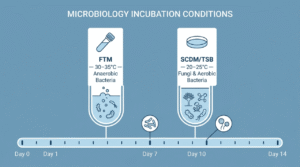
The comparison to food storage is a useful one: some items need refrigeration, others don’t, and using only one storage condition would spoil whatever needed the other. Skip either medium or temperature range in sterility testing, and a class of contaminants slips through undetected.
Read More: Growth Promotion Test (GPT) Inoculum Size: Why Is It Set Between 10–100 CFU?
Why Not Less Than 14 Days?
Shortening the incubation period doesn’t save time safely — it introduces blind spots:
- Slow-growing microbes may still be dormant and undetectable
- Fungal spores may not have finished germinating
- Anaerobic bacteria may not have had time to adapt and multiply
It’s the equivalent of stopping a marathon at mile 24 and calling it finished. The test looks complete, but the result isn’t reliable.
Why Not More Than 14 Days?
Extending incubation beyond 14 days doesn’t add meaningful protection — it adds cost and noise:
- False positives — longer exposure raises the odds of environmental contamination unrelated to the actual product
- No added benefit — data supporting the standard shows 14 days is sufficient to catch the organisms sterility testing is designed to detect
- Wasted resources — labs stay occupied longer than necessary, delaying release of unrelated batches
- Media breakdown — culture media degrade over extended incubation, which can undermine the reliability of the very result you’re waiting on
Fourteen days is the point where sensitivity and efficiency meet: long enough to catch what needs catching, short enough not to compromise the test itself.
FAQ
Why is the sterility test incubation period set at 14 days?
Because that’s the minimum time regulators have determined is needed for slow-growing organisms — including certain anaerobes, mycobacteria, and fungi — to produce detectable growth in culture media.
Which regulatory standards require 14-day sterility testing?
USP <71>, EP 2.6.1, and JP 4.06 all specify a minimum 14-day incubation period, and the three have been harmonized so results can satisfy all three regions.
What media are used in sterility testing, and at what temperatures?
Fluid Thioglycollate Medium (FTM) is incubated at 30–35°C to detect anaerobic and some aerobic organisms, while SCDM/TSB is incubated at 20–25°C to detect fungi and aerobic bacteria.
What happens if sterility test incubation is cut short?
Slow-growing contaminants — such as anaerobic bacteria, mycobacteria, and fungal spores — may not yet be detectable, risking a false “sterile” result on a contaminated batch.
Does incubating longer than 14 days improve accuracy?
No. Extending incubation mainly increases the risk of false positives from environmental contamination and can allow the culture media itself to degrade, without meaningfully improving detection.
