



















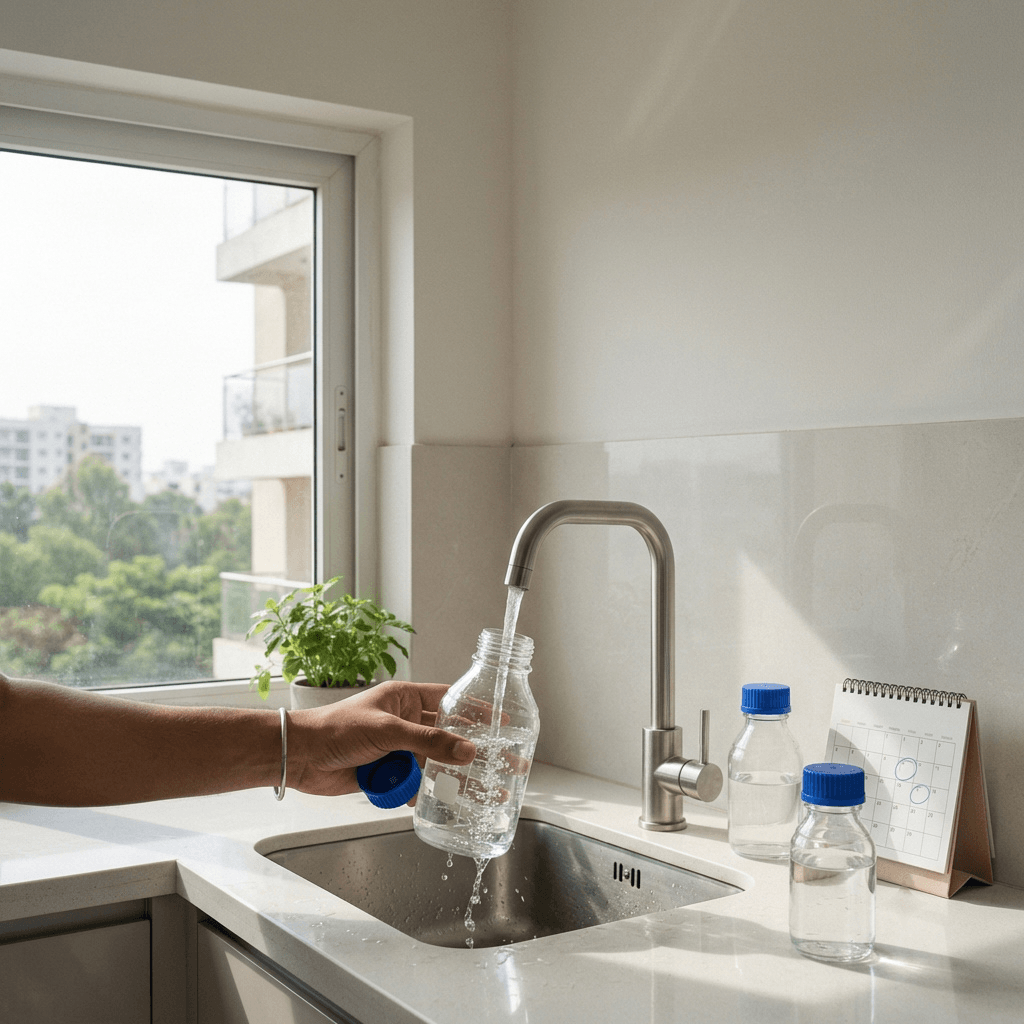
How Often Should Drinking Water Be Tested in Bangalore Homes and Apartments?
Last Updated on November 21, 2026
Most Bangalore families test their drinking water once: the week they move in, or the week someone falls ill. After that, the water keeps changing. Borewell levels drop in summer, the monsoon washes surface dirt into wells and sumps, tanker suppliers change, and the overhead tank goes another six months without a clean. A single good report from last year tells you very little about what’s coming out of the tap today.
So what’s the right drinking water testing frequency? For most Bangalore homes and apartments, test the water you drink for bacteria and residual chlorine every three months, run a full IS 10500 panel at least once a year (twice a year if you use a borewell or shared storage), and test straight away after any change such as a flood, plumbing work or a new tanker supplier. This guide explains where those numbers come from, how the schedule changes for borewells, tankers, RO plants and apartment complexes, what to test each time and where to take the samples.
Is There an Official Drinking Water Testing Frequency for Homes in India?
No. India’s drinking water standard, IS 10500:2012, tells you what safe water must contain, not how often a household should check it. No Indian rule sets a testing schedule for a private home or an apartment’s internal system, so the frequency is up to you, your resident welfare association or your facility manager.
The IS 10500:2012 drinking water specification from BIS sets the limits a lab compares your sample against: E. coli and total coliforms must not be detectable in any 100 mL sample, free residual chlorine should be at least 0.2 mg/L where water is chlorinated, and there are limits for TDS, hardness, nitrate, fluoride, iron and dozens of other parameters. Our guide to drinking water testing parameters under IS 10500 lists them in full.
Where official schedules do exist, they apply to water suppliers, not households. Three of them are useful benchmarks for a Bangalore home or apartment:
- Jal Jeevan Mission (rural piped water). The Ministry of Jal Shakti’s Concise Handbook for Monitoring Water Quality of Piped Drinking Water Supply to Rural Households asks for groundwater sources and storage tanks to be tested for chemical parameters at least twice a year, six months apart. Storage tanks before distribution also get bacteriological tests twice a year, and free residual chlorine is checked at least once a day where water is chlorinated. Villages test at least two household tap samples a month, one near the start of the network and one near the end. The handbook itself notes that the frequencies are suggestive and that each state decides its own.
- US EPA and CDC (private wells). Both say a private well should be tested at least once a year for total coliform bacteria, nitrates, total dissolved solids and pH. The EPA’s private well guidance adds that you may want to test more often if small children, elderly adults or someone pregnant or nursing lives in the house. A Bangalore borewell is effectively a private well, so this is a fair minimum.
- FSSAI (food businesses). Schedule 4 of the Food Safety and Standards (Licensing and Registration of Food Businesses) Regulations, 2011 says water used in food manufacturing must be potable and, if required, examined chemically and bacteriologically “at regular intervals” at a recognised laboratory. It doesn’t fix a number, which is why kitchens, PGs and canteens usually set a monthly or quarterly schedule with their lab.
Put together, the message is clear. Official programmes test the source and storage about twice a year, test what people actually drink far more often, and treat chlorine as a daily check. A household can’t match a water utility, but it can follow the same logic at a smaller scale.
Recommended Drinking Water Testing Frequency for Bangalore Homes and Apartments
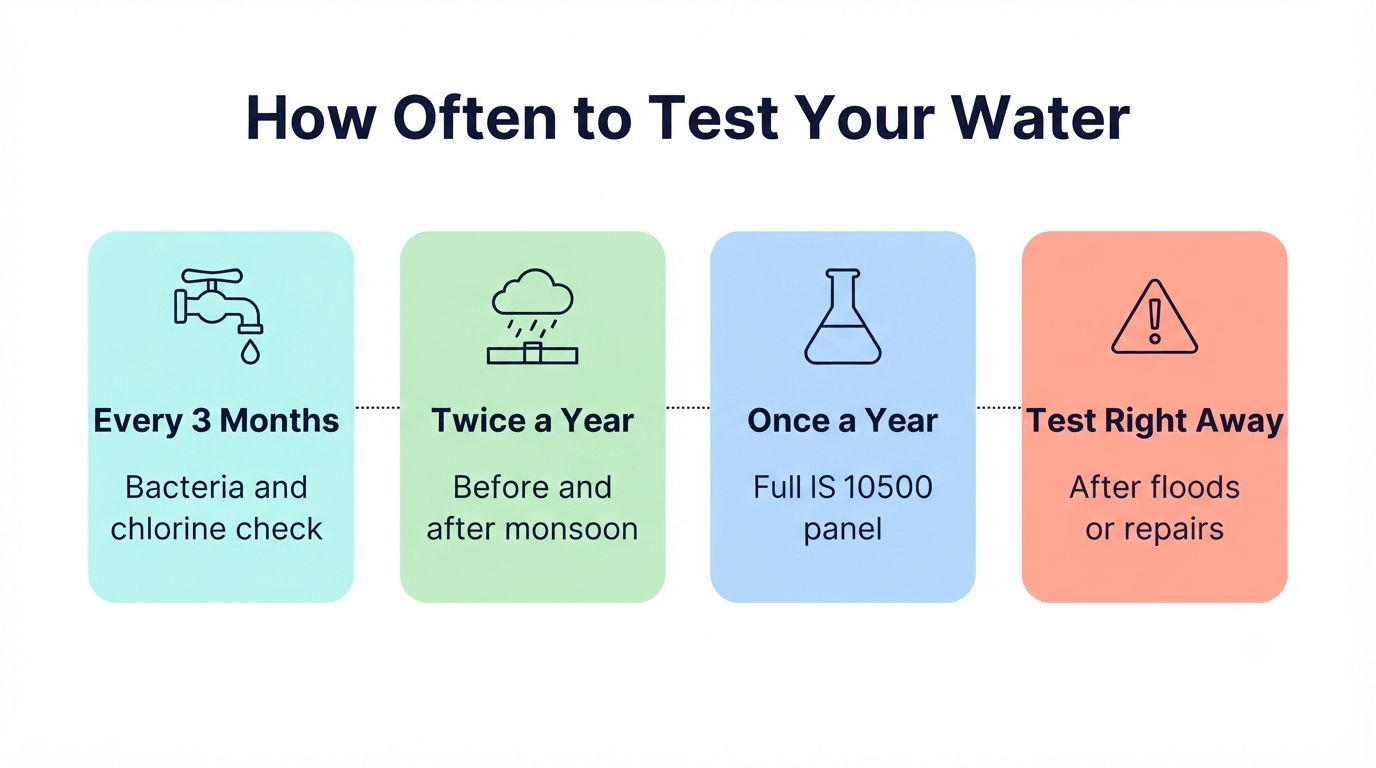
The right schedule depends on where your water comes from and how long it sits before you drink it. Prewel Labs recommends testing drinking water every three months, and testing a common RO plant every month or after any maintenance. The table below applies that to the setups most common in Bangalore.
| Your water setup | Full IS 10500 panel | Routine check (bacteria, residual chlorine, turbidity, TDS) | Also test |
|---|---|---|---|
| Independent house on BWSSB Cauvery supply only | Once a year | Every 3 months, at the kitchen tap | After sump or tank cleaning, plumbing work, or any change in taste or smell |
| House with its own borewell | Before first use, then at least once a year | Every 3 months; nitrate and TDS before and after the monsoon | After flooding, pump or casing repair, or drainage work nearby |
| Home or apartment that relies on tankers | When you start with a new supplier | Every month while tankers are your main source | Whenever the supplier, the source or the water’s look changes |
| Apartment with mixed sources and shared sumps and overhead tanks | Twice a year, before and after the monsoon | Every 1 to 3 months at several flats; residual chlorine daily if you chlorinate | After tank cleaning, pipe repairs, a source change or resident complaints |
| Common RO plant in an apartment | Once a year on the treated water | Every month, comparing raw and treated water | After membrane, filter or UV lamp replacement |
| Home RO or UV purifier | With the source water test | Every 3 months, before and after the purifier | After each service or filter change |
| PG, hostel, school, clinic or food business | Twice a year, or as your licence requires | Every month | After any illness among residents or customers |
Two things drive the shorter intervals. Bacteria can appear and disappear within days, so a microbiology result is only a snapshot. Minerals such as fluoride, hardness and TDS come from the rock and change slowly, so once or twice a year is enough to catch a trend. That’s why the routine check is frequent and cheap, and the full panel is occasional and thorough.
Why apartments should test more often than houses
An apartment’s water passes through more places where it can pick up contamination: a sump, pumps, an overhead tank and long internal pipe runs, often fed by a mix of Cauvery water, borewells and tankers. One cracked sump wall near a drain line can affect hundreds of flats. Testing at more than one point, more often, is the only way to know which part of the system is the problem. Our guide on why apartments in Bangalore need regular water testing covers the common failure points in more detail.
Why a borewell needs a pre and post monsoon test
Rain recharges shallow groundwater, and it can carry sewage and surface runoff down with it. Nitrate and coliform results taken in May can look very different from results taken in October. Testing once before the monsoon and once after it, about six months apart, mirrors the twice yearly interval the Jal Jeevan Mission uses for groundwater sources. If you’re on a borewell, our guide to borewell water testing in Bangalore explains which parameters matter most for Bangalore’s geology.
Why Bangalore Water Needs Testing More Often Than Once a Year
Because the water reaching most Bangalore taps changes through the year, and the biggest risks come from storage and distribution inside your own building, not from the treatment plant.
A few things make the city different from a place with a single, continuous, treated supply:
- Mixed sources. Many buildings blend Cauvery water, borewell water and tanker water in the same sump. When the mix changes in summer, the water quality changes with it.
- Intermittent supply and long storage. Water that sits in a sump and an overhead tank for a day or two loses its residual chlorine. Once the chlorine is gone, nothing stops bacteria that get in through a loose lid or a cracked wall.
- Underground sumps near drains. A sump that sits close to a sewer line or a soak pit can take in contaminated water when the ground is saturated, which is exactly what happens during heavy rain.
- Outbreak history. Bangalore has seen more than 300 residents of one apartment building fall ill from contaminated water, and cholera cases have put the city’s paying guest accommodation on high alert. Shared buildings with shared tanks are where a single fault reaches the most people.
The BWSSB tests the water it supplies, and it responds to complaints about that supply (Citizen Matters explains how to ask for a check). What it can’t do is check your sump, your overhead tank or your internal pipes. That part of the journey is your responsibility, and it’s where most problems start.
When Should You Test Drinking Water Straight Away?
Whatever your routine schedule, test again as soon as something changes. Both the CDC’s guidelines for testing well water and the EPA list similar triggers, and a few more apply to Bangalore apartments.
- The water’s taste, colour or smell changes, or it turns cloudy.
- Flooding or waterlogging around your borewell, sump or building.
- Any repair or replacement of the borewell pump, casing, pipes, sump or overhead tank.
- You switch to a new tanker supplier, or start using a borewell you’d stopped using.
- Drainage, sewer or construction work starts near your building.
- Someone in the home becomes pregnant, a baby joins the household, or an elderly or immune compromised person moves in.
- Residents or family members get repeated stomach upsets, diarrhoea or jaundice.
- Your society or the city reports a water problem in your area.
After a failed result and a fix such as tank cleaning or chlorination, test again to confirm the fix worked. A clean retest is the only evidence that the problem has actually gone.
What Should You Test Each Time?
You don’t need the full panel every quarter. Split your testing into a frequent routine check for the things that change quickly, and an occasional full panel for everything else.
| Test tier | Parameters | How often | What it tells you |
|---|---|---|---|
| Quick check | Free residual chlorine, turbidity, TDS | Daily or weekly with a field kit, if your society chlorinates | Whether disinfection is lasting through storage, and whether anything has changed suddenly |
| Routine lab test | Total coliforms, E. coli, pH, TDS, turbidity, residual chlorine | Every 1 to 3 months | Whether the water is safe from bacterial contamination right now |
| Full IS 10500 panel | Physical, chemical and microbiological parameters, including hardness, nitrate, fluoride, iron, chloride and sulphate | Once or twice a year | Whether the source meets the standard, and how the minerals are trending |
| Targeted extras | Heavy metals such as lead and arsenic, pesticides, other contaminants | Once, then repeat if there’s a reason | Whether a specific local risk, such as old pipes or nearby industry, is affecting your water |
Microbiology belongs in every lab round. E. coli is the indicator that sewage has reached the water, and you can’t see, smell or taste it. Our explainer on how E. coli is detected in drinking water walks through the lab methods and what a positive result means.
A note on home TDS meters: they’re handy for spotting a sudden change, but they say nothing about bacteria. A TDS reading of 80 mg/L can still come with E. coli. Treat the meter as an early warning, not as a test.
Where Should You Take the Samples?
Test the water people actually drink, plus enough points upstream to find where a problem starts. For a house, the kitchen tap and the purifier outlet are usually enough. For an apartment, sample at several points in the system.
- Each source: the borewell outlet before the sump, and the BWSSB inlet.
- The sump outlet, to see what storage does to the water.
- The overhead tank outlet, before distribution.
- A flat near the start of the line and a flat at the far end. The Jal Jeevan Mission handbook uses the same idea for villages: one tap among the first households on the network and one among the last. Water that has travelled furthest has had the most time to lose its chlorine.
- The common RO plant, before and after treatment, if you have one.
Rotate the flats you sample from each round, and add any flat that has complained. A few practical sampling points make the difference between a useful result and a misleading one:
- Use a clean, sterilised bottle from the lab, and don’t touch the inside of the bottle or cap.
- Let the tap run for 2 to 3 minutes before you fill the bottle, unless you’re specifically testing water that has been standing in the pipes.
- Get microbiology samples to the lab within about 6 hours, kept cool. Chemical samples can usually wait up to 24 hours, depending on the parameter.
- Label each bottle with the exact point, the date and the time, and keep the same points from round to round so you can compare results.
- Sample on a normal supply day, not just after a tank cleaning, or you’ll get a better picture than residents actually live with.
What Should You Do if a Test Fails?
Act on a failed microbiology result the same day. Stop using the affected water for drinking and cooking, switch to a safe alternative such as boiled water, find the source of the contamination, fix it and retest.
- E. coli or coliforms detected: check the sump and tank lids, cracks and nearby drain lines. Clean and disinfect the tanks, chlorinate, flush the pipes and retest from the same points. If only one flat fails, look at that flat’s tank connection and internal plumbing.
- Low or zero residual chlorine: the water is sitting too long or the chlorine dose isn’t enough for the dirt in the system. Review storage times and chlorination with your plumber or water treatment vendor.
- Nitrate above the IS 10500 limit of 45 mg/L: usually a sign of sewage or fertiliser reaching groundwater. Check what’s near the borewell, and don’t give this water to infants.
- High TDS, hardness or fluoride: these come from the rock and won’t go away with tank cleaning. You’ll need treatment matched to the level, such as RO for TDS or a system rated for fluoride, or a different source.
After any failure, shorten the interval for the next few rounds. Monthly tests for three months will show whether the fix has held, and then you can drop back to your normal schedule.
How Prewel Labs Can Help You Set a Water Testing Schedule
Prewel Labs tests drinking water, borewell water, tanker water and RO water in Bangalore against IS 10500, with physical, chemical and microbiological panels. We can help you work out a sensible schedule for your home or society: which points to sample, which parameters to run each round, and when to step up testing after a failed result. Our team can collect samples from your location, and reports are sent as PDFs.
For apartments, PGs, schools and food businesses that test regularly, we offer monthly, quarterly and custom testing packages, which usually work out cheaper per test than booking one-off tests each time. You can see the published price ranges and what each panel covers on our water testing lab page, and our guide to water testing costs in Bangalore explains what changes the price.
Prewel Labs is NABL accredited (National Accreditation Board for Testing and Calibration Laboratories) and ISO 9001 certified, so you get reports you can share with residents, your association or a regulator. If you’d like help setting up a schedule or booking your next test, send us your details below and we’ll get back to you.
Frequently Asked Questions
Is testing drinking water once a year enough?
Once a year is the minimum for a full chemical panel, and it’s what the EPA and CDC suggest for private wells. It isn’t enough for bacteria in a Bangalore building with sumps and overhead tanks, because contamination can come and go between tests. Add a microbiology and residual chlorine check every three months at the tap you drink from.
How often should an apartment test its water in Bangalore?
Plan for a full IS 10500 panel twice a year, before and after the monsoon, and a routine bacteria and chlorine check every one to three months at several flats. If the society chlorinates, check residual chlorine daily or weekly with a field kit. Test a common RO plant every month.
Do I still need to test if I have an RO purifier?
Yes. A purifier only works while its membrane, filters and UV lamp are in good condition, and a neglected unit can grow bacteria of its own. Test the water before and after the purifier every three months or after each service, so you know both what’s coming in and whether the unit is removing it.
Does the BWSSB test water inside my apartment?
The BWSSB tests the Cauvery water it supplies and looks into complaints about that supply. Water inside your building, in the sump, overhead tank and internal pipes, is generally the responsibility of the owner or the association. That’s why testing at the tap matters even when your only source is BWSSB.
When is the best time of year to test borewell water?
Test twice: once before the monsoon, around April or May, and once after it, around October or November. The pre monsoon sample shows the water after the dry months, and the post monsoon sample shows whether rain has carried surface contamination into the well. Our post on water testing during the monsoon explains why the rainy season is the riskiest time.
Make Water Testing a Routine, Not a Reaction
The households and societies that avoid water scares aren’t the ones with the most expensive purifiers. They’re the ones who know what their water looked like last quarter, so they notice when it changes. Pick a schedule that fits your setup, put the dates in the society calendar alongside tank cleaning, and keep every report in one folder. A year from now you’ll have something far more useful than a single test: a record that shows your water is safe, and the early warning if it stops being so.
This article is general information about drinking water testing. It doesn’t replace medical advice, regulatory requirements that apply to your business, or guidance specific to your building’s water system.