























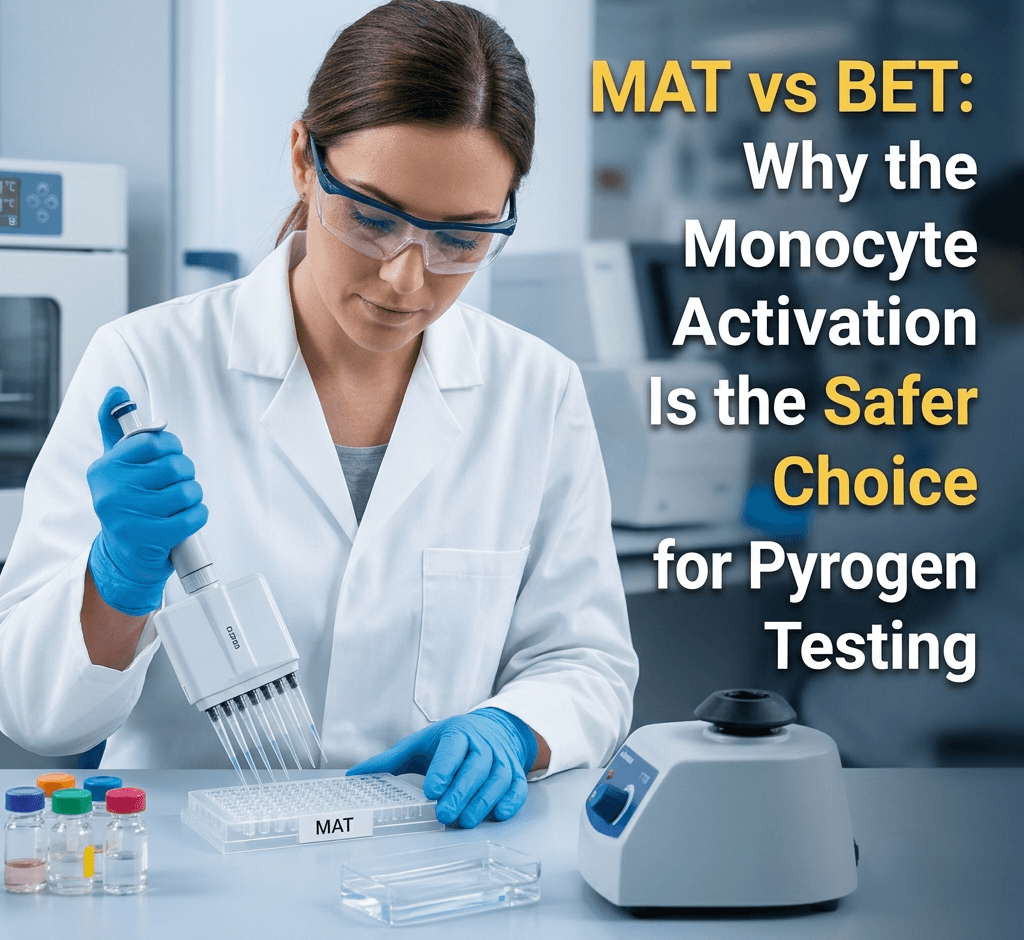
MAT vs BET: Why the Monocyte Activation Test Is the Safer Choice for Pyrogen Testing
If the Bacterial Endotoxin Test (BET) can detect endotoxins at concentrations as low as 0.005 EU/mL, why are regulators and pharma companies moving toward the Monocyte Activation Test (MAT) instead? Isn’t a more sensitive test always the better test?
Not quite. In pyrogen testing, sensitivity and safety aren’t the same thing. A test can be extremely good at spotting one type of threat and still miss others completely. That’s the exact gap between MAT and BET, and it’s why this comparison matters for anyone responsible for the safety of injectable drugs, biologics, or medical devices.
The Smoke Alarm Problem: A Simple Way to Understand BET’s Limitation
Think of a smoke alarm that’s extremely sensitive; it goes off the moment your toast burns. That sensitivity is great for smoke. But if there’s a gas leak in the house, that same alarm stays completely silent, because it was never designed to detect gas in the first place.
BET works the same way. It is exceptionally good at detecting endotoxins, which are components of the outer membrane of gram-negative bacteria. This sensitivity is the reason BET has been an industry standard in quality control labs for decades.
But endotoxins are not the only substances that can trigger a fever response in patients. And this is where BET’s blind spot becomes a patient safety issue.
What BET Can’t See: Non-Endotoxin Pyrogens
Non-endotoxin pyrogens (NEPs) are fever-inducing contaminants that don’t come from gram-negative bacteria. They can originate from gram-positive bacteria, fungi, viruses, and other microbial components. Because BET (based on Limulus Amebocyte Lysate, or LAL) is built specifically to react to endotoxin, it simply cannot detect these substances, regardless of how sensitive its detection threshold is.
A product can pass BET with a clean result and still contain pyrogenic contamination capable of causing a febrile reaction in a patient. That’s not a hypothetical scenario; it’s a well-documented reason regulatory bodies have pushed for testing methods that cover the full spectrum of pyrogens, not just one class of them.

How MAT Closes the Gap
The Monocyte Activation Test (MAT) takes a fundamentally different approach. Instead of using a single reagent tuned to detect endotoxin, MAT uses human monocytes, the same immune cells responsible for triggering fever in the human body.
When monocytes encounter a pyrogenic substance, they release cytokines such as IL-1β, TNF-α, and IL-6. These are the very same inflammatory mediators that drive fever in humans. MAT measures the release of these cytokines directly, which means it captures the immune system’s actual response to a contaminant, rather than relying on a proxy reaction to one specific type of molecule.
Because of this mechanism, MAT can detect both:
- Endotoxins (the same contaminants BET is built to find), and
- Non-endotoxin pyrogens (the contaminants BET cannot see at all)
In short, MAT doesn’t just test for the presence of one hazard. It replicates how the human body itself would react to a contaminated product.
MAT vs BET: A Side-by-Side Comparison
| Factor | BET (Bacterial Endotoxin Test) | MAT (Monocyte Activation Test) |
|---|---|---|
| Detects endotoxins | Yes, with very high sensitivity | Yes |
| Detects non-endotoxin pyrogens | No | Yes |
| Biological basis | LAL reagent reaction to endotoxin | Human monocyte cytokine response (IL-1β, TNF-α, IL-6) |
| Reflects human fever response | Indirectly, via endotoxin proxy | Directly, via the same immune pathway |
| Regulatory direction (Europe) | Being supplemented/replaced for full pyrogen coverage | Recommended by EDQM as part of the Ph. Eur. transition away from animal testing |
Read More: Medical Device Testing: Ensure Patient Safety
What Regulators Are Saying
This isn’t just an industry talking point. The European Directorate for the Quality of Medicines & HealthCare (EDQM) has been actively phasing out the Rabbit Pyrogen Test (RPT) from the European Pharmacopoeia, with references to the RPT removed from Ph. Eur. texts and the dedicated RPT chapter set for suppression. In place of a single mandated replacement, the Ph. Eur. introduced a new general chapter on pyrogenicity that asks manufacturers to select the most appropriate testing strategy based on a scientific, risk-based justification.
Within that shift, MAT has emerged as the leading alternative precisely because it is the only method among the three (RPT, BET, and MAT) that can detect both endotoxin and non-endotoxin pyrogens in a single in vitro assay, without relying on animal testing.
Why “More Sensitive” Doesn’t Automatically Mean “Safer”
It’s tempting to equate a lower detection limit with a better test. BET’s ability to detect endotoxin at extremely low concentrations is genuinely impressive, and it remains a valuable tool for endotoxin-specific quality control. But sensitivity only matters within the scope of what a test is designed to find.
If a test is blind to an entire category of fever-causing contaminants, no amount of precision within its narrow scope closes that gap. This is the core distinction: BET optimizes for detecting one hazard with high precision, while MAT optimizes for detecting the range of hazards relevant to actual patient safety.
Choosing the Right Test for Your Product
Deciding between MAT and BET (or using both, depending on the product) isn’t a one-size-fits-all decision. It depends on factors like:
- The product type (parenteral drug, biologic, vaccine, or medical device)
- Known or suspected contamination risks specific to the manufacturing process
- Applicable regulatory requirements in the markets where the product will be sold
- Whether the product has a history of low endotoxin recovery or non-endotoxin contamination concerns
A risk-based assessment, rather than a blanket switch from one method to another, is what regulators like the EDQM are actually recommending.
The Bottom Line
BET earned its place in pharmaceutical quality control because it’s a highly sensitive, reliable way to detect endotoxin. But sensitivity to one class of pyrogens was never the same as complete protection against all of them. MAT closes that gap by measuring the same cytokine response, IL-1β, TNF-α, and IL-6, that drives fever in the human body, giving it visibility into both endotoxin and non-endotoxin pyrogens.
The question worth asking isn’t “which test is more sensitive?” It’s “does this method truly protect the patient?” That’s the standard MAT is built around, and it’s a large part of why regulatory momentum in Europe continues to shift in its direction.
Read More: Understanding ISO 13485: Ensuring Quality in Medical Device Testing
Need Help Deciding Between MAT and BET for Your Product?
Choosing the right pyrogen testing strategy depends on your specific product, manufacturing process, and regulatory pathway. If your organization needs testing services related to MAT or BET, fill out the contact form on prewellabs.com and the team will help guide you toward the right solution for your products.
Frequently Asked Questions
What is the main difference between MAT and BET?
BET detects only endotoxins using a reaction with Limulus Amebocyte Lysate (LAL). MAT uses human monocytes to detect both endotoxins and non-endotoxin pyrogens by measuring the release of cytokines such as IL-1β, TNF-α, and IL-6.
Can a product pass BET and still contain harmful pyrogens?
Yes. Because BET is designed specifically to detect endotoxin, it cannot identify non-endotoxin pyrogens, which can also cause fever and adverse reactions in patients.
Is MAT replacing BET entirely?
Not necessarily. MAT is primarily replacing the Rabbit Pyrogen Test (RPT) in the European Pharmacopoeia’s pyrogenicity testing framework. BET remains a valuable, highly sensitive tool for endotoxin detection specifically. Many manufacturers use a risk-based approach to determine whether MAT, BET, or a combination best fits their product.
Why did the EDQM move away from the Rabbit Pyrogen Test?
The EDQM’s shift away from the RPT was driven by both ethical considerations around animal testing and the scientific advantages of in vitro alternatives like MAT, which more closely reflect the human fever response.