
























Why Brevundimonas diminuta Is Used for Microbial Ingress Testing (CCIT)
You’ve filled a life-saving injectable into a sterile vial. The cap is on. It looks sealed.
But can you be 100% sure that no microbe can sneak in through a crack too small to see?
That question is the whole reason Container Closure Integrity Testing (CCIT) exists. And when the method you pick is a microbial ingress test, one organism shows up again and again: Brevundimonas diminuta. Not E. coli. Not Staphylococcus aureus. This one.
Here’s why.
What is microbial ingress testing?
Microbial ingress testing checks whether microorganisms can get into a sterile container through microscopic leaks.
Think of testing whether rainwater can get into a tent. You don’t just look at the fabric and hope. You put it in the rain and see what happens. In the lab version, the sterile product container is filled with growth medium, then immersed in a culture of the challenge organism. Pressure and vacuum are typically applied during the immersion. Afterward the containers are incubated and checked for turbidity. If the medium turns cloudy, something got in.
Why bother? Because if microbes get in, product quality is at risk, and so is the patient.
Why Brevundimonas diminuta?
1. It’s very small
When grown under carefully controlled conditions, B. diminuta cells can be as small as about 0.3 microns. That’s far smaller than most bacteria you’d worry about.
The logic is simple. If the smallest challenge organism can’t get through a seal, bigger ones won’t either. It’s like testing a house’s security with a mouse. If a mouse can’t get in, a cat or a dog won’t.
One practical note: cell size isn’t fixed. Published work shows B. diminuta gets smaller as its growth rate goes up, so how you culture it matters. That’s also why the organism is a long-standing standard for validating sterilizing-grade 0.2 micron membrane filters.
2. It swims toward leaks
B. diminuta is motile. It propels itself with a single polar flagellum. A bacterium that can move on its own is a tougher, more realistic test than one that just sits in the broth waiting to be carried in.
3. It’s safe to handle in the lab
It’s a Gram-negative environmental organism that is generally treated as low risk. To be accurate, rare opportunistic infections have been reported, mostly in immunocompromised or critically ill patients, so normal lab biosafety still applies. But it’s a far more comfortable choice than handling a pathogen like E. coli or P. aeruginosa at the high concentrations a challenge test needs.
4. Industry and standards bodies use it
B. diminuta (ATCC 19146 is the usual strain) appears across CCIT practice. PDA Technical Report 27 recommends evaluating container closure integrity with both a physical and a microbial test. USP <1207> covers package integrity evaluation for sterile products and, worth knowing, leans toward deterministic leak test methods where they’re available, since microbial tests are probabilistic. The revised EU GMP Annex 1 puts extra emphasis on container closure integrity as part of contamination control.
Service labs describe the choice the same way: B. diminuta represents a most severe bacterial challenge because of its small size.
Read More: Pathogen Testing in Purified Water: Why Pharma Tests Beyond USP, EP and JP
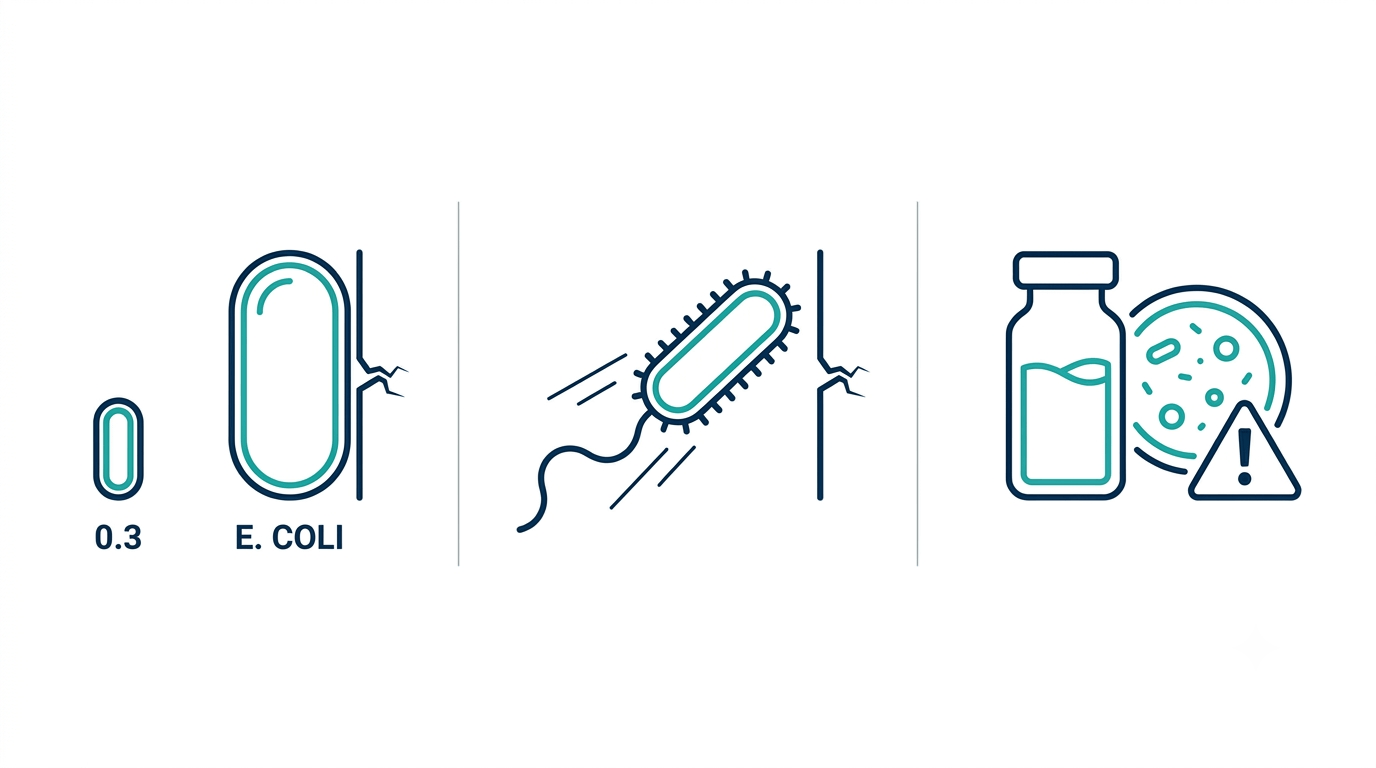
So why not E. coli or Staphylococcus aureus?
Let’s go through the usual suspects.
| Organism | Why it isn’t the first pick |
|---|---|
| E. coli | Larger (around 1 micron) and a pathogen, so less comfortable to handle in volume |
| Pseudomonas aeruginosa | Opportunistic pathogen, risky to handle |
| Bacillus subtilis | Spore-forming and larger, so it behaves differently |
| Staphylococcus aureus | Gram-positive and not a typical ingress challenge organism |
A fair caveat, though. B. diminuta isn’t the only organism ever used. The Japanese Pharmacopoeia chapter on package integrity for sterile products, for example, lists several options, including E. coli, Serratia marcescens, Pseudomonas aeruginosa, Staphylococcus epidermidis and B. diminuta, and says to choose based on risk. Patents and test labs also mention E. coli and S. marcescens alongside B. diminuta. So the real answer isn’t “the others are wrong.” It’s that for a worst-case, small-cell, motile, lab-safe challenge, B. diminuta is the easiest to defend.
A practical tip for your test design
B. diminuta is aerobic. When you fill test containers with medium, labs recommend leaving an air headspace of at least 50% of the container volume where possible, so the organism has oxygen if it gets in. Run positive controls (containers with a known defect) and negative controls alongside your test samples, so a “no growth” result actually means something.
Frequently asked questions
What is Brevundimonas diminuta used for in pharma?
It’s used as a challenge organism in microbial ingress testing for container closure integrity, and as the standard test organism for validating sterilizing-grade 0.2 micron membrane filters.
How small is Brevundimonas diminuta?
Under carefully controlled growth conditions it can be about 0.3 microns, though cell size changes with culture conditions such as growth rate.
Is Brevundimonas diminuta dangerous?
It’s generally handled as a low-risk organism, but rare opportunistic infections have been reported in immunocompromised and critically ill people. Standard laboratory biosafety practice still applies.
Is microbial ingress testing the only way to do CCIT?
No. Physical and deterministic leak test methods exist too. PDA TR 27 recommends using both physical and microbial tests, and USP <1207> favors deterministic methods where they’re suitable.
Over to you
Have you used B. diminuta in your own ingress tests? What challenges did you run into? Share them in the comments on the original post.