























Growth Promotion Test Inoculum and Plate Size: Why 75 CFU Doesn’t Fit Every Plate
During a microbiology audit, an auditor asked a deceptively simple question:
“Why did you use the same inoculum (75 CFU) on both your 90mm and 55mm plates?”
The team’s answer was an honest one: “Well… that’s what we’ve always done.”
And that is exactly the problem. Doing something the same way for years doesn’t make it scientifically sound. When it comes to growth promotion test (GPT) inoculum and plate size, the two are linked, and ignoring that link can quietly undermine your media validation.
This article explains why plate size matters, what can go wrong, and how to adjust your inoculum so your GPT results hold up, both in the lab and in front of an auditor.
What Is a Growth Promotion Test, and Why Does Inoculum Matter?
A growth promotion test (GPT) confirms that a batch of culture media can actually support the growth of the microorganisms it is meant to recover. You inoculate the medium with a small, controlled number of viable organisms and check that growth is acceptable.
The “small, controlled number” is the key phrase. Pharmacopoeial requirements, including USP <61> and <62> and the European Pharmacopoeia, specify an inoculum of not more than 100 CFU. The inoculum has to be low enough for colonies to be counted and compared reliably, and that depends on how much room those colonies have to grow.
Plate Surface Area: 90mm vs 55mm
Here is the part that is easy to overlook. A plate’s diameter determines how much agar surface is available for colonies:
| Plate size | Approximate surface area |
|---|---|
| 90mm plate | ~63.6 cm² |
| 55mm plate | ~23.8 cm² |
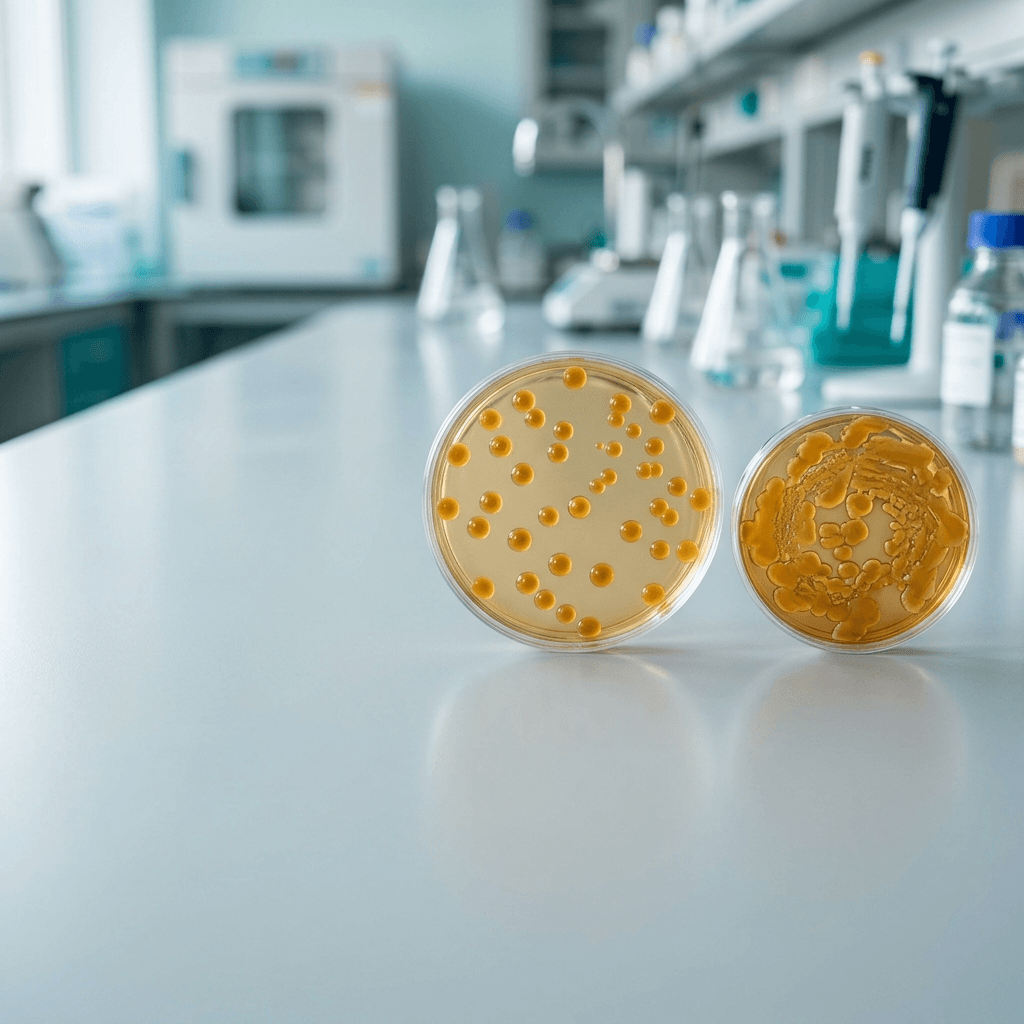
A 55mm plate offers almost 3x less space than a 90mm plate. Putting the same number of CFUs on both means the smaller plate is far more crowded.
A Simple Analogy: Two Flower Pots
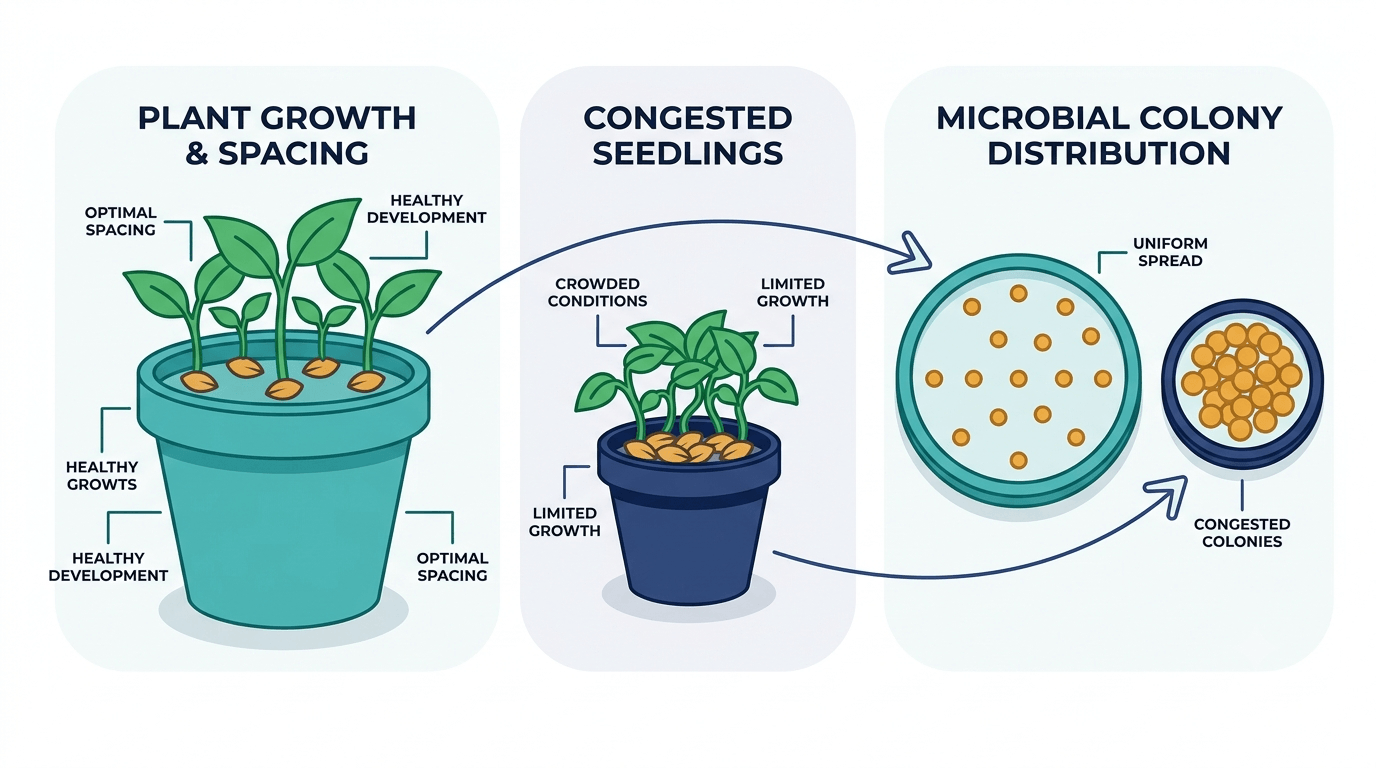
Picture two flower pots, one big and wide, the other small and compact. Would you sow the same number of seeds in both?
Of course not. Too many seeds in the small pot will fight for space, water, and sunlight. Some won’t grow well, and some might not grow at all. In the large pot, the same seeds have enough room to breathe and bloom.
Agar plates work the same way.
Read More: Growth Promotion Test (GPT) Inoculum Size: Why Is It Set Between 10–100 CFU?
What Happens When You Overload a Smaller Plate
Drop 75 CFU on a 90mm plate and the colonies spread out nicely. Put 75 CFU on a 55mm plate and you create a microbial traffic jam. Colonies begin to overlap, compete for nutrients, and interfere with each other’s growth.
This overcrowding can lead to:
- Inhibited recovery due to competition for nutrients and space
- Inconsistent visibility and differentiation between colonies
- In some cases, even false-negative results in GPT
That is where audit red flags start to appear.
What the Pharmacopoeias Say About Inoculum Limits
USP <61> and <62>, along with the European Pharmacopoeia, require GPT inoculation with not more than 100 CFU. That ceiling is a limit, not a license to use the same number on every plate format.
If you are working with smaller plates, you should adjust the CFU proportionally to the plate size.
A worked example
Using the plate areas above, scaling the 75 CFU used on a 90mm plate to a 55mm plate gives:
75 CFU × (23.8 cm² ÷ 63.6 cm²) ≈ 28 CFU
This calculation is an illustration of the proportional principle. Your own SOP should define the actual target inoculum for each plate size, supported by your validation data.
The Compliance Risk of “We’ve Always Done It This Way”
Skipping this adjustment carries real consequences:
- You risk inaccurate GPT results
- You compromise your media validation
- You invite avoidable audit observations
Microbiologists often repeat this mistake without realizing it, because the practice was inherited from an older SOP and never questioned. Adjusting inoculum to plate size for every GPT removes the problem at the source.
Frequently Asked Questions
Can I use the same inoculum on 90mm and 55mm plates for GPT?
It is not advisable. A 55mm plate has almost three times less surface area than a 90mm plate, so the same CFU count leads to overcrowding, overlapping colonies, and unreliable recovery.
What is the maximum inoculum allowed for a growth promotion test?
USP <61> and <62> and the European Pharmacopoeia call for not more than 100 CFU. That is an upper limit, and smaller plates call for a proportionally lower inoculum.
How do I adjust the CFU for a smaller plate?
Scale the inoculum in proportion to the plate’s surface area. For example, comparing a 63.6 cm² plate (90mm) with a 23.8 cm² plate (55mm), the smaller plate needs roughly 37% of the inoculum used on the larger one.
What problems does overcrowding cause in GPT?
Overcrowding can inhibit recovery, make colonies harder to see and differentiate, and in some cases cause false-negative GPT results.
Why does this matter for audits?
An unjustified, unadjusted inoculum on smaller plates can weaken your media validation and draw audit observations, as the auditor’s question at the start of this article shows.
Final Thoughts
Matching inoculum to plate size is simple science and smart compliance, and it keeps auditors happy.
If your lab still applies one inoculum across every plate format, it is worth reviewing your GPT procedure today.
We have seen microbiologists unknowingly repeat this mistake, which is why we always recommend adjusting inoculum based on plate size for every GPT.