






















Gas Chromatography in Pharma and Medical Device Testing
Last Updated on October 19, 2026
Every medicine and every device that touches a patient has to be clean, and “clean” is not something you can judge by eye. A trace of leftover solvent in a tablet or a sterilization residue on a catheter can sit well below anything visible and still matter. Gas chromatography (GC) is one of the main tools labs use to find those traces. It separates a sample into its individual volatile components, so each one can be identified and measured.
This guide covers how GC works, where it fits in pharmaceutical and medical device testing, and where it runs into limits. If you work in quality, regulatory or R&D, it should help you decide when GC is the right method and what to ask your testing lab.
What Is Gas Chromatography and How Does It Work?
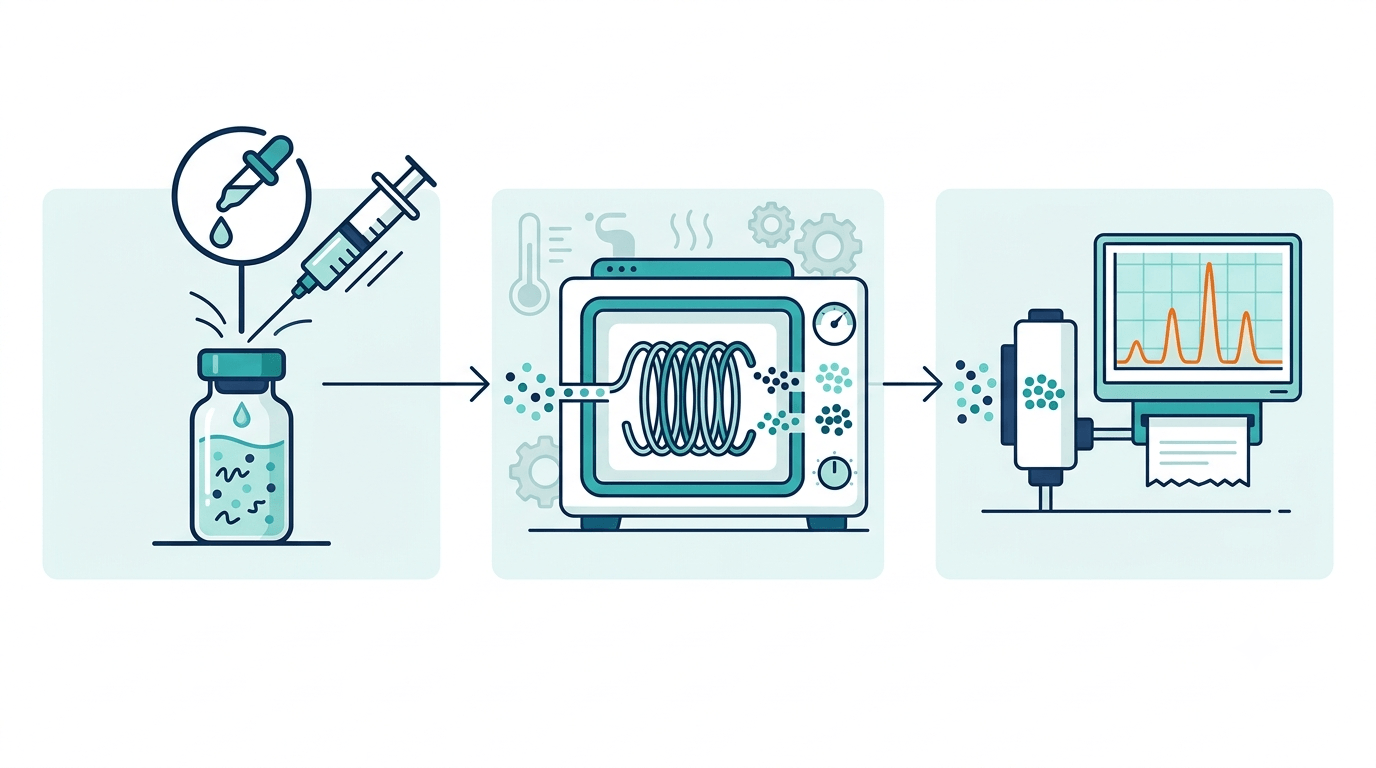
Think of GC as a molecular detective. A sample is vaporized and carried by a gas through a column. Different compounds travel through at different speeds, so they come out the other end one after another. A detector records each one as a peak. Pair it with a flame ionization detector (FID) and you get reliable quantification. Pair it with a mass spectrometer (GC-MS) and you can also confirm what each compound is.
GC suits volatile and semi-volatile compounds. That is the reason it shows up so often in two places: checking what is left behind after manufacturing, and characterizing what a material can release.
Why It Works Well for Complex Mixtures
Pharmaceutical products and device materials are rarely a single substance. GC breaks a mixture into its parts, so you can judge purity instead of guessing at it. It can also measure trace amounts, which is what lets labs show that a product meets its stated limits rather than just claim it.
Gas Chromatography in Pharmaceutical Testing
Residual Solvent Analysis
Solvents are used to make and purify many drug products, and some stay behind. ICH Q3C is the harmonized guideline that classifies residual solvents by toxicity and sets acceptable limits. USP <467> describes how to test for them, and it calls for testing only the solvents that are used or produced during manufacture or purification.
The usual approach is headspace GC, which samples the volatile solvents directly from the product, often with FID or mass spectrometry detection. The classes give you a quick sense of the risk:
| Class | Risk level | Examples |
|---|---|---|
| Class 1 | Unacceptable toxicity or environmental hazard, to be avoided | Benzene, carbon tetrachloride, 1,2-dichloroethane |
| Class 2 | Limited by risk at higher concentrations | Acetonitrile, methanol, chloroform, cyclohexane |
| Class 3 | Lower toxic potential | Ethanol, acetone, isopropyl alcohol |
Impurity Detection and Formulation Analysis
Impurities are where the details matter most. GC can detect and quantify volatile and semi-volatile impurities that might affect drug quality, which supports regulatory requirements and patient safety. For formulation work, it helps confirm that volatile or semi-volatile components are present at the intended level and flags degradation products when they are volatile.
Stability Testing
Products change over time. When degradation shows up as volatile compounds, GC can track it across storage conditions. That feeds into shelf-life decisions and storage recommendations, so the product still does what it should until the last dose.
Gas Chromatography in Medical Device Testing
Material Characterization and Chemical Characterization
A medical device is an assembly of materials, and each can release chemicals. ISO 10993-18 is the standard for chemical characterization of device materials. It is the first step in biological evaluation and feeds the toxicological risk assessment. Within it, GC-MS is used for semi-volatile compounds and headspace GC-MS for volatile ones, to identify and measure extractables (released under worst-case lab conditions) and leachables (those that may migrate under real use).
Residual Solvents From Manufacturing
Device manufacturing often involves solvents too. GC analyzes and quantifies any that remain, so the finished product is free of residues that could harm a patient.
Sterilization Residues
For devices sterilized with ethylene oxide (EtO), ISO 10993-7 covers the residues that can remain, namely EtO and ethylene chlorohydrin (ECH), a toxic by-product that can form when EtO reacts with chlorides such as those in PVC. Ethylene glycol is often included as well. The standard sets maximum permissible doses that depend on how long the device contacts the patient: limited (under 24 hours), prolonged (24 hours to 30 days) or permanent (over 30 days). Labs measure these residues with headspace GC, often with FID or MS detection.
One point worth being clear about: GC measures what is left on the device. It does not by itself prove that a device is sterile.
How GC Supports Regulatory Compliance
Regulators care about results that are accurate and reproducible. GC delivers both when the method is well developed and validated, and that gives you data you can defend in a submission and confidence that the product behaves as stated.
Challenges and What Is Changing
GC is not a cure-all. Matrix interference can mask a signal, and method sensitivity has to be good enough for the limit you need to meet. Analysts keep refining methods to deal with both. It also only covers volatile and semi-volatile compounds, so a full picture usually needs other techniques alongside it.
That is where Liquid Chromatography and Mass Spectrometry come in. Used together with GC inside a wider quality assurance plan, they give a more complete read on a complex sample. On the instrument side, progress in columns, detectors and automation points to better sensitivity, speed and ease of use.
Frequently Asked Questions
What is gas chromatography used for in pharmaceutical testing?
Mainly for residual solvent analysis, impurity detection, formulation analysis and stability work involving volatile or semi-volatile compounds.
How is GC used in medical device testing?
It supports chemical characterization of device materials under ISO 10993-18, tests for leftover manufacturing solvents, and measures ethylene oxide sterilization residues under ISO 10993-7.
What is the difference between GC-FID and GC-MS?
FID is a dependable way to quantify compounds. MS identifies and confirms what a compound is. Labs choose based on the solvent or compound, the product and the regulatory requirement.
Can GC test every compound in a product?
No. It is designed for volatile and semi-volatile compounds. Other techniques, such as liquid chromatography, are used alongside it for the rest.
Our Services
At PreWell Labs, we employ cutting-edge Gas Chromatography (GC) techniques to ensure the highest standards in medical device and pharmaceutical testing. Our commitment to precision and accuracy makes us a trusted partner in delivering reliable results for all your quality assurance needs.
Learn more about Medical Device Testing here.