

















Why Is 70% Isopropyl Alcohol Better Than 100%?
It seems counterintuitive: shouldn’t a purer, more concentrated alcohol kill more germs? When it comes to isopropyl alcohol (IPA), the answer is no. A 70% isopropyl alcohol solution is actually a more effective disinfectant than 100% (or 99%) pure alcohol, and the reason comes down to basic cell biology and chemistry.
The short version: 70% IPA strikes the right balance between alcohol and water. That balance lets it stay on a surface longer, penetrate bacterial cells more easily, and disable the proteins those cells need to survive. Pure alcohol, by contrast, evaporates too fast to do the same job.
Here’s the full breakdown of why that 30% water content matters so much.
Why 70% Isopropyl Alcohol Outperforms 100%
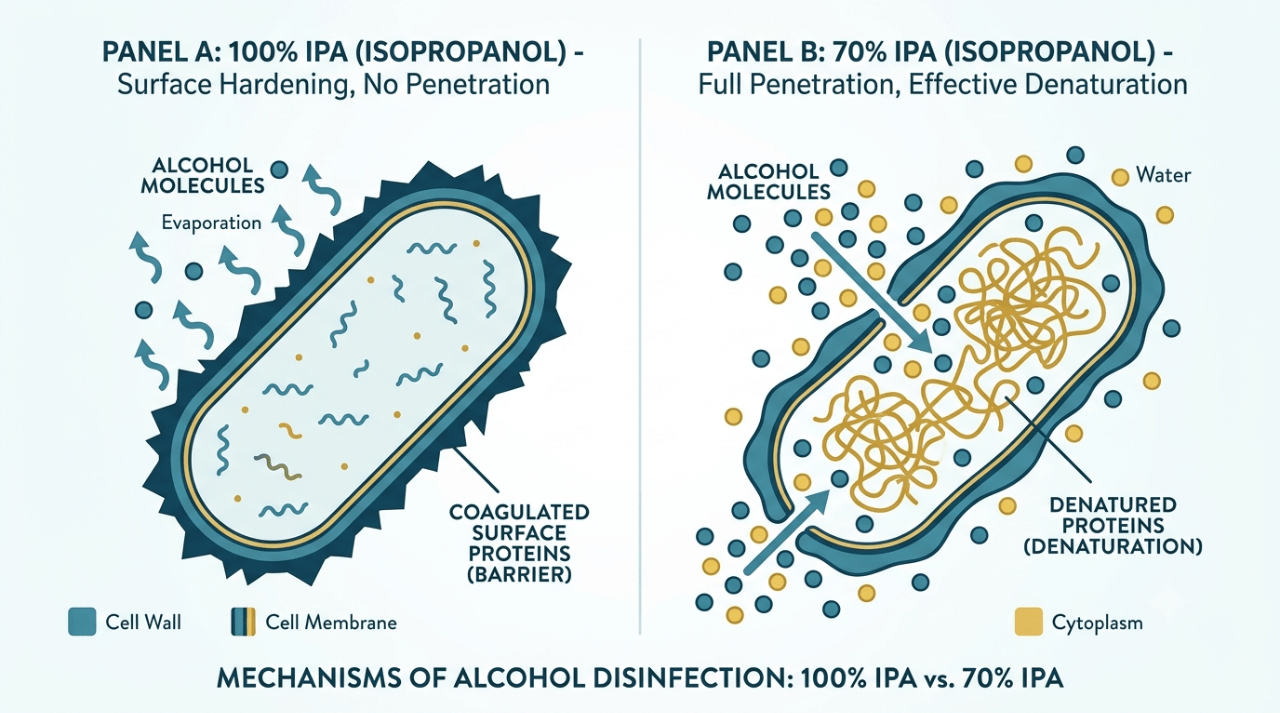
Pure alcohol evaporates almost immediately after it touches a surface. That speed works against it as a disinfectant it simply doesn’t stay in contact with a microorganism long enough to fully penetrate and disable it.
A 70% solution behaves differently. Diluting IPA with water slows down evaporation, which extends the contact time between the alcohol and the microbe. That extra time is what allows the alcohol to fully penetrate the cell and break down the bacterial cell membrane, rather than just damaging its outer surface.
How IPA Breaks Down Bacterial Cells
Bacteria are protected by an outer wall and membrane that maintain their shape and shield them from outside threats. When 70% IPA comes into contact with a bacterial cell, it’s able to cross that protective layer relatively easily and water is a key reason why.
The presence of water helps the alcohol move through the cell’s outer layer more effectively than alcohol alone could manage. Once inside, IPA goes to work on the proteins and enzymes the bacteria depend on to survive.
Proteins are made of long chains of amino acids folded into precise shapes, and that shape is what gives each protein its function. Alcohol disrupts those folded structures a process called denaturation in much the same way unraveling a ball of yarn destroys its usefulness as a ball. Once a protein’s structure is compromised, it can no longer do its job.
This matters because proteins drive nearly every essential process inside a bacterial cell: metabolism, replication, and repair among them. When IPA denatures enough of these proteins, the bacterium loses its ability to function and dies.
The Role Water Plays in Disinfection
Water isn’t just a filler in a 70% IPA solution it’s an active ingredient in the disinfection process.
At 100%, IPA evaporates too quickly to keep doing its job. It may coagulate proteins on the outer surface of a cell almost instantly, but that rapid surface reaction can actually seal the cell off, preventing the alcohol from penetrating deeper and finishing the process. In effect, high-concentration alcohol can protect the microorganism from itself.
In a 70% solution, the 30% water content slows that reaction down. It gives the alcohol time to fully penetrate the cell and denature proteins throughout not just on the surface which produces a more complete, more reliable kill.
Read More: 8 Industry Standards You Must Know for Disinfectant Efficacy Testing
Why This Balance Is Key to Antimicrobial Effectiveness
Put simply, 70% isopropyl alcohol works better than 100% because it combines two things a disinfectant needs: the ability to get inside the cell, and enough time in contact with it to finish the job. The alcohol provides the antimicrobial action; the water slows evaporation and assists in denaturing proteins.
This is why organizations like the CDC recommend isopropyl alcohol solutions in the 60–90% range for disinfection, with 70% widely regarded as the sweet spot. Concentrations below roughly 50% don’t have enough alcohol to be effective, while concentrations far above 90% lose effectiveness because they evaporate too fast and can leave microbes protected rather than destroyed.
FAQ: 70% vs. 100% Isopropyl Alcohol
Is 70% isopropyl alcohol really more effective than 99% or 100%?
Yes. Multiple studies and CDC guidance point to 60–90% IPA solutions as most effective for disinfection, with 70% commonly cited as optimal. Higher concentrations evaporate too quickly and can coagulate surface proteins in a way that shields the microorganism from deeper penetration.
Why does water make isopropyl alcohol a better disinfectant?
Water slows the alcohol’s evaporation rate, giving it more contact time with a surface or organism. It also plays a direct role in the protein denaturation process, helping the alcohol unfold and disable bacterial proteins more thoroughly.
Does 70% isopropyl alcohol kill viruses too, not just bacteria?
Yes, 70% IPA is effective against many bacteria, fungi, and enveloped viruses. It is not effective against bacterial spores.
Is there a concentration where isopropyl alcohol stops being effective as a disinfectant?
Yes. Below roughly 50% alcohol, effectiveness drops off sharply because there isn’t enough alcohol present to denature proteins and disrupt cell membranes reliably.
Can I dilute 99% isopropyl alcohol down to 70% myself?
Yes, mixing 99% IPA with distilled or purified water to reach approximately 70% is a common practice, as long as it’s measured accurately and mixed thoroughly.