























Water System Qualification: The Right Approach for a Robust, GMP-Compliant System
A pharmaceutical water system is a critical GMP utility. It has to deliver water that meets predefined quality requirements, not just on commissioning day, but throughout its entire lifecycle. Water system qualification is how you prove that, with documented evidence that the system is designed, installed, operated and performing consistently as intended.
So what is the right qualification approach for a new water system? A structured, stage-by-stage lifecycle: define what you need, assess the risks, then qualify the design, installation, operation and performance, and finally keep the system in a validated state through routine monitoring.
This guide walks through each stage and the GMP principles that run through all of them.
The Water System Qualification Lifecycle at a Glance
- User Requirement Specification (URS)
- Risk Assessment
- Design Qualification (DQ)
- Installation Qualification (IQ)
- Operational Qualification (OQ)
- Performance Qualification (PQ), in three phases
- Routine Monitoring
Each stage builds on the one before it. Skipping or rushing an early stage tends to show up as problems during PQ, when they are most expensive to fix.
Step 1: User Requirement Specification (URS)
Everything starts with a clear definition of what the system must do. Your URS should cover:
- Water quality requirements
- Capacity and flow requirements
- Distribution points
- Sanitization strategy
- Monitoring requirements
Typical quality parameters include conductivity, TOC (total organic carbon), microbial limits and loop temperature. A precise URS gives every later qualification stage something concrete to be tested against.
Step 2: Risk Assessment
Before you finalize the design, assess what could go wrong. Key risk areas for a water system include:
- Dead legs
- Stagnation
- Biofilm formation
- Improper flow
- Sampling strategy
- Sanitization effectiveness
Tools such as FMEA, risk ranking and impact assessment help you prioritize these risks and decide where your qualification effort should focus.
Step 3: Design Qualification (DQ)
Design Qualification verifies that the proposed design meets GMP requirements before anything is installed. A DQ review typically covers:
- P&IDs (piping and instrumentation diagrams)
- Material selection, such as SS316L
- Pipe slopes and drainability
- Dead leg limitation
- Instrumentation
- Sanitization design
Objective: confirm the design is fit for purpose before installation begins.
Step 4: Installation Qualification (IQ)
Installation Qualification verifies that what was built matches the approved design. Typical checks include:
- Equipment identification
- Welding and passivation records
- Calibration certificates
- Utility connections
- Piping traceability
- Filter installation
Objective: confirm the system is properly installed.
Step 5: Operational Qualification (OQ)
Operational Qualification verifies that the system operates within its defined limits. This includes:
- Flow and pressure
- Conductivity and TOC
- Alarms and interlocks
- Sanitization cycle verification
- Pump operation
Objective: confirm functional performance.
Step 6: Performance Qualification (PQ)
PQ demonstrates that the system delivers consistent water quality during routine operation. It runs in three phases:
| Phase | Duration | What happens |
|---|---|---|
| Phase I | 14 days | Daily chemical and microbiological testing at all generation system and user points |
| Phase II | 14 days | Continued daily monitoring, with chemical and microbiological testing of all generation system and user points, to demonstrate consistency |
| Phase III | 1 year | Routine lifecycle monitoring |
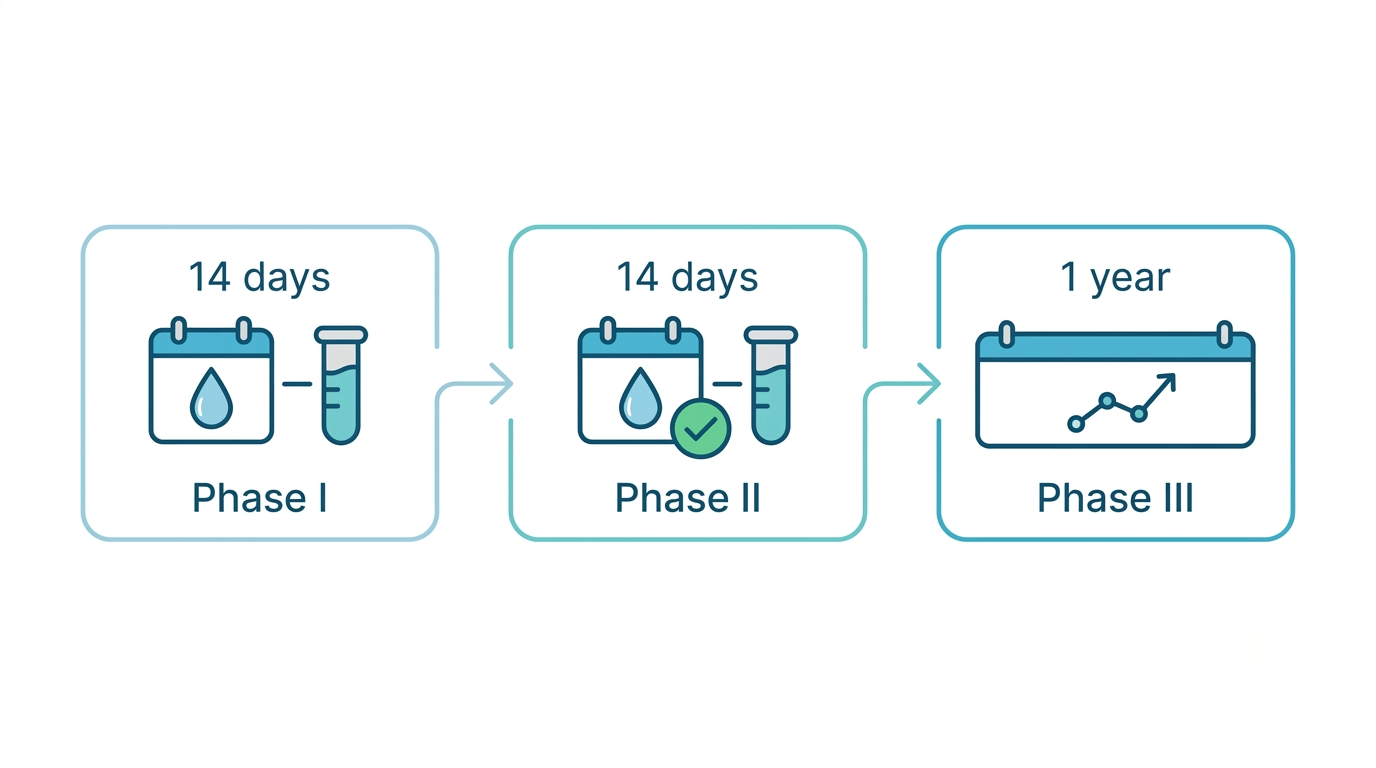
Throughout PQ, monitor conductivity, TOC, microbial count and endotoxins (where applicable).
The long Phase III matters because it captures the system’s behavior over time, including any variation in the water entering the system, rather than a short snapshot.
Objective: demonstrate long-term process consistency.
Step 7: Routine Monitoring
Qualification is not the finish line. To maintain the validated state, you need:
- Routine monitoring and trending
- Sanitization
- Preventive maintenance
- Calibration
- Change control
- Periodic requalification
Key GMP Considerations for Any Water System
A few principles apply at every stage:
- Avoid dead legs. Stagnant water is where problems start.
- Maintain turbulent flow and continuous recirculation.
- Implement effective sanitisation.
- Establish a robust sampling strategy. What you sample, where and how often determines what you will actually know about the system.
- Prevent biofilm formation.
- Trend results to detect issues early. Trending turns routine data into an early-warning system.
Frequently Asked Questions
What is water system qualification?
Water system qualification is the documented process of showing that a pharmaceutical water system is designed, installed, operated and performing consistently as intended, so that it reliably delivers water meeting its quality requirements.
What are the stages of water system qualification?
The lifecycle covers the URS, risk assessment, Design Qualification (DQ), Installation Qualification (IQ), Operational Qualification (OQ), Performance Qualification (PQ) and routine monitoring.
How long does water system PQ take?
PQ is carried out in three phases: Phase I (14 days), Phase II (14 days) and Phase III (1 year of routine lifecycle monitoring).
Which parameters are monitored during water system PQ?
Conductivity, TOC, microbial count and, where applicable, endotoxins.
What are the biggest GMP risks in a water system?
Dead legs, stagnation, biofilm formation, improper flow, a weak sampling strategy and ineffective sanitization. A risk assessment early in the lifecycle helps address these before they become qualification failures.