























Feller Correction in Air Sampling: Why r and Pr Start Differing
During a routine air sampling check, a simple question came up: “Why do r and Pr start differing after 17?”
It sounds small, but the answer shows how probability, microbiology, and cleanroom science fit together. This article explains the Feller correction step by step, without heavy math, and shows why it matters when you monitor air in controlled environments.
What happens inside a microbial air sampler?
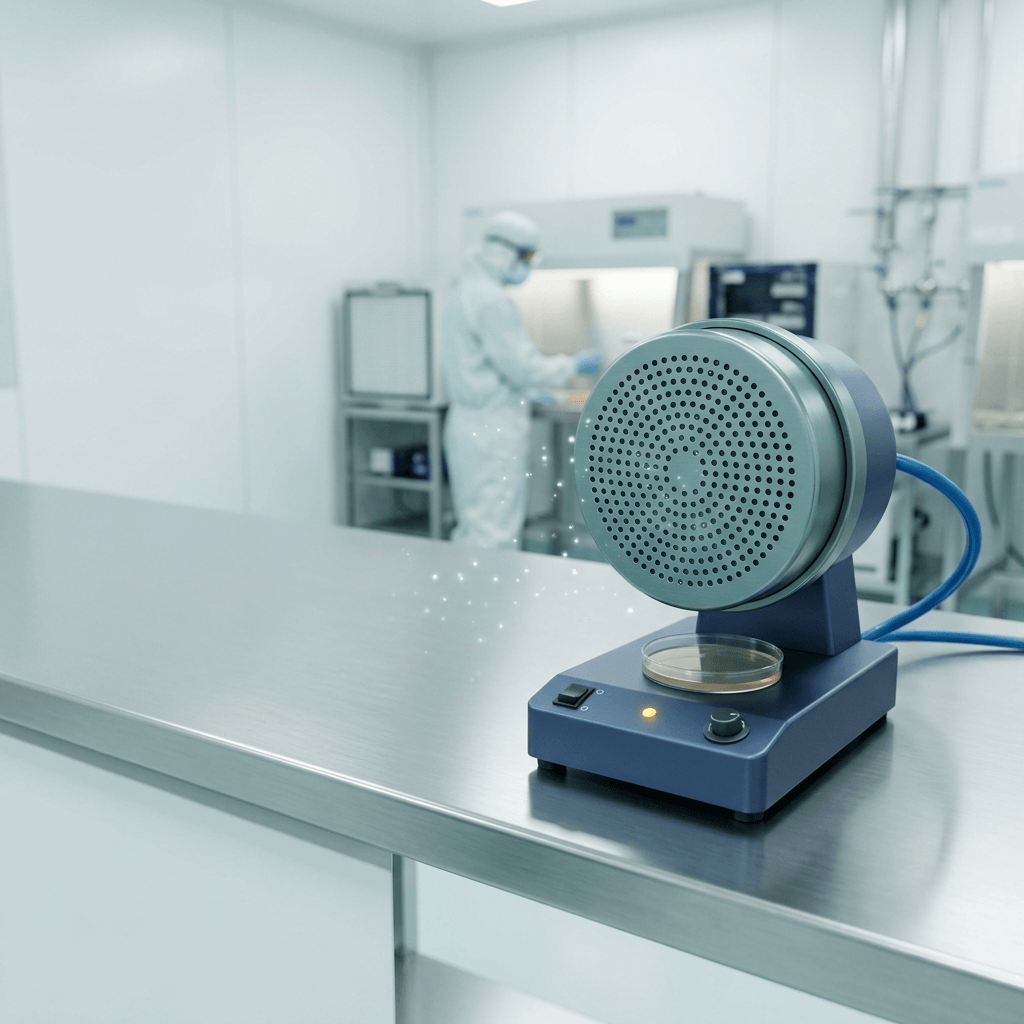
Picture an air sampler in your lab. Air is drawn through a plate (the sieve head) with hundreds of tiny holes. Each hole is like a small doorway through which airborne microbes can enter and hit the agar surface below.
After incubation, each impact turns into a visible colony. In a sieve-type sampler, the colonies you count are the starting point for estimating how many viable microorganisms were in the air.
Why r and Pr are almost the same in clean air
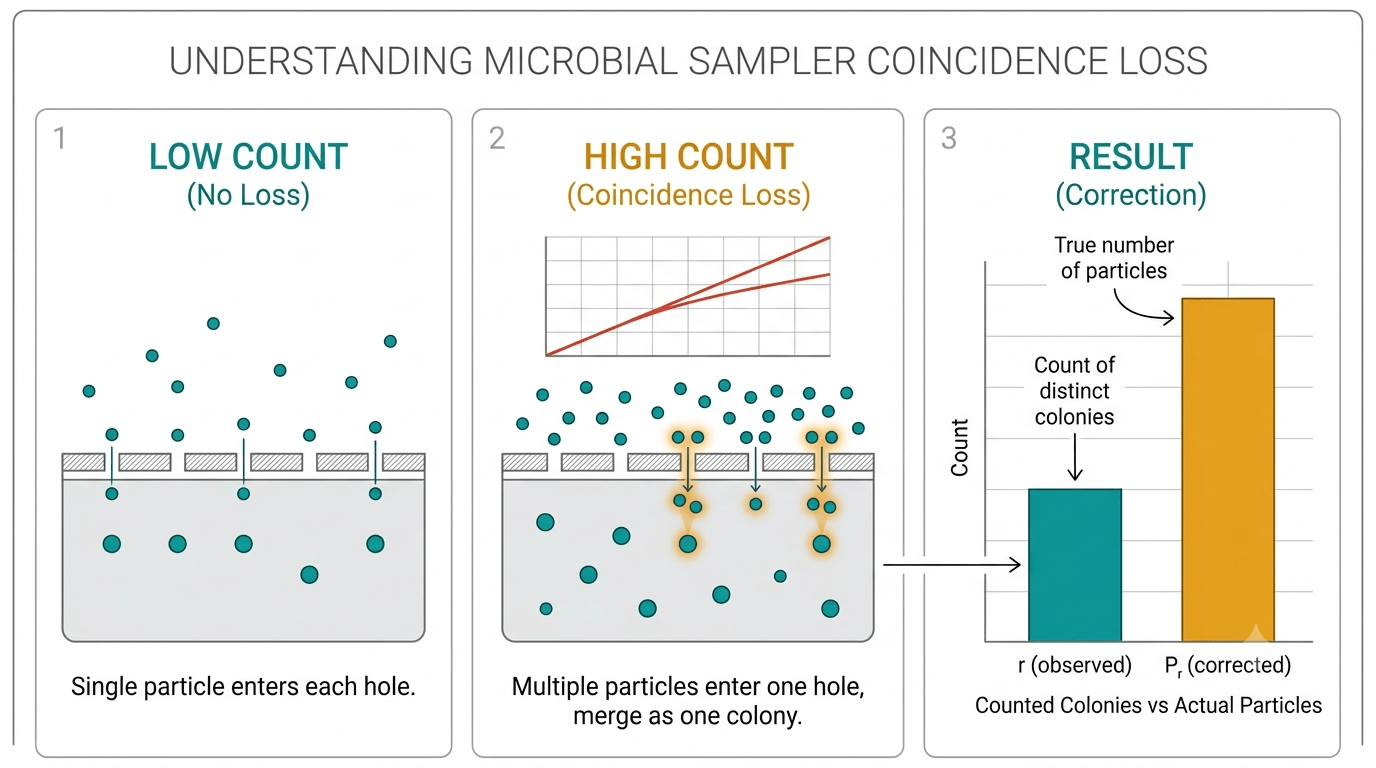
When the air is clean, with very few microorganisms (say, around 10 or 15), each hole usually receives only one particle. Every microorganism that enters creates its own separate colony.
In that situation:
- r is the number of colonies you actually count on the plate.
- Pr is the statistically corrected value.
At low counts the two are almost the same, because there are very few “shared doorways” to correct for.
What changes when there are more microbes in the air?
Now imagine 30, 50, or 100 microbes in the air. The number of holes stays the same, but more microbes are trying to get through. Some pass through the same hole together and land on the same spot on the agar.
When that happens, they grow into one single colony, even though multiple microbes were present.
This is where r and Pr start to drift apart:
- r, what you see with your eyes, becomes smaller than the true number.
- Pr estimates the true number of viable particles that were actually in the air.
This is why a plain visual count can under-report contamination at higher counts.
Read More: Environmental Isolates in Growth Promotion Testing: Why ATCC Strains Aren’t Enough
What is the Feller correction?
The Feller correction is a statistical adjustment that accounts for the chance that more than one microorganism enters the same hole and forms a single colony. It is also known as the positive hole correction, and manufacturers usually publish it as a conversion table. The probability theory behind it comes from the mathematician William Feller, and it was introduced for multi-jet microbial air impactors by Janet Macher in 1989.
In plain terms, the Feller correction uses probability so your results reflect the real microbial load, not just the colonies you could see.
The Feller correction formula
The formula is:
Pr = −n × ln(1 − r/n)
Where:
- Pr = corrected count (the true estimate)
- n = total number of holes in the sieve head
- r = number of colonies observed
- ln = natural logarithm
You will also see the same correction written as a sum, Pr = N × (1/N + 1/(N−1) + 1/(N−2) + … + 1/(N−r+1)), in some sampler manuals. The logarithmic form above is the compact version of that idea.
The logic behind both is the same: as more particles land on the plate, the chance that the next particle goes into a hole that is still empty keeps falling, so the observed count increasingly lags behind the true count.
A worked example
Take a sieve head with 400 holes and 120 observed colonies:
Pr = 400 × ln(400 / (400 − 120)) ≈ 143
So 120 visible colonies correspond to roughly 143 viable particles. The higher the count, the larger the gap.
Why do r and Pr start differing after about 17?
At low counts, the correction is so small that the corrected value rounds to the same whole number as the observed count. As r climbs, the correction grows, and eventually the two values stop matching.
The exact point depends on the sampler. For most microbial air samplers, the correction generally does not start making visible adjustments until somewhere between 18 and 21 colony forming units are counted, depending on the manufacturer. Some sieve sampler producers do not apply the calculation until an r value of 15 to 30 CFU. That is why the table you read in your lab may show r and Pr matching up to a point and then diverging.
Why this matters for cleanrooms and controlled environments
In cleanrooms and manufacturing areas, every single microbe counts. If you rely only on the colonies you can see, you may under-report the true microbial load, particularly at the higher counts where the Feller correction matters most.
That is why Feller correction tables are used in air monitoring and microbial analysis. Published sampler comparisons, such as this evaluation of three active air samplers in Pharmaceutical Technology, apply Feller’s positive hole conversion table to sieve-type sampler counts. The numbers in them are not random. They tell a story of invisible microbes, tiny collisions, and smart mathematics that make air testing more accurate.
Frequently asked questions
What is the Feller correction in air sampling?
It is a statistical correction applied to colony counts from sieve-type microbial air samplers. It adjusts for the possibility that more than one microorganism passes through the same hole and forms only one colony.
What is the difference between r and Pr?
r is the number of colonies you observe on the plate. Pr is the corrected count, an estimate of the true number of viable particles that entered the sampler.
Why do r and Pr match at low counts?
When there are only a few microbes in the air, each hole usually receives just one particle. Almost every microbe forms its own colony, so little or no correction is needed.
What does n stand for in the Feller correction formula?
n is the total number of holes in the sieve head of the air sampler.
Is the Feller correction the same as the positive hole correction?
Yes. The two names refer to the same statistical approach, and sampler manufacturers typically provide a positive hole conversion table so you do not have to calculate it by hand.
Need help with air monitoring and microbial testing?
At Prewel Labs, we use scientific corrections like this every day while performing air monitoring and microbial analysis, because in controlled environments like cleanrooms or manufacturing areas, every single microbe counts.