
















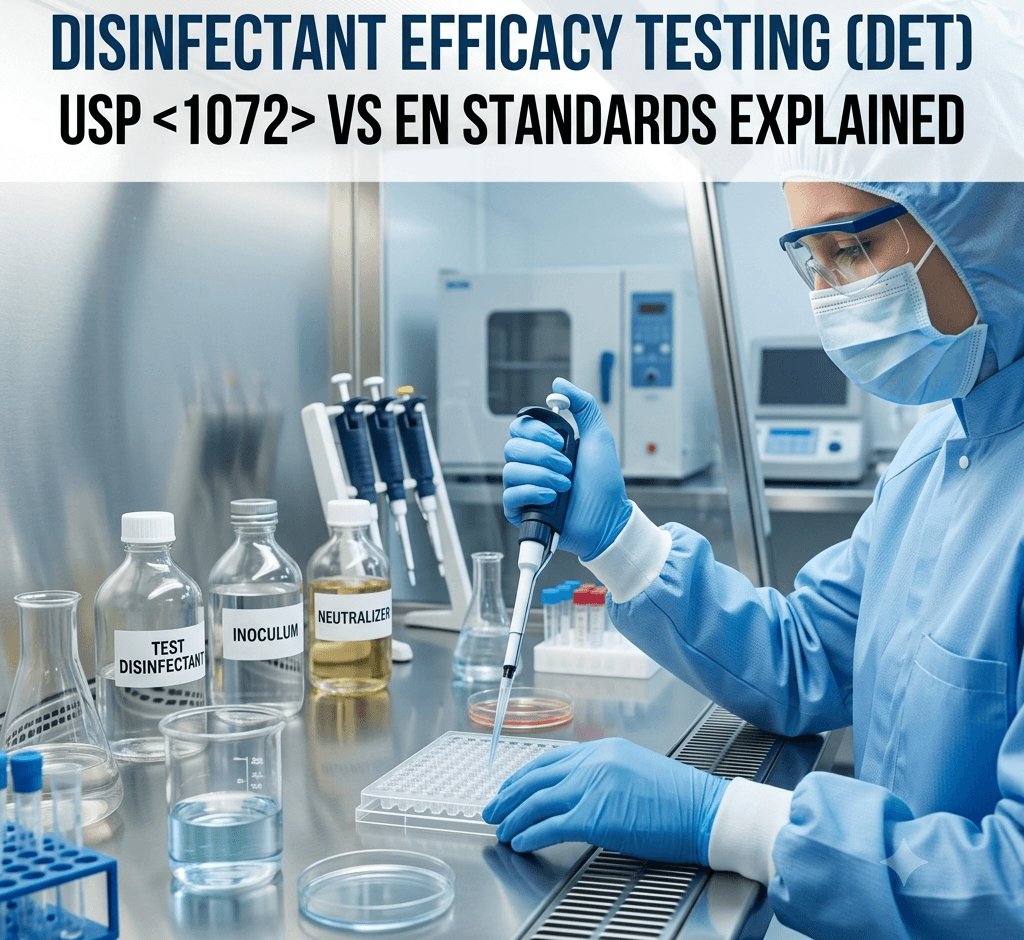
Disinfectant Efficacy Testing (DET): USP <1072> vs EN Standards Explained
In pharmaceutical manufacturing, disinfection is a daily, non-negotiable routine. Floors are wiped, equipment is sanitized, and critical surfaces are disinfected on a fixed schedule to protect product quality and patient safety. Yet routine cleaning alone does not answer the most important quality question: does the disinfectant actually work under real-world conditions?
This is the exact gap that Disinfectant Efficacy Testing (DET) is designed to close. DET provides the scientific evidence that a chosen disinfectant can reliably reduce microbial contamination on the surfaces and equipment found in a controlled environment.
Globally, two major frameworks are used to evaluate disinfectant performance in pharmaceutical and other controlled environments:
- USP <1072> Disinfectants and Antiseptics (United States Pharmacopeia guidance)
- European Disinfectant Standards (EN series)
Both frameworks assess how well a disinfectant performs, but they differ in philosophy, test design, and acceptance criteria. Understanding these differences is essential for quality, microbiology, and regulatory teams choosing the right validation approach for their facility.
What Is Disinfectant Efficacy Testing?
Disinfectant Efficacy Testing (DET) is the process of scientifically demonstrating that a disinfectant reduces microbial populations to an acceptable level on the surfaces and equipment where it is used. In pharmaceutical cleanrooms, this validation step is what turns a routine cleaning schedule into documented, defensible evidence for regulators and internal quality systems.
Two internationally recognized approaches — USP <1072> and the EN series of standards — provide the frameworks manufacturers use to design and execute these studies.
USP <1072> vs. EN Standards: Key Differences
1. Nature of the Guideline
USP <1072> is a guidance chapter, not a fixed laboratory method. Rather than prescribing one rigid protocol, it helps pharmaceutical manufacturers design disinfectant qualification studies that are specific to their own facility, surfaces, and contamination risks.
EN standards, such as EN 1276 (bactericidal activity standard), EN 1650 (fungicidal activity standard), and EN 13697 (surface disinfectant standard), are standardized methods with clearly defined procedures, test conditions, and acceptance criteria that must be followed as written.
2. Microorganisms Used
USP <1072> recommends testing against standard reference strains, including:
- E. coli
- S. aureus
- B. subtilis
- P. aeruginosa
- C. albicans
- A. brasiliensis
- Environmental isolates recovered from the facility itself
Including environmental isolates is a key feature of the USP approach — these organisms represent the actual contamination risks present in a specific cleanroom, rather than only laboratory reference strains.
EN standards require testing against a defined, fixed panel of reference organisms:
- Staphylococcus aureus
- Pseudomonas aeruginosa
- E. coli
- Enterococcus hirae
- Candida albicans
- Aspergillus brasiliensis
Because these strains are fixed and standardized, EN testing produces results that are reproducible across different laboratories.
3. Surface vs. Suspension Testing
USP-based validation typically relies on a surface challenge / tube dilution method, in which microorganisms are dried onto representative surfaces — such as stainless steel, glass, or epoxy flooring — before the disinfectant is applied. This mimics how contamination actually sits on cleanroom surfaces.
EN standards include both suspension and surface-based tests:
- EN 1276 / EN 1650 — suspension tests
- EN 13697 — surface carrier test
4. Organic Load Conditions
EN methods define specific interfering substances to simulate real-world contamination levels during testing:
- 0.3 g/L bovine serum albumin (clean conditions)
- 3 g/L bovine serum albumin (dirty conditions)
USP <1072> does not prescribe specific interfering substances. Instead, it recommends that studies be designed to simulate real environmental conditions relevant to the facility being tested.
5. Acceptance Criteria
USP-based studies typically expect:
- ≥3 log reduction for vegetative bacteria
- ≥2 log reduction for bacterial spores
EN standards often require higher reductions, for example:
- ≥5 log reduction for bacteria (in many suspension tests)
- ≥4 log reduction for yeast and fungi
Read More: Real-World Applications of Disinfectant Efficacy Testing in Pharma and Biotech
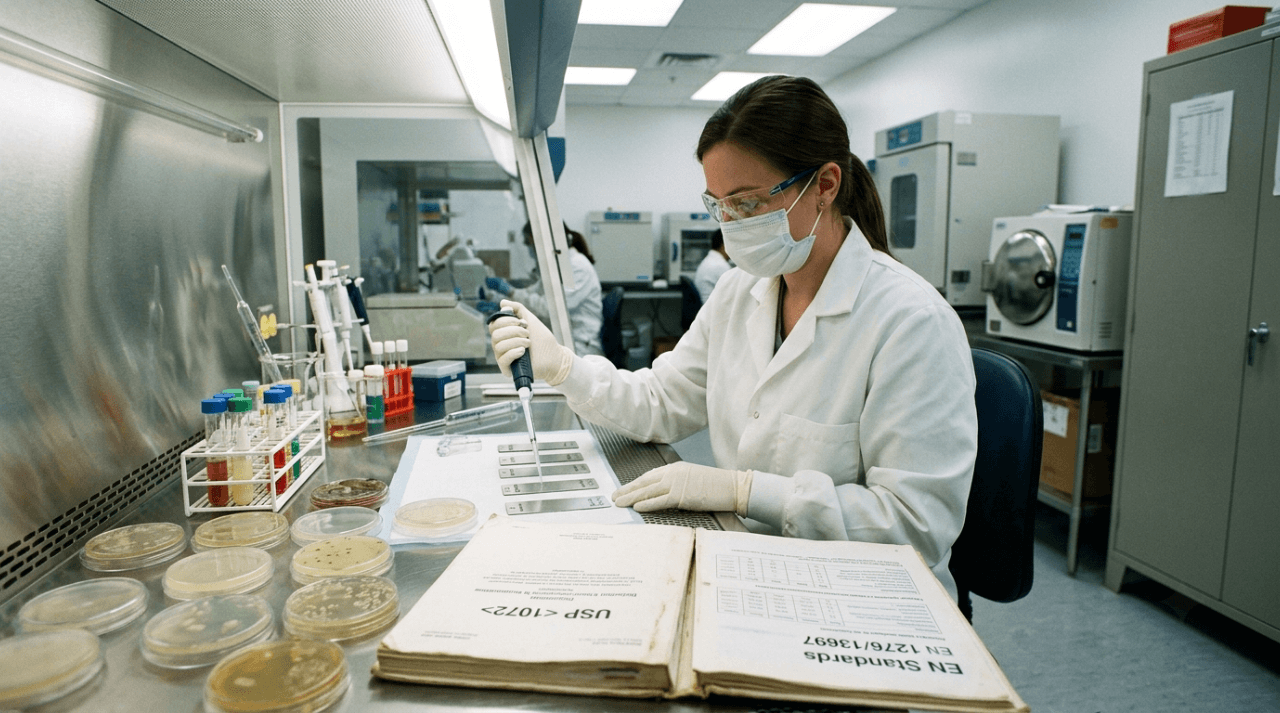
Quick Comparison: USP <1072> vs. EN Standards
| Criteria | USP <1072> | EN Standards (EN 1276 / 1650 / 13697) |
|---|---|---|
| Type of guideline | Guidance chapter, facility-specific | Standardized, fixed methods |
| Organisms | Reference strains + environmental isolates | Fixed reference organism panel |
| Test format | Surface challenge / tube dilution | Suspension (EN 1276, EN 1650) and surface carrier (EN 13697) |
| Organic load | Not prescribed; simulate real conditions | Defined BSA levels (0.3 g/L clean, 3 g/L dirty) |
| Acceptance criteria | ≥3 log (vegetative bacteria), ≥2 log (spores) | ≥5 log (bacteria), ≥4 log (yeast/fungi) |
Why the Difference Matters for Pharmaceutical Manufacturers
Choosing between USP <1072> and EN-based testing isn’t just a technical formality — it is a regulatory decision. A manufacturer supplying markets that follow USP guidance may need facility-specific studies that include environmental isolates, while one operating under European regulatory expectations may need to meet the fixed, higher-reduction criteria of the EN series. Many global manufacturers end up needing both, depending on the markets they serve and the regulatory bodies reviewing their submissions.
Because these frameworks differ in organisms, test format, organic load, and acceptance criteria, disinfectant qualification studies should be designed with a clear understanding of which regulatory pathway — or combination of pathways — applies to a given facility.
Frequently Asked Questions
Is USP <1072> a mandatory test method? No. USP <1072> is a guidance chapter, not a fixed laboratory method. It helps manufacturers design a disinfectant qualification study suited to their own facility rather than dictating one rigid protocol.
What is the difference between EN 1276, EN 1650, and EN 13697? EN 1276 is a bactericidal activity standard, EN 1650 is a fungicidal activity standard, and EN 13697 is a surface disinfectant standard. EN 1276 and EN 1650 are suspension tests, while EN 13697 is a surface carrier test.
Why does USP <1072> recommend environmental isolates? Environmental isolates are organisms recovered from the facility itself, and they represent the actual contamination risks present in that specific cleanroom — in addition to standard reference strains.
Are EN acceptance criteria stricter than USP criteria? In general, EN standards often require higher log reductions than USP-based studies — for example, ≥5 log for bacteria and ≥4 log for yeast and fungi in many EN suspension tests, compared with ≥3 log (vegetative bacteria) and ≥2 log (spores) typically expected in USP-based studies.
Conclusion
Disinfectant Efficacy Testing is what transforms a daily cleaning routine into documented proof that a disinfectant works. USP <1072> and the EN series both serve this purpose, but they take different paths to get there one guidance-based and facility-specific, the other standardized and reproducible across laboratories. Understanding these differences in guideline type, test organisms, test format, organic load, and acceptance criteria is essential for designing a compliant disinfectant qualification program.
At Prewel Labs, we perform Disinfectant Efficacy Testing (DET) using both USP and EN methodologies, depending on your specific regulatory requirements. Visit Prewel Labs and fill out the contact form for support with water, food, air, soil, environmental, pharmaceutical, medical device, gas, and compressed air & steam quality testing.