









How Much Does Water Testing Cost in Bangalore in 2026?
Last Updated on November 1, 2026
A cheap TDS meter can tell you your water has a lot of dissolved salts in it. It can’t tell you whether there’s E. coli in your sump, nitrate in your borewell or fluoride in your tap. That gap is why so many Bangalore homes, apartment associations and businesses end up asking the same question: what does a proper lab test actually cost?
Here’s the short answer. At Prewel Labs, the water testing cost in Bangalore starts at about ₹500 to ₹2,000 for a basic or home test, rises to ₹2,000 to ₹7,000 for a full chemical and microbial analysis, and is quoted separately for industrial and pharma panels of 30 to 60 parameters. The final price depends on which parameters you need, and that’s what the rest of this guide helps you work out.
You’ll find what each type of test covers, what pushes the price up or down, what different buyers in Bangalore typically need, and how to avoid paying for a test that doesn’t answer your question.
Why Bangalore Water Is Worth Testing
Bangalore water comes from several sources, and each one carries different risks. Many homes mix Cauvery supply from BWSSB with borewell water, and in dry months, tanker water too. A test is the only way to know what’s actually coming out of your tap.
Groundwater is the biggest unknown. The Central Ground Water Board’s district profile for Bangalore Urban lists electrical conductivity, fluoride, arsenic, iron and nitrate among the constituents found above permissible limits in parts of the district, and it flags high nitrate as a particular problem. A Department of Mines and Geology study of groundwater in and around the city, summarised by India Water Portal, found nitrate above the permissible limit in 29% of the samples it analysed. Nitrate usually points to sewage or wastewater getting into the aquifer.
Piped water can also go wrong between the treatment plant and your glass. Old pipes, damaged lines running near drains, and dirty sumps and overhead tanks can all let bacteria in. Our post on the cholera outbreak in Bangalore PGs shows how quickly that can turn into an outbreak.
The reference for drinking water in India is IS 10500:2012, the Bureau of Indian Standards drinking water specification. A good lab report compares each result against it, so you can see at a glance whether your water passes.
Water Testing Cost in Bangalore: Prewel Labs Price Ranges for 2026
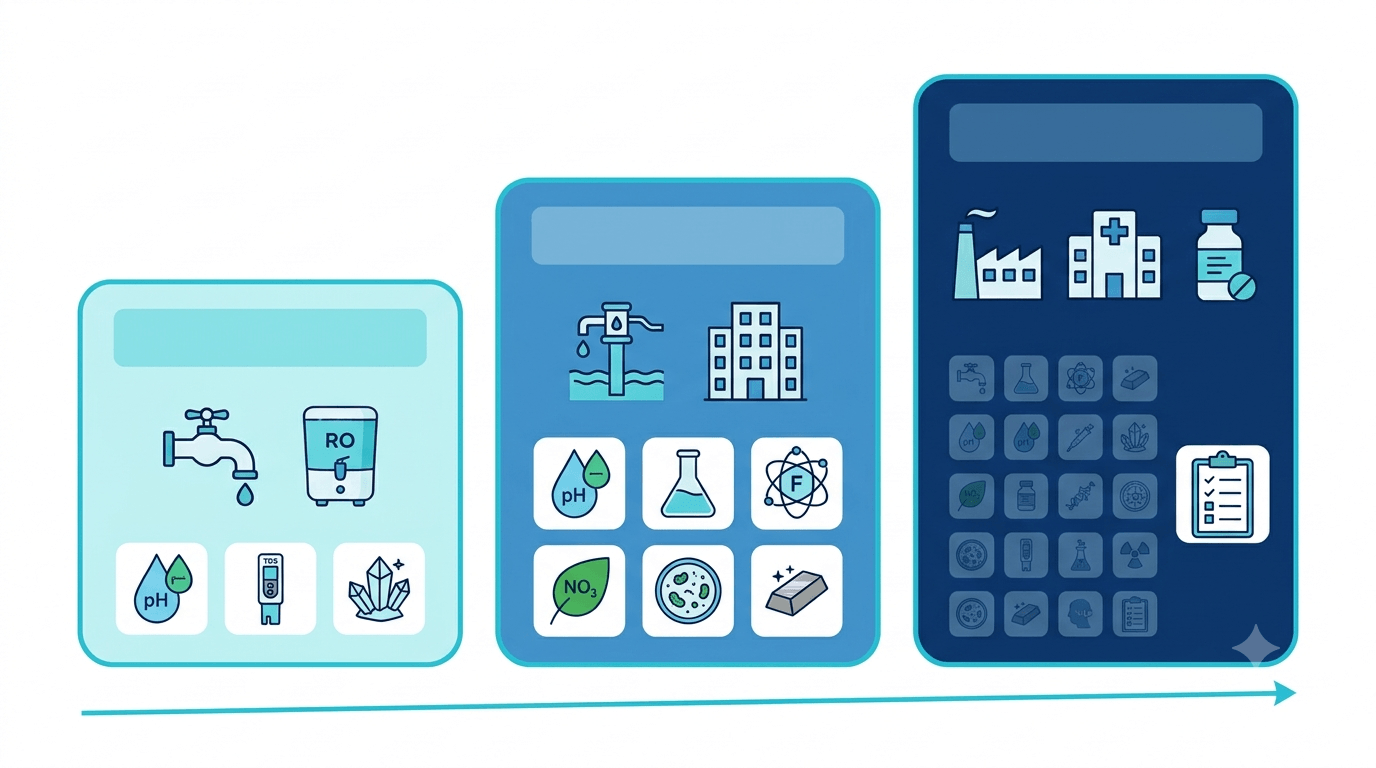
The cost of a water test depends mostly on how many parameters the lab measures and which methods it uses. These are the ranges Prewel Labs publishes on its water testing lab page.
| Test type | Typical use | Price range |
|---|---|---|
| Basic or home testing | Checking household drinking water, RO output, a new borewell or tanker water for the key parameters | ₹500 to ₹2,000, depending on parameters |
| Full chemical and microbial analysis | A full picture of drinking water quality, apartment sumps and borewells, or water you plan to rely on long term | ₹2,000 to ₹7,000, depending on parameters |
| Industrial or pharma panels | Process water, purified water, boiler feed, cooling tower, dialysis water and other regulated uses | Custom quote, based on 30 to 60 parameters |
Monthly, quarterly and custom testing packages are also available if you need to test regularly. For a fixed quote, share your water source, why you need the test and any standard you have to meet. The lab can then put together the exact parameter list instead of a guess.
What a basic water test usually covers
A basic test answers the question “is this water broadly okay to drink, and does my filter work?” It typically checks physical and chemical basics such as pH, TDS and hardness, often with a microbial check for coliform bacteria. It’s a good first step for a home or for checking an RO unit after servicing.
What a full chemical and microbial analysis adds
A full analysis tests many more of the parameters listed in IS 10500, such as fluoride, nitrate, chloride, sulphate, iron, alkalinity and turbidity, plus microbiology. Depending on the package, it can also include heavy metals and pesticides. This is the test to run on a borewell you depend on, on water feeding an apartment complex, or when you need a report you can show to residents or authorities.
Why industrial and pharma panels are quoted separately
Regulated water uses have their own standards and their own parameter lists, often 30 to 60 parameters. A pharma unit testing purified water, a dialysis centre checking RO water and a factory monitoring boiler feed water all need different tests. These are quoted after we understand the application and the specification you have to meet.
What Affects the Price of a Water Test
Two tests that both say “water analysis” can differ in price by several thousand rupees. Here’s what makes the difference.
- Number of parameters. This is the biggest factor. Every parameter needs its own method, reagents and analyst time, so a 6-parameter test costs far less than a 30-parameter one.
- Type of analysis. pH and TDS are quick, routine tests. Heavy metals such as lead, arsenic and mercury, and pesticide residues, need specialised instruments and careful sample preparation, so they cost more.
- Microbiology. Tests for total coliforms and E. coli need sterile sampling and incubation time. They’re usually priced separately from chemical tests or as an add-on.
- NABL accreditation. An NABL-accredited report is backed by an assessed quality system, and it’s often what authorities, auditors and clients ask for. Accreditation covers specific parameters, so check that the ones you need are inside the lab’s scope. Our guide on what NABL accreditation is explains why it matters.
- Sample collection. You can collect the sample yourself or have a trained technician collect it on site. Technician collection costs more but cuts the risk of a contaminated or badly collected sample.
- Standard and purpose. A test for your own peace of mind can be simple. A test for a BIS licence, a pollution control board requirement, a hospital or a GMP audit has to follow a defined parameter list and method, which sets the price.
- Frequency. If you test every month or quarter, a package usually works out cheaper per test than booking one-off tests.
Which Water Test Do You Need? Costs by Type of Buyer
The right test depends on who you are and what the water is used for. Use this as a starting point, then confirm the exact list with the lab.
Households with Cauvery supply, an RO purifier or a borewell
If you’re on BWSSB supply and just want to know whether your water and your RO purifier are working, a basic test is usually enough. If you depend on a borewell, go for a fuller analysis at least once, and include nitrate, fluoride, hardness and microbiology, because these are the common problems in Bangalore groundwater. Test again after the monsoon, when contamination risk tends to rise. Our post on why water testing matters during the monsoon explains why.
Apartment associations and gated communities
Apartments often mix borewell water, tanker water and Cauvery supply in shared sumps, and the source can change from week to week. A full chemical and microbial analysis of each source and the sump gives the association a baseline. Regular microbial checks on sumps and overhead tanks then catch contamination early. A testing package is usually the better deal here. If your complex runs a sewage treatment plant, treated water testing is a separate service, covered in our post on STPs in Bangalore.
Restaurants, cafés, PGs and hostels
If you serve water or use it in food, you’re responsible for its safety. Microbiology is the priority, since one contaminated source can make many people ill. A full analysis is a good baseline, with routine microbial checks after that. Keep the reports on file. They help during food safety inspections and show customers you take hygiene seriously.
Packaged drinking water and food businesses
Packaged drinking water is covered by its own standard, IS 14543, and needs a defined set of tests for certification and ongoing compliance. These tests go well beyond a basic drinking water test, so ask for a quote based on your product and the standard that applies.
Construction sites
Water used for concrete and mortar affects the strength and durability of the structure. Construction water is checked for things like alkalinity, hardness, chlorides, sulphates and organic matter. It’s usually a short, targeted test, priced on the parameters your engineer or consultant specifies.
Hospitals, dialysis centres and pharma units
These are the most demanding uses. Dialysis water, purified water and water for injection have tight limits on conductivity, microbial counts and endotoxins, and they need testing at set intervals. Pricing is custom because the parameter list comes from the applicable standard. See our guides on RO water testing for dialysis and water system qualification in pharma for what’s involved.
Key Drinking Water Limits Your Report Will Be Checked Against
When your report comes back, each result is compared with IS 10500:2012. The standard gives an “acceptable” limit and, for some parameters, a higher “permissible” limit that applies only when no better source is available. Here are some of the parameters Bangalore readers ask about most.
| Parameter | Acceptable limit | Permissible limit (no alternative source) |
|---|---|---|
| pH | 6.5 to 8.5 | No relaxation |
| Total dissolved solids (TDS) | 500 mg/L | 2,000 mg/L |
| Total hardness (as CaCO3) | 200 mg/L | 600 mg/L |
| Turbidity | 1 NTU | 5 NTU |
| Fluoride | 1.0 mg/L | 1.5 mg/L |
| Nitrate (as NO3) | 45 mg/L | No relaxation |
| E. coli or thermotolerant coliforms | Not detectable in any 100 mL sample | No relaxation |
Source: BIS, IS 10500:2012 Drinking Water Specification. Your report will list more parameters than this, depending on the package you choose.
A result above the acceptable limit doesn’t always mean the water is dangerous, and a result inside it doesn’t make the water safe on every count. That’s why it helps to talk through the report with the lab instead of just reading the pass and fail column.
Free and Low-Cost Options, and Where They Fall Short
A lab test isn’t your only option, but the cheaper routes answer narrower questions.
- BWSSB testing of public supply. According to Citizen Matters, BWSSB tests public water supply free of charge, while testing water on private property is charged. That helps if you think the Cauvery supply itself is the problem, but it won’t cover your borewell, your tanker water or what happens inside your building’s sump.
- TDS meters and DIY kits. A TDS meter only measures dissolved solids. It can’t detect bacteria, nitrate, fluoride or heavy metals, and low TDS doesn’t mean water is safe. Strip kits give rough readings for a few parameters, and they’re useful between lab tests, not instead of them.
- App-based home collection services. Some diagnostic platforms offer single water tests, such as a microbial culture. Check exactly which parameters are included and whether the report is NABL-accredited before comparing prices.
How to Avoid Paying Twice for a Water Test
The most expensive water test is the one you have to repeat. Most repeat tests come down to a few avoidable mistakes.
- Define the question first. “Is my RO purifier working?”, “Is my borewell safe to drink?” and “Do I meet a BIS or pollution board requirement?” each need a different test. Tell the lab your reason and it can pick the right parameters, so you don’t pay for ones you don’t need or miss ones you do.
- Use the right container. Microbiology samples need a sterile bottle from the lab. A rinsed mineral water bottle can give a false positive for bacteria or contaminate a chemical sample.
- Get the sample to the lab quickly. Bacteria in a sample can multiply or die off over time, so microbiology samples should be kept cool and delivered as soon as possible. Follow the lab’s instructions, or book technician collection.
- Sample the right point. Test where the problem might be. If you suspect the sump, sample the sump. If you want to know what your family drinks, sample the tap or purifier outlet. For a borewell, let the water run for a few minutes before sampling.
- Ask for an accredited report if anyone else will see it. If the report is for an authority, a buyer, an auditor or a residents’ meeting, ask for an NABL-accredited report up front. Re-testing later just to get an accredited report costs more.
- Retest after fixing a problem. If a result fails and you chlorinate a sump, clean a tank or change a filter, retest the failed parameter to confirm the fix worked. You don’t usually need to repeat the full panel.
How Prewel Labs Can Help with Water Testing in Bangalore
At Prewel Labs, we test water from homes, apartment complexes, construction sites, swimming pools, STPs and industry, from our laboratory in J P Nagar, Bengaluru. Our water testing covers drinking water, borewell and RO water, packaged drinking water, swimming pool water, construction water, STP and ETP water, cooling tower and boiler feed water, dialysis water, and pharma purified water and water for injection.
Prewel Labs is NABL accredited and ISO 9001 certified. We follow the methods and standards set out by BIS (including IS 10500 for drinking water) and APHA, and we provide NABL-accredited reports for the parameters in our scope.
We offer sample pickup by a trained technician, or you can collect the sample yourself by following our sampling instructions. Most results are ready in 3 to 5 days, depending on the tests, and microbiology tests need 24 to 48 hours of incubation. Reports come as a PDF by email. If you need regular testing, we offer monthly, quarterly and custom packages.
Not sure which test you need? Tell us your water source and why you’re testing, and we’ll recommend the right parameters and send you a clear quote.
Frequently Asked Questions
How much does a basic water test cost in Bangalore?
At Prewel Labs, a basic or home water test costs about ₹500 to ₹2,000, depending on how many parameters you include. A test for pH, TDS and hardness sits at the lower end. Adding microbiology or more chemical parameters moves it up.
Is a TDS meter reading enough to know if my water is safe?
No. A TDS meter only measures the total dissolved solids in water. It can’t detect bacteria, nitrate, fluoride, arsenic or other contaminants, and water with low TDS can still be unsafe. You need a lab test to check those.
How often should I test borewell water in Bangalore?
Test a borewell you rely on at least once a year with a full analysis, and more often if the water changes in taste, smell or colour. A microbial check after the monsoon is a sensible extra, since rain can carry surface contamination into wells. Apartment complexes with shared sumps usually benefit from monthly or quarterly microbial checks.
How long does it take to get water test results?
At Prewel Labs, results usually take 3 to 5 days, depending on the tests. Microbiology tests need 24 to 48 hours of incubation before a result can be read, so a test that includes them can’t be completed the same day.
Do I need an NABL-accredited water test report?
If the report is only for your own peace of mind, accreditation is optional, though it gives you more confidence in the result. If you need it for a regulator, a certification, an audit, a buyer or a dispute, ask for an NABL-accredited report for the parameters that matter.
Knowing What’s in Your Water
A lab test is a small cost next to the money most people spend treating water they have never actually tested, and it tells you whether your filters are dealing with the right problem. Start with the question you want answered, pick the test that answers it, and keep your reports so you can see when something changes.
This article is general information about water testing and costs. Prices are indicative and depend on the parameters selected. It does not replace advice from your doctor, regulator or water treatment professional.