
























Environmental Isolates in Growth Promotion Testing: Why ATCC Strains Aren’t Enough
You walk into your facility. Your EM plates look clean. Your media passes growth promotion testing (GPT) with ATCC strains, and everything feels perfect.
But here is the question many labs avoid asking: are ATCC strains the same organisms that actually trouble your cleanroom?
They are not. That gap is why environmental isolates in growth promotion testing have moved from “nice to have” to a core expectation of modern GMP. This article explains why USP historically validated media with ATCC strains, why that is no longer enough for environmental monitoring (EM), and how to close the gap.
Why Did USP Historically Rely on ATCC Strains?
Compendial test chapters such as USP <61>, <62> and <71> specify reference strains, and those strains come from recognized culture collections such as ATCC. Reference strains give every laboratory the same, well-characterized organism, which makes results comparable and repeatable.
That approach works well for a standardized compendial test. The limitation appears when the media is used for something the compendia do not fully define: monitoring your facility. Industry groups have noted that the media used for EM, and the organisms used to test them, are not definitively defined in the compendial methods.
USP does leave the door open. Chapter <1116> describes GPT for EM and media-fill media as demonstrating growth of indicator organisms and of environmental isolates from the monitoring program, or their corresponding ATCC strains. Chapter <1117> says representative environmental isolates may be used, while noting they are not compendial requirements.
So the historical ATCC-only approach was never wrong. It was simply incomplete for the question EM media has to answer.
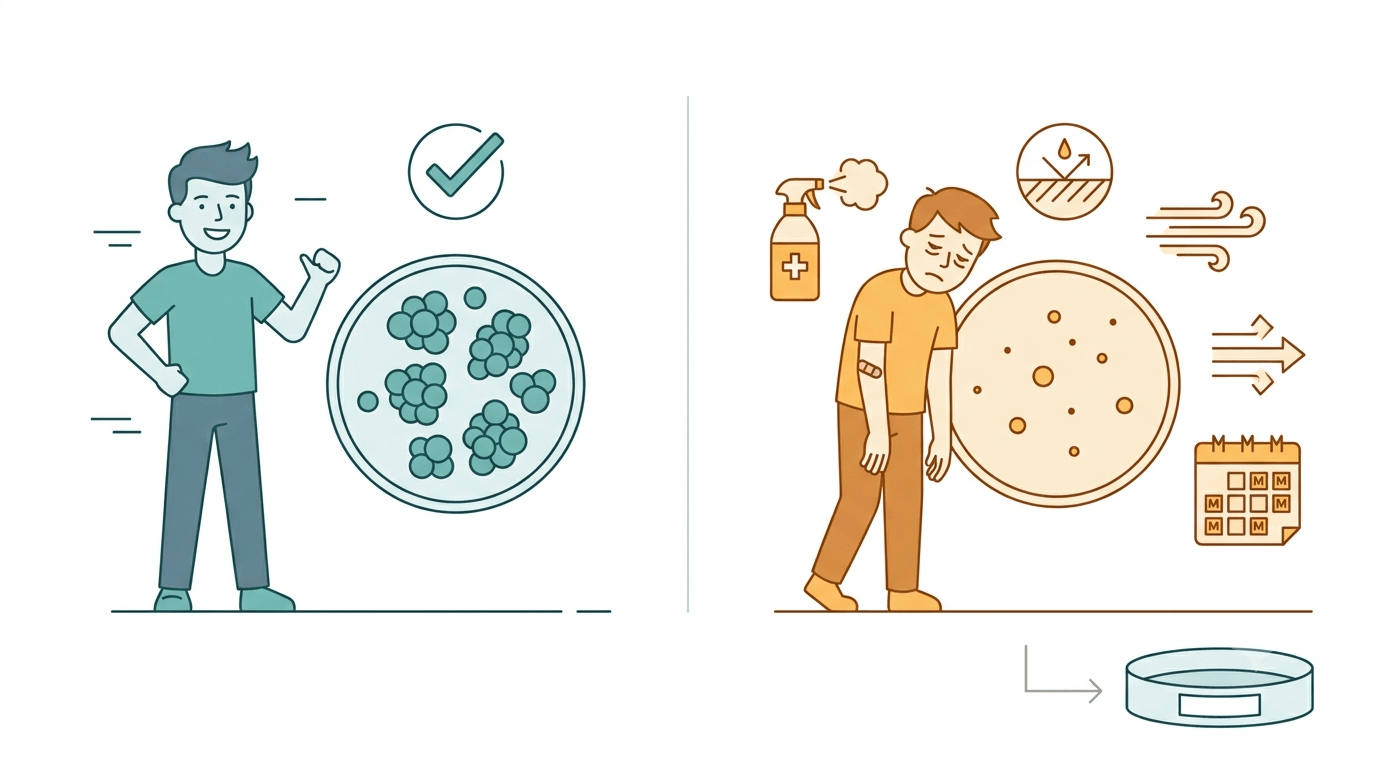
ATCC Strains vs. Environmental Isolates: The Classroom Analogy
Think of ATCC strains as the bright, energetic students who always score full marks. They grow fast, behave well, follow the rules and never create trouble.
Environmental isolates are the students who walk in tired, stressed, sometimes injured, maybe even half-asleep. They have been exposed to disinfectants, dry surfaces, airflow and months of survival pressure. They do not grow like textbook organisms.
So which one represents your real cleanroom risk?
What Regulators Expect Today
The expectation has shifted. Inspectors across PIC/S, FDA and MHRA, and the text of EU Annex 1, point toward the same audit question:
“Can your media recover the actual organisms found in your facility, not just ideal ATCC strains?”
Here is what the published documents say:
- EU GMP Annex 1 (2022): Media used for environmental monitoring and aseptic process simulation should be tested for growth promotion using a scientifically justified group of reference organisms and suitably representative local isolates. Annex 1 describes local isolates as representative site organisms frequently recovered through EM in classified areas, especially Grade A.
- USP <1116> and <1117>: Environmental isolates are recognized as appropriate challenge organisms for EM media, though not compendial requirements.
- FDA inspections: Observations (Form 483s) have criticized firms that did not challenge their media with environmental isolates, and others whose isolates covered only Gram-positive organisms and left out Gram-negatives, molds and yeasts.
In practice, relying only on ATCC GPT has drawn regulatory attention, and the observations above show it is a recurring inspection theme.
Read More: Settle Plate Placement in Cleanroom: Why Location Decides Everything
The Cricket Pitch Test: Why Worst-Case Organisms Matter
If you test a cricket pitch only with professional players, of course it looks perfect. But your real match has tired players, stressed players, maybe even injured ones. If the pitch works only for the pros, is the test valid?
Environmental isolates show the worst-case scenario: organisms weakened by disinfectants, desiccation, temperature changes, poor nutrition or long exposure to cleanroom conditions. If your media cannot recover these stressed isolates, your EM program may completely miss a contamination event.
Your Alert Limits and Trending Are Built on Your Own Flora
There is another point that is easy to forget. Your alert limits, trending and risk assessments are all based on the flora recovered in your own facility.
That means your GPT must prove that your media can actually grow the organisms you rely on for EM decisions. ATCC strains alone cannot support that claim. If the media under-recovers your real flora, the data feeding your trends is quietly biased, and so are the decisions built on it.
How to Approach Environmental Isolates in GPT
A practical, defensible approach keeps the strengths of both organism types:
- Keep your ATCC reference strains. They provide the standardized, comparable baseline.
- Add isolates from your own EM program. Choose organisms that are representative of what your facility actually recovers, and make sure the selection is scientifically justified and documented.
- Cover the range of organism types. FDA observations show that using only Gram-positive isolates can be a gap.
- Test both together. ATCC strains show the media performs to standard; isolates show it works in your real environment.
Testing Real-World Performance with Prewel Labs
At Prewel Labs, we test media with both ATCC strains and facility isolates, because modern GMP is not about “ideal conditions.” It’s about proving real-world performance.
Frequently Asked Questions
Why must environmental isolates be included in GPT?
Because ATCC strains are healthy, standardized organisms, while the organisms in your cleanroom are stressed by disinfectants, dryness and long survival. Including your own isolates shows that your media can recover the organisms your EM decisions depend on. EU Annex 1 expects suitably representative local isolates in GPT of EM and aseptic process simulation media.
Does USP require environmental isolates in growth promotion testing?
Not as a compendial requirement. USP <1117> states that representative environmental isolates may be used but are not construed as compendial requirements, and USP <1116> recognizes environmental isolates or their corresponding ATCC strains for EM media. Regulatory expectations such as EU Annex 1 and inspector practice go further.
Are ATCC strains still needed if I use environmental isolates?
Yes. ATCC strains remain the standardized reference organisms that compendial tests specify, and they give a consistent baseline across batches and laboratories. Isolates supplement them; they do not replace them.
What is a “local isolate” under Annex 1?
It is a suitably representative microorganism of your site that is frequently recovered through environmental monitoring in classified areas, especially Grade A.
What happens if my media can’t recover stressed isolates?
Your EM program could miss real contamination, and your alert limits and trending could rest on incomplete data.
The Bottom Line
The next time someone asks, “Why use environmental isolates?”, ask them: do you want your media to work only in theory, or in your actual cleanroom?