























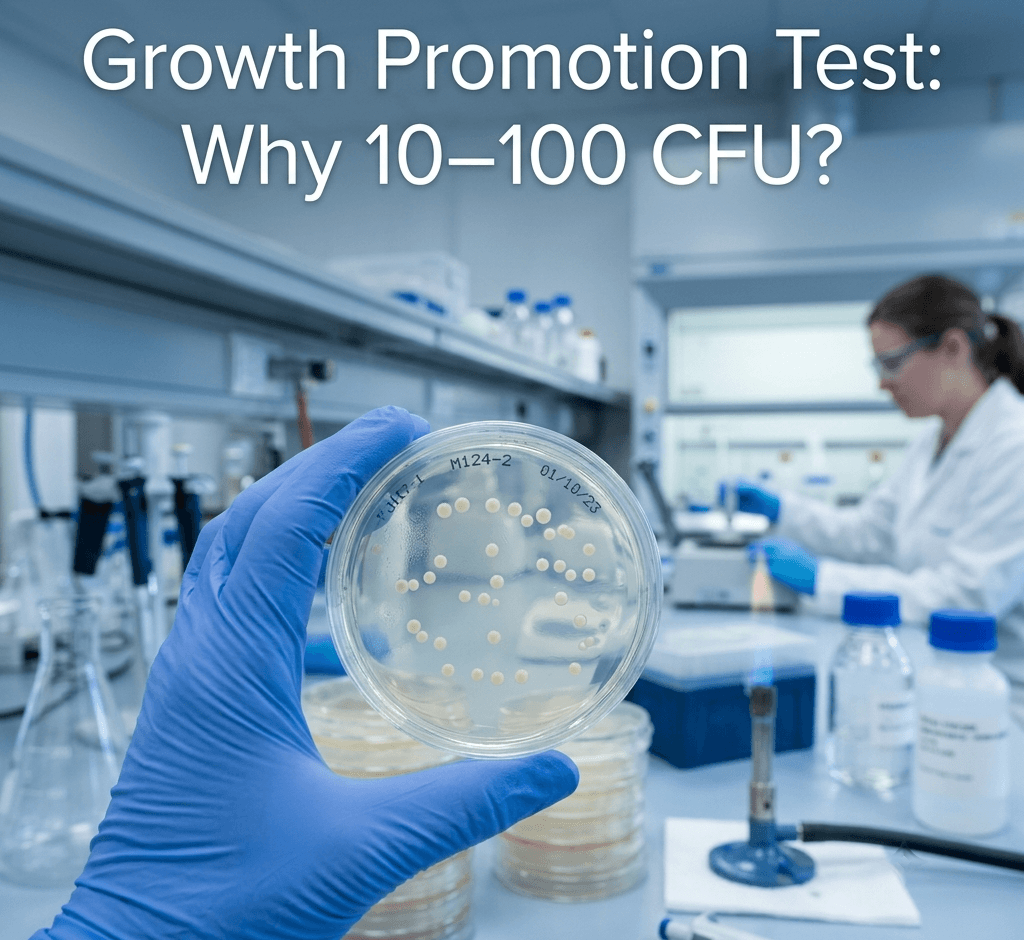
Growth Promotion Test (GPT) Inoculum Size: Why Is It Set Between 10–100 CFU?
If you work in pharmaceutical, medical device, food, or environmental microbiology, you’ve almost certainly run a Growth Promotion Test (GPT) before releasing a batch of culture media. And you’ve probably noticed that every protocol whether it references USP, EP, or JP asks for the same narrow inoculum target: 10 to 100 colony-forming units (CFU).
Why that specific range? Why not 500 CFU for a stronger signal, or a single organism for simplicity? This guide breaks down the microbiology and the regulatory logic behind the 10–100 CFU rule, what goes wrong outside that window, and why a range rather than one exact number is the practical answer.
What Is Growth Promotion Testing (GPT)?
Growth Promotion Testing is a quality control check performed on every new batch or lot of microbiological culture media. Its job is simple: confirm that the media can actually support the growth of a defined panel of representative microorganisms before that media is trusted to detect contamination in real samples.
In other words, GPT is a test of the test system itself. If the media can’t reliably grow a small, known number of organisms under controlled conditions, it has no business being used to catch unknown, low-level contamination in a sterility test or microbial limit test later on.
Why the Inoculum Is Capped at 100 CFU
Regulatory chapters including USP <61> (Microbiological Examination of Nonsterile Products: Microbial Enumeration Tests), USP <62> (Tests for Specified Microorganisms), USP <71> (Sterility Tests), EP 2.6.12 (Microbiological Examination of Non-Sterile Products), and JP 4.06 (Sterility Test) all specify an inoculum of not more than 100 CFU for GPT.
The reasoning comes down to two practical constraints of working with living organisms on a plate:
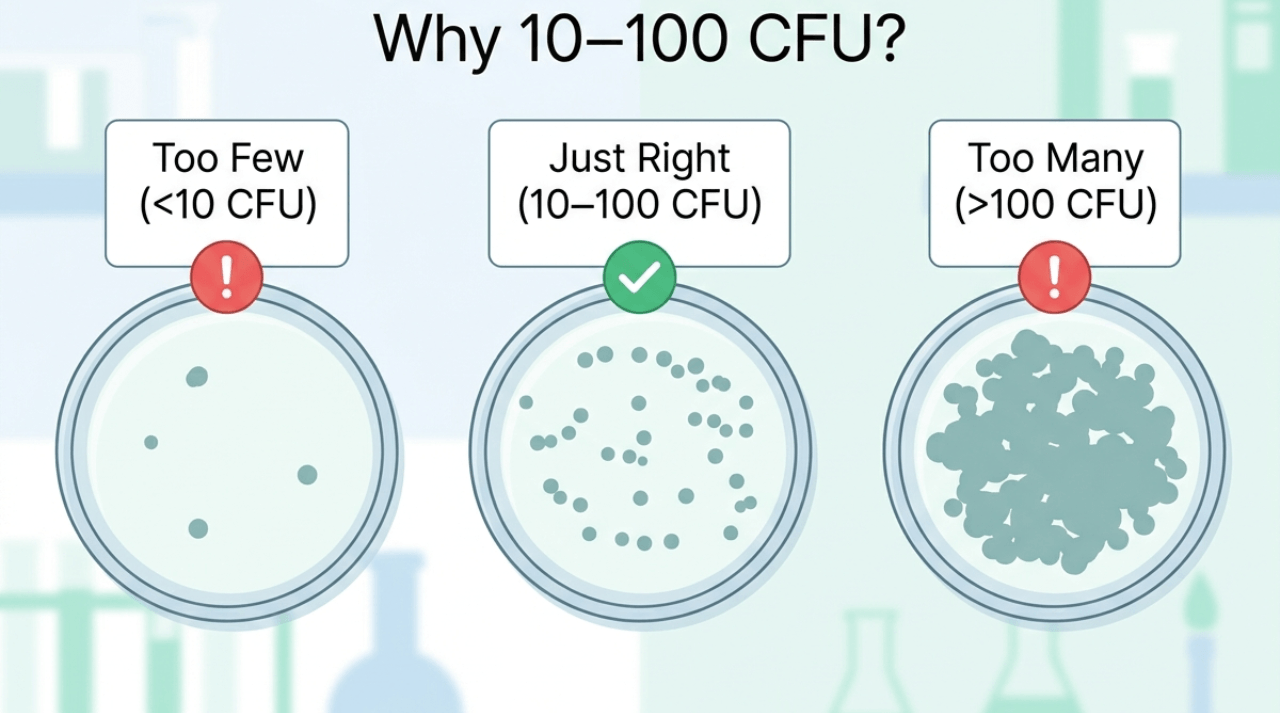
- Overcrowding distorts the picture. Push too many organisms onto a plate or into a broth, and they start competing with each other for nutrients, oxygen, and physical space. That competition can suppress visible growth or make individual colonies impossible to distinguish which defeats the purpose of the test.
- Countability matters. GPT isn’t just a yes/no check; for solid media, the recovered growth is compared against the standardized inoculum (commonly within a factor of 2, per USP <61>). That comparison only works if the colonies can actually be counted accurately, which requires a manageable, low-density plate.
Read More: Understanding Chemical Indicators for Sterilization
Why the Inoculum Can’t Drop Below 10 CFU Either
The lower bound exists for the opposite reason: at very low counts, the test becomes fragile and unreliable.
- Small errors become big errors. If the target inoculum is only 5 CFU, a minor pipetting variation a fraction of a milliliter off, a slightly uneven suspension can shift the result by a large percentage. At higher CFU counts, the same absolute error barely moves the needle.
- Slow-growing organisms need a fair chance. Some microorganisms anaerobes and mycobacteria among them grow more slowly or less predictably than fast-growing aerobes. Starting with too few cells increases the risk that these organisms simply fail to show visible growth within the incubation period, producing a false sense that the media doesn’t work when the real issue is an inadequate starting population.
What Happens If the GPT Inoculum Exceeds 100 CFU
An over-inoculated GPT plate creates problems that look like “extra growth is good” but actually undermine the test:
- Overcrowding and false negatives. Too many organisms compete for the same limited nutrients and surface area, which can mask whether the media is genuinely supporting healthy, individual growth.
- False confidence in the media. A crowded plate can look like strong growth promotion while hiding the fact that the media would struggle to recover a genuinely low-level contaminant which is exactly the scenario a real sterility test needs to detect.
- Regulatory non-compliance. Because USP, EP, and JP chapters explicitly cap the inoculum at 100 CFU, exceeding that limit puts the test outside the validated method, which can invalidate the results and trigger a deviation investigation.
What Happens If the GPT Inoculum Is Below 10 CFU
Under-inoculating creates the mirror-image problem a test that’s technically “compliant” on paper but statistically shaky in practice:
- High variability from small sampling errors. With only a handful of cells in suspension, normal pipetting and dilution variability can swing the observed CFU count dramatically, making pass/fail decisions less reproducible.
- Reduced sensitivity for fastidious or slow-growing organisms. As noted above, low counts combined with organisms that grow slowly (anaerobes, mycobacteria) raise the risk of a missed detection that has nothing to do with the media’s actual quality.
Why a Range (10–100 CFU) Instead of One Exact Number?
It might seem cleaner to specify a single fixed number say, exactly 100 CFU instead of a range. But microbial cultures don’t divide or dilute with that kind of precision. Achieving an exact count on demand isn’t realistic in a working lab, so the pharmacopeias built in a practical tolerance window instead.
The 10–100 CFU range balances three goals at once:
- Consistency without overengineering the process. Labs can hit the target reliably using standard dilution and plating techniques, without needing exotic equipment to nail an exact cell count.
- Reliable, reproducible results. The range is wide enough to absorb normal biological and technical variability, but narrow enough to keep the test meaningful.
- Global compliance. Because USP, EP, and JP all converge on the same 10–100 CFU expectation, a single validated GPT protocol can typically satisfy multiple pharmacopeial requirements at once.
The Bigger Picture: GPT as a Stress Test for Your Media
It helps to think of GPT less as a simple pass/fail checkbox and more as a stress test. The whole point is to confirm that culture media can recover even a small, defined number of organisms because if it can’t do that under ideal, controlled conditions, it certainly won’t detect the unpredictable, often very low levels of contamination present in a real sterility or microbial limit test. The 10–100 CFU range is what makes that stress test both meaningful and repeatable.
Frequently Asked Questions
What does CFU mean in Growth Promotion Testing? CFU stands for colony-forming unit a measure of the number of viable microbial cells capable of forming a visible colony on a culture medium.
Which pharmacopeias require the 10–100 CFU inoculum for GPT? USP <61>, USP <62>, USP <71>, EP 2.6.12, and JP 4.06 all specify that the GPT inoculum should not exceed 100 CFU, with 10–100 CFU used as the practical working range.
Why not just use exactly 100 CFU every time? Because microbial populations can’t be diluted or counted with that level of precision on a routine basis. A range accommodates normal biological and technical variability while still keeping results reliable and reproducible.
What is the risk of using more than 100 CFU in a GPT? Overcrowding can suppress or distort visible growth, create false confidence in the media’s performance, and take the test outside its regulatory-compliant range potentially invalidating the result.
What is the risk of using fewer than 10 CFU in a GPT? Very low counts are more sensitive to small pipetting or dilution errors and may not give slow-growing organisms, such as anaerobes or mycobacteria, a fair chance to demonstrate growth within the incubation period.
Have you run into challenges maintaining GPT inoculum counts in your lab? Share your experience in the comments.
Need Pharma, Medical Device, Utility, Food, Air, Water, Environmental, or Soil testing support? Reach out to Prewel Labs.