





















Does Longer Contact Time Always Improve Disinfectant Efficacy?
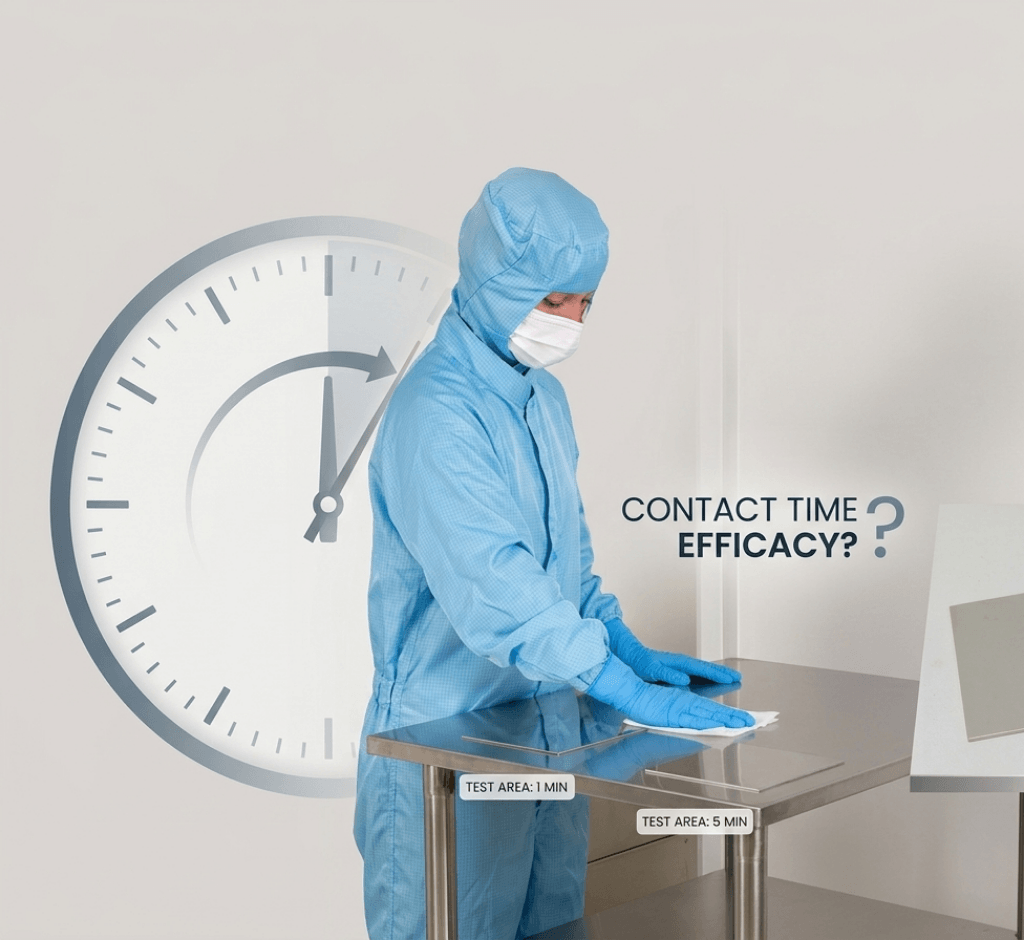
If you increase contact time, does disinfectant efficacy always improve? It sounds like it should. More time in contact with a surface or a pair of hands feels like it should mean more germs killed. But this assumption is one of the most common and most costly mistakes made when evaluating disinfectant performance.
In reality, disinfectant efficacy does not scale endlessly with contact time. It improves up to a point, and then it plateaus, and can even work against you if pushed too far.
The Logical Assumption vs. The Actual Behaviour
On the surface, “more contact time equals better efficacy” sounds like sound logic. It’s an easy trap to fall into, and it’s exactly where many disinfection processes quietly go wrong: assuming that “more” automatically means “better.”
The truth is more nuanced. Increasing contact time genuinely does improve disinfectant efficacy, but only up to a certain point.
Why More Contact Time Helps — At First
In the early stages of exposure, additional contact time gives the disinfecting agent more opportunity to interact with its target. This is why timing instructions exist in the first place.
A simple, everyday example makes this clear: when you use a hand sanitizer or a surface disinfectant, it needs a few seconds of contact to kill germs effectively. Wipe it off or let it evaporate too soon, and it simply hasn’t had enough time to work. In this early phase, efficacy genuinely rises alongside contact time.
Where Efficacy Plateaus: Diminishing Returns and Saturation
Past a certain point, though, the relationship changes. Efficacy reaches a maximum limit, and once most of the target organisms have already been eliminated, leaving the disinfectant in contact for longer doesn’t make the surface “extra clean.”
Think of it like charging your phone: once the battery hits 100%, keeping it plugged in longer doesn’t give you 120%. The same principle applies to disinfectant efficacy.
This levelling-off happens for a few distinct reasons:
1. Diminishing Returns
After the optimal contact time has passed, extending it further doesn’t meaningfully improve results. The disinfecting system has already delivered its maximum effect, and additional time adds little to no extra benefit.
2. Saturation Effect
Once all the available targets have already been affected, there’s nothing left for the disinfectant to act on. More time at this stage doesn’t create more impact — it simply adds delay without adding value.
3. Stability Matters
Not every disinfecting agent remains active indefinitely. Environmental conditions can reduce an agent’s activity over time. Beyond a certain point, you’re not improving efficacy at all — you may actually be losing it as the agent degrades or loses potency.
4. Biological Balance
In biological systems, excessive exposure can shift from beneficial to harmful. More exposure doesn’t necessarily mean more effectiveness; it can instead mean more side effects, without any corresponding gain in performance.
5. Real-World Practicality
In actual, real-world applications, unnecessarily long contact times are often impractical and resource-intensive, adding cost and complexity without a meaningful return in disinfection performance.
The Real Insight: It’s Not About Maximising Time
The core takeaway is simple, but easy to overlook: disinfectant efficacy isn’t about maximising contact time. It’s about understanding the system well enough to know exactly when more time stops helping — and when it can start to work against you.
This is precisely why determining the right contact time, rather than assuming “longer is always better,” matters so much in real-world disinfectant use.
How Disinfectant Efficacy Testing (DET) Helps
Because the relationship between contact time and efficacy isn’t linear, the only reliable way to know where a disinfectant’s optimal point actually falls is through structured testing.
At Prewel Labs, we support Disinfectant Efficacy Testing (DET) to help determine the right contact time and real-world effectiveness of a disinfectant, based on both regulatory and practical requirements. This helps ensure that contact time recommendations are grounded in actual performance data, rather than assumptions.
Frequently Asked Questions
Does increasing contact time always improve disinfectant efficacy?
No. Efficacy improves with increased contact time only up to an optimal point. Beyond that point, efficacy plateaus due to diminishing returns and saturation, and can even decline if the agent’s stability breaks down over time.
Why does disinfectant efficacy plateau over time?
Once most of the target organisms have already been eliminated, there’s nothing left for the disinfectant to act on (a saturation effect). Combined with diminishing returns, additional contact time no longer produces meaningful improvement.
Can too much contact time be harmful?
In biological systems, excessive exposure can shift from beneficial to harmful, potentially producing more side effects without any corresponding increase in effectiveness.
How do you determine the right contact time for a disinfectant?
The right contact time is determined through Disinfectant Efficacy Testing (DET), which evaluates real-world effectiveness against regulatory and practical requirements, rather than assuming longer is always better.

