





















Pathogen Testing in Purified Water: Why Pharma Does It Even When USP, EP and JP Don’t Require It
If you’ve worked with purified water (PW) in pharma or medical device manufacturing, you’ve probably asked this at some point: the pharmacopoeias don’t specifically require pathogen testing in purified water, so why do we bother?
Fair question. Let’s walk through it.
What USP, EP and JP actually ask for
For purified water, the pharmacopoeial focus is the total aerobic microbial count. The figure everyone quotes is 100 CFU/mL. USP <1231> gives it as a recommended action level, and the European Pharmacopoeia uses the same number for purified water in bulk. Neither one lists E. coli or Pseudomonas aeruginosa as mandatory checks for the water itself.
Two details about that number are worth knowing. USP <1231> is an informational chapter, so 100 CFU/mL is guidance rather than a pass/fail line written into the monograph. And FDA’s own inspection guide for high purity water systems says plainly that the limits for water are action limits, not pass/fail limits.
So the compendia give you a way to count. They don’t tell you what, exactly, you’re counting.
Does “not mandated” mean “doesn’t matter”?
No. Think about a glass of water that looks crystal clear. Would you drink it without knowing whether E. coli was in it? Probably not.
The same logic applies in pharma. Purified water can meet its total microbial count limit and still harbour opportunistic pathogens that put product safety at risk.
Why a passing plate count isn’t the whole story
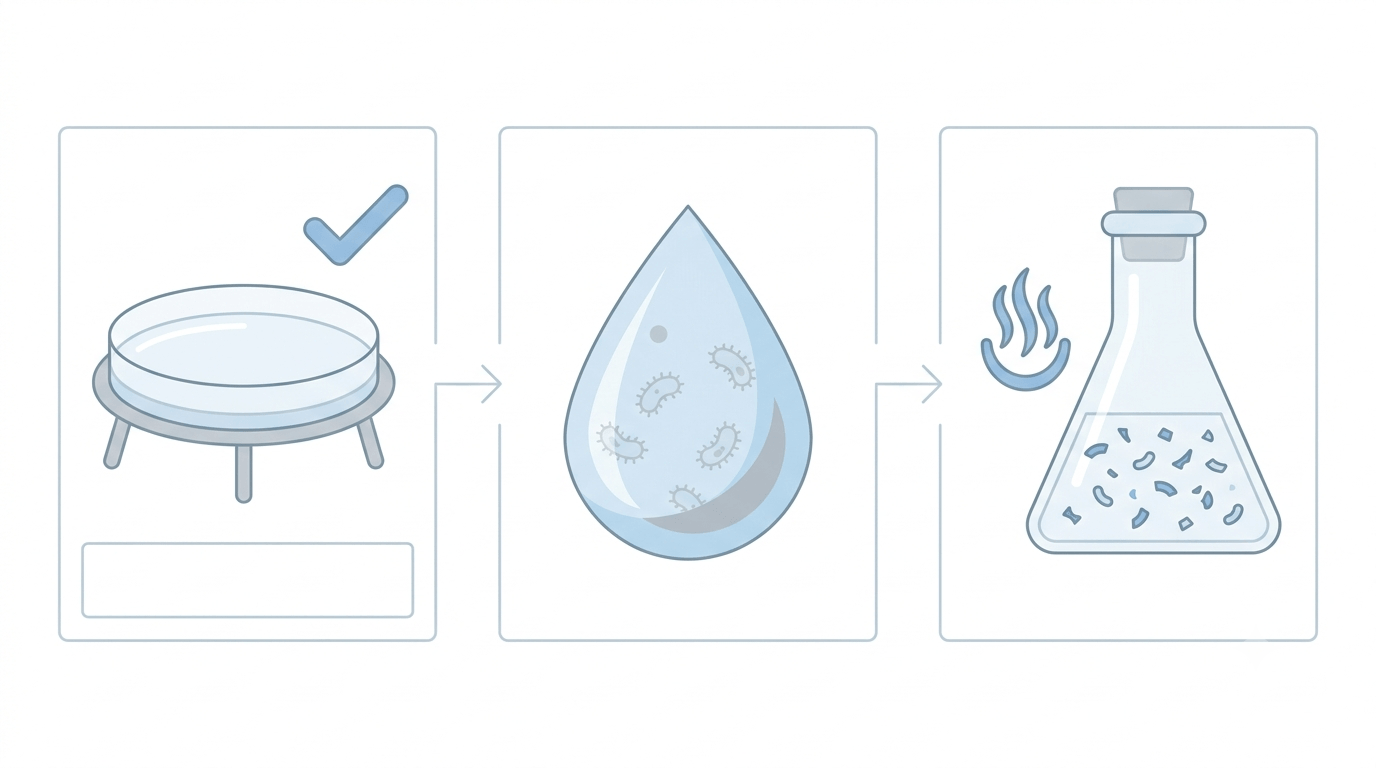
A plate count is a number. It tells you how many colonies grew, not who they were. Colonies of harmless water bacteria and colonies of Pseudomonas aeruginosa add up the same way on the count.
Some organisms make this worse than others. Burkholderia cepacia complex can form biofilms in pharmaceutical water systems, which makes it hard to clear out once it’s established. It also shrugs off many disinfectants and preservatives, and FDA has warned manufacturers that it poses a contamination risk in non-sterile, water-based drug products.
Endotoxins: the problem that outlives the bacteria
This is the part of the science that changes how people think about it.
Gram-negative bacteria such as Pseudomonas and E. coli carry endotoxin (a lipopolysaccharide) in their outer membrane. When the cells die and break apart, the endotoxin is released. It is also very heat stable. Ordinary sterilization cycles like autoclaving don’t destroy it. Dry heat at around 250 degrees C for 30 minutes is the established route, and even that is rated at a 3-log reduction.
In practice, that means killing the bacteria in your water doesn’t remove what they left behind. If endotoxin reaches the bloodstream through an injectable product, the effects range from fever to shock, and in severe cases fatal reactions.
One nuance for accuracy. The purified water monograph has no endotoxin limit, and purified water isn’t meant to be injected. But it’s commonly the starting material for water for injection, so what lives in PW doesn’t always stay in PW. That’s one reason industry practice goes past the minimum and screens for specified microorganisms.
Read More: How to Perform an Effective Bacterial Endotoxin Test
What regulators expect beyond the pharmacopoeias
In the US, CGMP expects non-sterile drug products to be free of objectionable organisms. USP <62> describes tests for specified microorganisms (Staphylococcus aureus, Pseudomonas aeruginosa, E. coli and Salmonella among them), and USP <60> covers the Burkholderia cepacia complex. Which organisms count as objectionable for your product is a risk decision that sits with the manufacturer, based on the product, how it’s used and who the patient is. FDA has also pushed manufacturers, through warning letters, to set limits for objectionable organisms in purified water.
India’s rules point the same way. Schedule M of the Drugs and Cosmetics Rules requires a validated water treatment system, water that meets pharmacopoeial specifications, and water that is free from harmful microorganisms. That lines up with global GMP expectations.
What a practical purified water testing program covers
If you want protection that goes beyond the baseline, the testing menu looks like this:
- Total aerobic microbial count
- Specified microorganisms: E. coli, Pseudomonas, Salmonella, Burkholderia cepacia and Staphylococcus
- Endotoxin testing
At Prewel Labs, we often see manufacturers trying to balance pharmacopoeial compliance with real-world safety. Our water testing services cover total aerobic microbial count, specified microorganisms (E. coli, Pseudomonas, Salmonella, Burkholderia cepacia and Staphylococcus) and endotoxin testing, so you aren’t only meeting the baseline. You’re protecting patients.
FAQ
Do USP, EP or JP require pathogen testing in purified water?
The pharmacopoeial focus for purified water is the total aerobic microbial count. They don’t list specific pathogens as mandatory checks for the water. Product-level and GMP expectations about objectionable organisms can still apply, which is why many manufacturers test anyway.
What is the microbial limit for purified water?
The commonly used figure is 100 CFU/mL. It appears as a recommended action level in USP <1231> and as the limit for purified water in bulk in the European Pharmacopoeia.
Which organisms should purified water be tested for?
There’s no single mandated list for the water. A common panel in industry is E. coli, Pseudomonas, Salmonella, Burkholderia cepacia and Staphylococcus, chosen according to your product and risk assessment.
Why does endotoxin matter if the water has been sterilized?
Endotoxin comes from the cell wall of Gram-negative bacteria and is released when they die. It is heat stable, so standard sterilization doesn’t destroy it. A separate endotoxin test is the only way to know it isn’t there.
The short answer
So the next time someone says, “USP/EP/JP doesn’t mandate it, so why bother?”, you have a reply. Patient safety and the regulators both expect more than the minimum.
References
- FDA, Guide to Inspections of High Purity Water Systems
- GMP Publishing, Water Qualities: Purified Water
- European Pharmacopoeia, Water, purified (monograph 0008)
- American Pharmaceutical Review, Excluding Burkholderia cepacia complex from aqueous non-sterile drug products
- American Pharmaceutical Review, A Comparative Study of Different Methods for Endotoxin Destruction
- FDA CDER, Microbiological quality considerations in non-sterile drug manufacturing