





















USP 1072 Log Reduction Requirements: Why 3-Log and 2-Log Aren’t Arbitrary
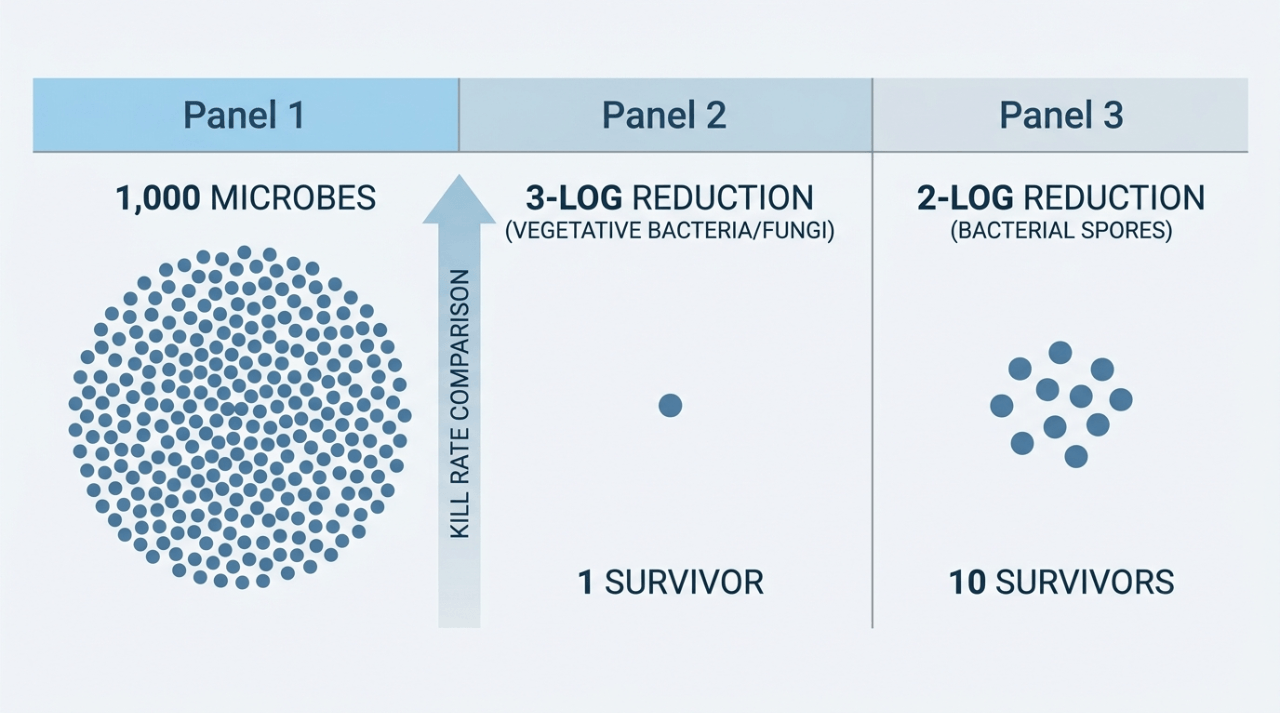
If you work in pharmaceutical manufacturing or cleanroom operations, you’ve almost certainly run into the disinfection efficacy criteria in USP General Chapter <1072>: a 3-log reduction for vegetative bacteria and fungi, and a 2-log reduction for bacterial spores.
At first glance, these numbers can look like they were pulled out of thin air. They weren’t. USP <1072> sets these thresholds based on risk-based rationale and real microbiological constraints a balance between what’s scientifically achievable, what’s practically necessary, and what’s safe to use on a daily basis in a controlled environment.
Here’s the reasoning behind the numbers, broken down.
What Does “Log Reduction” Actually Mean?
A “log reduction” is a measure of how much a disinfectant reduces the microbial population on a surface, expressed in powers of ten:
- 1-log reduction = 90% of microbes killed
- 2-log reduction = 99% killed
- 3-log reduction = 99.9% killed
Each additional log represents a tenfold increase in killing power.
To put that in perspective: imagine 1,000 bacteria sitting on a cleanroom surface. A 3-log reduction eliminates 999 of them, leaving just one survivor. That’s the level of control USP <1072> expects from a properly validated disinfectant against everyday microbial contamination.
Why a 3-Log Reduction for Vegetative Bacteria and Fungi?
Vegetative bacteria and fungi are the most commonly encountered contaminants in cleanroom and pharmaceutical environments and they’re comparatively easy to kill. They lack the protective structures that make some microorganisms harder to eliminate, so a well-formulated disinfectant can reliably achieve a high kill rate against them.
Typical challenge organisms used in USP <1072> and related efficacy testing (such as the AOAC Use-Dilution Test) include:
- Staphylococcus aureus — commonly shed from human skin
- Pseudomonas aeruginosa — often associated with water sources and damp surfaces
- Candida albicans — a frequently encountered fungal contaminant
None of these organisms have the tough protective coatings that make spores so resistant. A 3-log reduction against them confirms that a disinfectant is doing meaningful, measurable work while still being achievable with routine, everyday chemistries that are safe for regular use around people and equipment.
Why Only a 2-Log Reduction for Bacterial Spores?
Bacterial spores are a different challenge entirely. Organisms like Bacillus subtilis can form spores that survive extreme heat, desiccation, and chemical exposure making them dramatically harder to eliminate than vegetative cells.
Because of this resistance, USP <1072> sets a more realistic bar: a 2-log (99%) reduction for bacterial spores. Achieving even this level with a standard-use disinfectant is a meaningful result. Pushing further toward the higher log reductions achievable with dedicated sporicides such as peracetic acid typically requires more aggressive chemistry that isn’t always practical or safe for frequent use on all surfaces or around operators.
In other words, the 2-log threshold reflects a trade-off that shows up throughout USP <1072>’s broader guidance on disinfectant selection: what’s achievable against a genuinely tough organism, balanced against material compatibility and operator safety.
Read More: Why Disinfectant Efficacy Testing Uses 10⁶ CFU/mL
The Bigger Picture: A Practical Standard, Not Just a Kill Count
USP <1072> isn’t just about hitting a number on a lab report. It’s built around a practical standard for pharmaceutical and cleanroom disinfection one that accounts for:
- Efficacy — does the disinfectant demonstrably reduce microbial load?
- Safety — is it safe for regular use around operators and product?
- Compatibility — does it damage equipment, surfaces, or materials with repeated use?
- Consistency — can the result be reliably reproduced across routine cleaning cycles?
A disinfectant that scores extremely high on kill rate but corrodes equipment or poses an operator safety risk isn’t actually a good fit for daily cleanroom use. USP <1072>’s log reduction criteria reflect that reality they’re a floor for efficacy, not a ceiling, and they’re deliberately calibrated against what’s realistic for routine, ongoing disinfection programs rather than one-off worst-case scenarios.
FAQ: USP 1072 Log Reduction Requirements
What log reduction does USP <1072> require for disinfectants?
USP <1072> requires at least a 3-log reduction for vegetative bacteria and fungi, and at least a 2-log reduction for bacterial spores.
What does a 3-log reduction mean in practical terms?
A 3-log reduction means 99.9% of the target microbial population is eliminated out of 1,000 organisms, only one would survive.
Why is the spore reduction requirement lower than the bacteria requirement?
Bacterial spores, such as those formed by Bacillus subtilis, are far more resistant to heat and chemical exposure than vegetative bacteria or fungi. A 2-log reduction represents a realistic, achievable standard for routine-use disinfectants against this more resilient organism type.
What organisms are typically used to test disinfectant efficacy under USP <1072>?
Common challenge organisms include Staphylococcus aureus and Pseudomonas aeruginosa (bacteria), Candida albicans (fungus), and Bacillus subtilis (bacterial spores).
Do I need a sporicide to meet USP <1072> requirements?
Not necessarily for routine cleaning a standard disinfectant achieving 2-log spore reduction can satisfy the baseline. Dedicated sporicides (like peracetic acid) achieve higher spore kill rates but are typically reserved for periodic, more intensive disinfection due to material compatibility and safety considerations.