























Why Do Medical Devices Have Limited Reuse Cycles?
Drop your phone once, and it might survive with barely a scratch. Drop it a second or third time, and those hairline cracks start to spread — until, eventually, it stops working altogether.
Medical devices go through something remarkably similar. Even with rigorous cleaning and sterilization between uses, they don’t last forever. Every device that’s labeled reusable comes with a limit on how many times it can safely go through that cycle — and once it hits that limit, no amount of cleaning can bring it back to “like new.”
So why can’t hospitals just keep reprocessing and reusing the same instruments indefinitely? Here’s what’s actually happening beneath the surface.
Reusable Devices Wear Out Like Anything Else You Use Repeatedly
Think about your favorite t-shirt. You wash it again and again, and for a while it holds up fine. But eventually it fades, stretches out of shape, and starts developing thin spots or holes. No amount of careful washing stops that process — it just slows it down.
Medical devices behave the same way. Every single cleaning, disinfection, and sterilization cycle puts physical and chemical stress on the device. Over time, that repeated stress changes the material itself, making the device less safe or less effective than it was when it left the factory.
What Actually Happens to a Device Over Repeated Reprocessing Cycles
There are three main ways reprocessing takes a toll on medical devices and their accessories:
They Get Physically Weaker
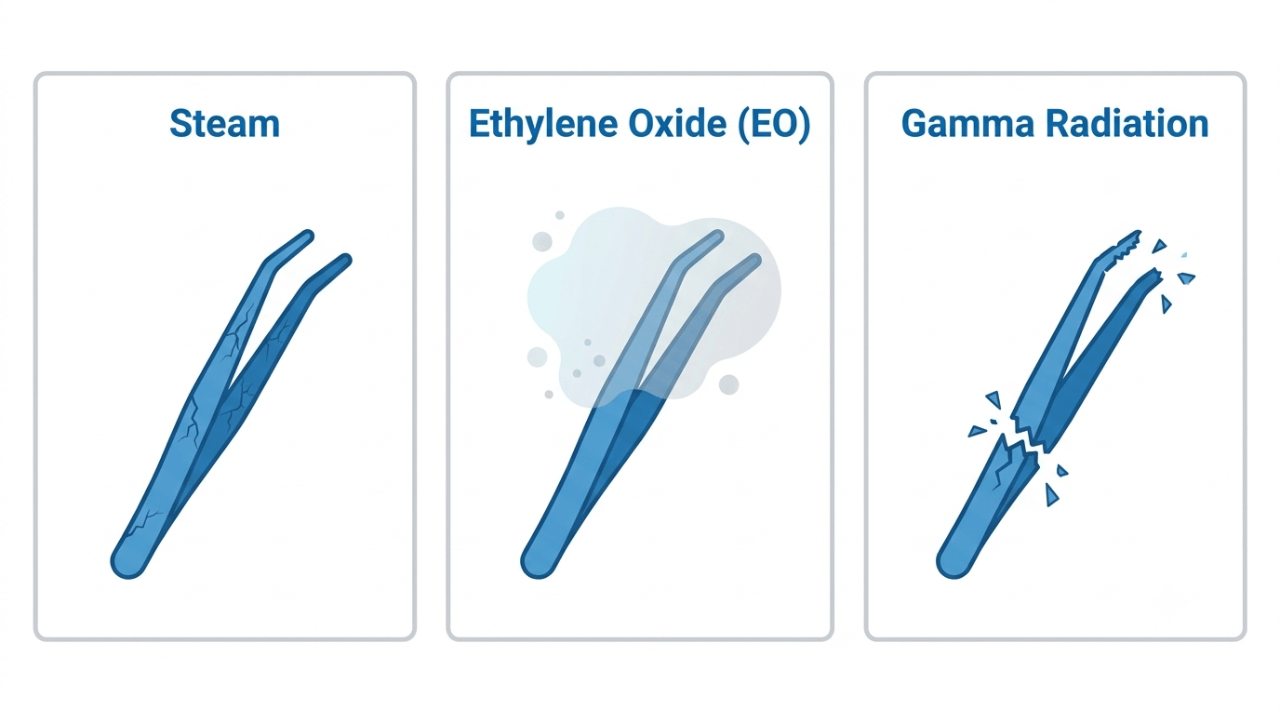
Sterilization isn’t gentle. Steam sterilization exposes devices to high heat and pressure — a robust, well-established process, but one that’s hard on materials sensitive to heat or moisture. Ethylene oxide (EO) gas penetrates porous materials effectively, but it leaves chemical residues behind that have to be carefully monitored and cleared. Gamma radiation, meanwhile, works by breaking intermolecular bonds within polymers, which over time leads to embrittlement and a loss of toughness, along with reduced elongation and discoloration in certain elastomers.
Put simply: plastics can turn brittle, rubber seals can lose their flexibility, and even metal components can be affected over repeated cycles. As industry guidance puts it, medical devices are made of many different materials that can be damaged if exposed to the wrong type of sterilization — radiation, for instance, can make plastics brittle.
They Stop Performing the Way They’re Supposed To
Precision matters in medical instruments. A surgical scissor needs a sharp, true edge to cut cleanly. A catheter needs to retain its exact shape and flexibility. As materials degrade cycle after cycle, that precision erodes — and a device that’s technically still “intact” may no longer perform to the standard it was designed and validated for.
They Can Trap Contaminants Even After Cleaning
Devices with tiny crevices, lumens, tubing, or hinged joints are notoriously difficult to fully clean. Even with a validated reprocessing protocol, invisible residue or biological material can remain in hard-to-reach areas, raising the risk of cross-contamination between patients.
Read More: Sterility Testing: Ensuring Medical Device Safety
Why Not Just Keep Sterilizing the Device Forever?
It’s a fair question — and the honest answer is that sterilization and physical integrity are two completely different things. Sterilization kills or removes microorganisms. It does nothing to reverse material degradation, brittleness, or dulled edges.
It’s a bit like reheating the same leftovers over and over: reheating makes the food safe to eat again, but it doesn’t restore the flavor or nutrients that were lost the first, second, or third time around. In the same way, once a medical device’s materials have degraded past a certain point, no cleaning or sterilization cycle can make it “safe” again — because the underlying problem was never contamination in the first place, it was material failure.
What Do Regulations Actually Require?
This isn’t just a manufacturing best practice — it’s a regulatory requirement in most major markets.
In the United States, the FDA distinguishes between single-use devices and reusable devices at the labeling stage. To market a device as reusable, a manufacturer must provide data demonstrating to the FDA’s satisfaction that the device can be cleaned and sterilized without impairing its function. Devices that get reprocessed for reuse — including some originally labeled single-use — fall under increasing FDA scrutiny depending on their risk classification.
Internationally, the ISO 17664 series is the primary standard governing what manufacturers must tell users about reprocessing. It requires that a device’s lifetime be clearly defined, either through a maximum number of reprocessing cycles or an end-of-life indicator, and that this definition be backed by appropriate testing data or scientific literature.
In the European Union, the Medical Device Regulation (MDR) goes further and makes this a labeling requirement. Instructions for use must include information on when a device should no longer be reused — for example, signs of material degradation or the maximum number of allowable reuses. For devices that are single-use but have been reprocessed, the MDR also requires an indication of that fact, the number of reprocessing cycles already performed, and any limitation on the number of cycles allowed.
In practice, this means a label that says “reusable up to 10 cycles” isn’t a suggestion — it’s the result of validated testing, and exceeding it puts patient safety, and regulatory compliance, at risk.
The Bottom Line
Like anything subjected to repeated stress, medical devices and their accessories have a defined lifespan. Reprocessing cycle limits aren’t arbitrary — they’re grounded in how sterilization methods physically and chemically affect materials over time, and they’re backed by testing data required under frameworks like FDA guidance, ISO 17664, and EU MDR.
Ignoring those limits doesn’t just risk equipment failure. It risks infection, non-compliance, and ultimately, patient safety. Just as you wouldn’t trust a worn-out parachute, hospitals shouldn’t rely on medical instruments that have outlived their validated reprocessing life.
Frequently Asked Questions
How many times can a reusable medical device be sterilized?
It depends entirely on the specific device. Manufacturers validate a maximum number of reprocessing cycles through testing, and that number — often printed directly on the device label or in its instructions for use — varies by device type, material, and sterilization method used.
Does sterilization damage medical devices?
Not the sterilization process itself in terms of microbial safety, but the physical processes involved (heat, gas exposure, or radiation) can degrade materials over repeated cycles — making plastics brittle, affecting rubber components, and dulling precision edges.
What happens if a hospital exceeds a device’s reprocessing limit?
Exceeding a validated reuse limit can compromise the device’s mechanical performance and sterility, increasing the risk of device failure or infection. It can also violate FDA, ISO, or EU MDR requirements, depending on jurisdiction.
Who decides how many times a medical device can be reused?
The device manufacturer determines and validates the maximum reprocessing cycle count through required testing, in line with standards like ISO 17664, and must disclose that limit in the device’s labeling and instructions for use.
Are single-use devices ever legally reprocessed and reused?
Yes, in some cases. In the US, this is regulated by the FDA, which requires reprocessors of single-use devices to meet the same regulatory standards as the original manufacturer, including demonstrating the reprocessed device remains safe and effective.
Want to ensure your medical devices meet safety standards? Contact Prewel Labs for expert medical device reusability studies!