






















Disinfectant Efficacy Testing: Why “Clean” Isn’t Always Sterile
Have you ever cleaned a surface that looked spotless, but wasn’t truly clean?
That’s exactly what happens in pharma, medical device, and healthcare facilities when disinfectants look effective but aren’t. A surface can appear immaculate under normal light and still carry a microbial load capable of contaminating a batch, a device, or a patient. The gap between “looks clean” and “is clean” is precisely what disinfectant efficacy testing (DET) is designed to close.
Here’s why DET sits at the center of any serious contamination control program — broken down simply, scientifically, and practically.
1. Contamination Control Starts With Efficacy
A disinfectant is your first line of defence against contamination. If it doesn’t truly kill microorganisms, every other measure — air handling, gowning, HEPA filtration — loses its purpose. Those systems are built to support a disinfection strategy, not replace one.
As per WHO TRS 961, ineffective cleaning is linked to a large share of microbial excursions in cleanrooms. In other words, most contamination events don’t start with a dramatic equipment failure — they start with a disinfectant that quietly wasn’t doing its job.
2. Regulators Ask for Proof, Not Promises
Authorities including the US FDA, EU GMP Annex 1, and WHO don’t accept a vendor’s efficacy data at face value. They expect disinfectant efficacy testing performed on your own facility’s actual surfaces, using your own environmental isolates — not just the reference organisms a manufacturer tested in a lab.
USP <1072> is explicit on this point: efficacy must be demonstrated under practical use conditions, including the correct use-dilution, contact time, and exposure temperature that match how the disinfectant is actually applied on the floor. A certificate from the manufacturer tells you the chemistry can work. DET tells you it does work, in your facility, against your microflora.
3. Every Surface Behaves Differently
A disinfectant might achieve a 5-log kill on stainless steel but only a 2-log reduction on vinyl flooring. Surface texture, residue, and porosity can all shield microorganisms from full contact with the active ingredient, letting them survive a disinfection cycle that looked complete.
This is exactly why EU GMP Annex 1 asks facilities to validate efficacy on representative materials — not just on lab glass coupons. If your cleanroom has stainless steel benches, vinyl flooring, and epoxy-coated walls, your DET program needs to reflect all three, because a disinfectant qualified on one surface type can’t be assumed to perform the same way on another.
Read More: The Evolution of Disinfectant Efficacy Testing: From Traditional Methods to Advanced Technologies
4. Your Microbial Flora Changes Over Time
Cleanrooms aren’t static. New equipment, new personnel, and changes in airflow all shift the microbial population living in your environment. A disinfectant that was highly effective against last year’s isolates may be less effective against organisms that have since become established.
Requalification — repeating DET periodically rather than treating it as a one-time exercise — ensures your disinfectant still works against what’s actually growing in your facility today, not just what was there when the program was first validated.
5. Chemistry Has Limits
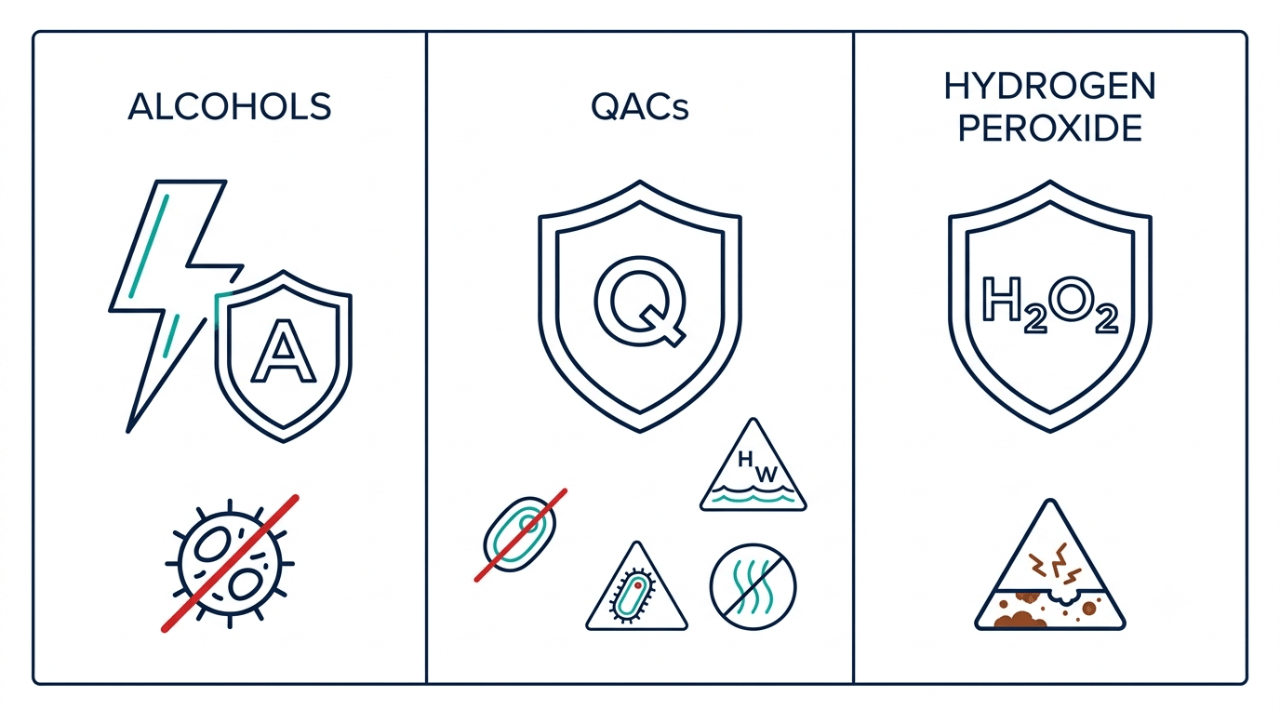
No single disinfectant kills everything, and understanding each chemistry’s blind spots is part of building a sound program:
- Alcohols act fast but fail against bacterial spores.
- Quaternary ammonium compounds (QACs) are effective against Gram-positive organisms but not spores.
- Hydrogen peroxide offers broad-spectrum activity but can corrode certain metals with repeated use.
Because every chemistry has a gap, facilities typically rotate disinfectants — commonly a broad-spectrum agent paired with a periodic sporicidal treatment — to prevent microbial resistance and reduce residue buildup over time.
6. Real-World Conditions Aren’t Perfect
Laboratory efficacy testing is often done under clean, controlled conditions. Real cleanrooms aren’t always that forgiving — organic soil, residue from previous cleaning agents, and less-than-ideal contact time can all reduce a disinfectant’s actual performance.
DET is designed to recreate these worst-case, “dirty” conditions specifically so facilities can see true performance, not best-case performance. A disinfectant that only works when everything is optimal isn’t one you can rely on during a busy production day.
7. The Cost of Failure Is Significant
Between 2020 and 2023, a notable share of sterile product recalls were attributed to poor disinfection or contamination control. Beyond the recall itself, a single ineffective disinfectant can trigger batch rejections, lengthy investigations, regulatory findings — and in the worst cases, direct patient risk. The cost of skipping or under-scoping DET is rarely just financial.
8. DET Is Part of Your Contamination Control Strategy (CCS)
EU GMP Annex 1 explicitly links disinfectant efficacy testing to the broader Contamination Control Strategy. DET isn’t a standalone checkbox or a one-time validation exercise — it’s a continuous assurance activity that confirms your disinfectants are still protecting your process as conditions, isolates, and surfaces evolve.
Frequently Asked Questions
What is Disinfectant Efficacy Testing (DET)? DET is the process of validating that a disinfectant actually kills microorganisms under the real conditions of a specific facility — using its own surfaces, soil loads, and environmental isolates — rather than relying solely on the manufacturer’s generic lab data.
Why isn’t vendor efficacy data enough on its own? Vendor data is typically generated under standardized lab conditions using reference strains. Regulators such as the FDA, EU GMP Annex 1, and WHO expect facilities to confirm efficacy on their own representative surfaces and against their own microbial isolates, since real-world performance can differ from lab results.
How often should DET be repeated? DET should be requalified periodically rather than performed once. Because a facility’s microbial flora shifts with new equipment, personnel, and airflow changes, retesting ensures the disinfectant still performs against what is currently present in the environment.
Why do facilities rotate disinfectants instead of using just one? No single chemistry is effective against every type of microorganism. Rotating a broad-spectrum disinfectant with a periodic sporicidal agent helps close chemistry-specific gaps — such as alcohols failing against spores — while also reducing the risk of microbial resistance and residue buildup.
How does DET relate to a facility’s Contamination Control Strategy (CCS)? EU GMP Annex 1 links DET directly to the CCS. Rather than being an isolated validation step, DET functions as ongoing evidence that a facility’s contamination control measures — including disinfection — are actually working as intended.
At Prewel Labs, we perform Disinfectant Efficacy Testing using real-world conditions, actual surfaces, realistic soil loads, and your own microbial isolates.
Our goal? To help you not just meet compliance, but build confidence in your contamination control program.