






















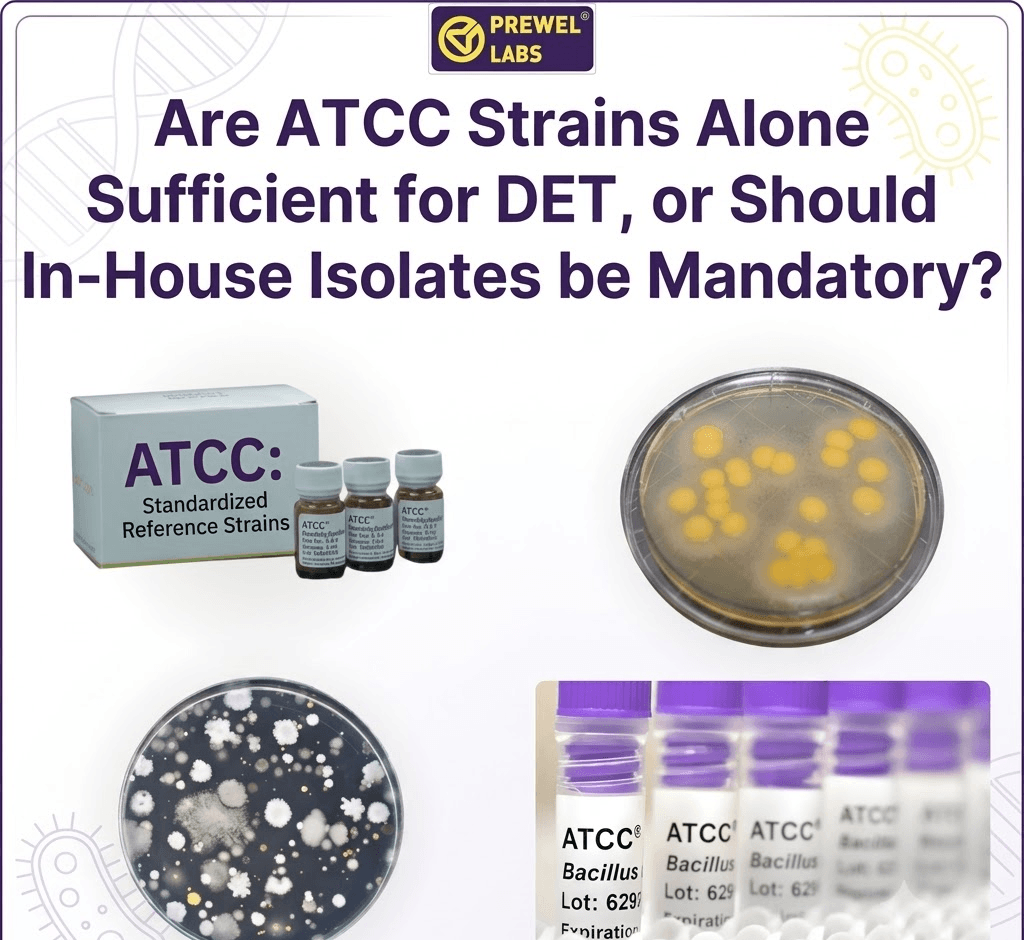
Disinfectant Efficacy Testing: Why ATCC Strains Alone May Not Be Enough for Your Cleanroom
Passing Disinfectant Efficacy Testing (DET) with standard ATCC strains feels like a milestone. The paperwork is in order, the log reductions meet the acceptance criteria, and the audit trail looks clean. But a harder question tends to surface later: does passing DET with ATCC strains actually mean your cleanroom is protected every single day?
For pharmaceutical and medical device manufacturers, that question sits at the center of contamination control strategy. And increasingly, regulators and auditors expect a more complete answer than “we tested against the standard organisms.”
What Is Disinfectant Efficacy Testing (DET)?
Disinfectant Efficacy Testing is the study used to demonstrate that a disinfectant, at a defined concentration and contact time, can achieve the required microbial log reduction on the surfaces actually found in a facility. It is a core part of disinfectant validation and, more broadly, of a site’s cleaning and disinfection program.
DET is often confused with “disinfection validation” or “cleaning validation.” Strictly speaking, DET is one component of a broader validation effort that also considers environmental monitoring trends, surface materials, contact times, and use-dilution studies. Getting DET right matters because disinfectants are not evaluated to satisfy a checklist they are evaluated to prevent contamination that could reach a patient.
The Role of ATCC Strains: Your Bowling Machine
Think of ATCC (American Type Culture Collection) strains as a bowling machine in cricket practice. They are standard, predictable, and repeatable. Every lab that runs the same ATCC strain under the same conditions should get comparable results, which is exactly why regulators rely on them as a baseline.
ATCC strains give you:
- A reproducible, industry-recognized baseline for disinfectant performance
- Regulatory confidence, since inspectors expect to see recognized reference organisms in a DET study
- A consistent way to compare disinfectants or contact times against each other
That predictability is valuable. But a bowling machine, however well calibrated, cannot fully prepare a batsman for a real fast bowler who varies pace, seam position, and line on the day. ATCC strains play a similar, necessary, but incomplete role in DET.
Why Facility Isolates Change the Risk Picture
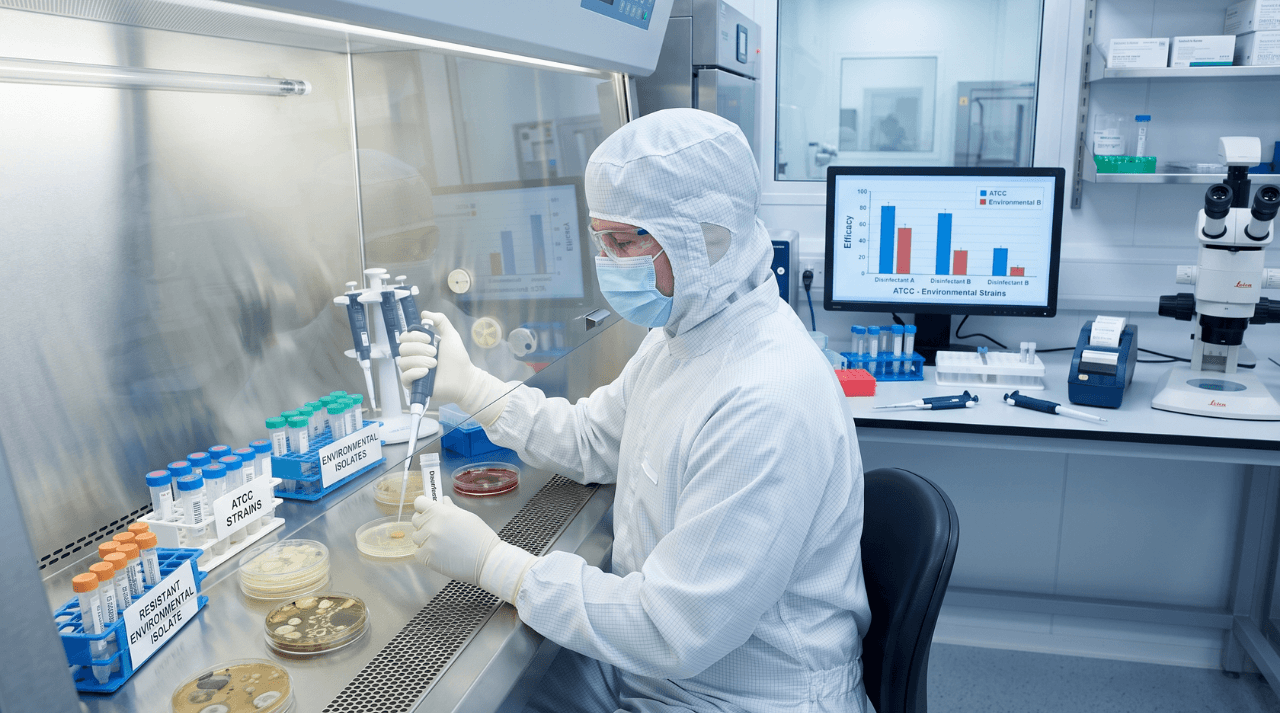
The organisms that actually survive inside a facility are not always the same as the standard strains used in baseline testing. Microorganisms recovered from a site’s own environmental monitoring program commonly called facility isolates or environmental isolates can behave differently from ATCC reference strains in ways that matter for real-world protection:
- They may form biofilms, which can shield cells from disinfectant contact and make surface kill claims harder to achieve in practice.
- They may adapt to the specific disinfectants in routine use, particularly when the same chemistry is used repeatedly without rotation.
- They may grow slowly but survive longer, persisting in a facility even when routine cleaning appears effective.
If a DET program only ever challenges ATCC strains, it never actually tests against the organisms most likely to be lurking in the facility itself. That is the gap facility isolates are meant to close.
Read More: Does Longer Contact Time Always Improve Disinfectant Efficacy?
What EU GMP Annex 1 and USP <1072> Say
This is not just a theoretical concern it is reflected in current regulatory guidance.
- USP General Chapter <1072>, Disinfectants and Antiseptics, advises that disinfectant efficacy testing use a wide range of standard test organisms and environmental isolates, and describes surface challenge tests and use-dilution tests built around both. It also sets commonly referenced acceptance criteria at least a 3-log reduction for vegetative bacteria and a 2-log reduction for bacterial spores as a starting point that manufacturers build their own validation criteria around.
- EU GMP Annex 1, which governs the manufacture of sterile medicinal products, ties disinfectant efficacy directly into a site’s Contamination Control Strategy (CCS). Under Annex 1, disinfectants should be demonstrated to be effective against local environmental isolates, not just standard laboratory organisms, and the level of microbial kill required is decided based on room grade, environmental monitoring trends, and risk assessment all documented within the CCS.
The common thread in both is the same: disinfectant validation is expected to reflect actual site conditions, not only laboratory conditions.
ATCC Strains vs. Facility Isolates: Two Different Jobs
It helps to be clear that this is not an either/or choice. ATCC strains and facility isolates serve different, complementary purposes in a DET program:
| ATCC Strains | Facility Isolates | |
|---|---|---|
| Role | Regulatory baseline, reproducibility | Real-world, site-specific challenge |
| Predictability | High standardized organisms | Variable reflects actual flora |
| Regulatory expectation | Expected as a reference point | Expected under USP <1072> and EU GMP Annex 1 |
| Risk covered | Baseline disinfectant performance | Biofilm formation, adaptation, survival in situ |
A strong, science-based DET program uses both. ATCC strains provide the regulatory backbone; facility isolates provide assurance that the disinfectant actually works against what is living in your cleanroom.
Building a Science-Based DET Program
Bringing facility isolates into a DET program does not replace ATCC-based testing it extends it. In practice, this means:
- Continuing to test against recognized ATCC reference strains to maintain the regulatory baseline.
- Trending environmental monitoring data to identify recurring or persistent facility isolates.
- Including relevant facility isolates in surface challenge and use-dilution studies alongside ATCC strains, with documented rationale for which isolates are selected.
- Feeding the results back into the site’s Contamination Control Strategy, including disinfectant rotation decisions where resistance or biofilm risk is identified.
Companies that build their DET programs this way tend to see two practical benefits: audits go more smoothly because the rationale for isolate selection is already documented, and quality teams have more confidence that a “pass” on DET reflects real protection not just a passed test.
The Bottom Line
Disinfectant Efficacy Testing with ATCC strains alone can satisfy a baseline expectation, but it does not, by itself, confirm that a cleanroom is protected under real, everyday conditions. Facility isolates organisms that may form biofilms, adapt to disinfectants, or persist despite routine cleaning represent the risk that ATCC strains alone cannot fully capture. Guidance such as USP <1072> and EU GMP Annex 1 reflects this by pointing toward the use of environmental isolates alongside standard strains.
Disinfectants are not validated simply to pass an audit. They are validated to protect patients, every day, not only on the day of the test.
FAQs on Disinfectant Efficacy Testing and Facility Isolates
Are facility isolates mandatory in Disinfectant Efficacy Testing?
Neither USP <1072> nor EU GMP Annex 1 mandates testing against every environmental isolate recovered from a site. What they do expect is that disinfectant efficacy is demonstrated against organisms relevant to the facility, with a documented, risk-based rationale for which isolates are selected as part of the site’s Contamination Control Strategy.
What is the difference between ATCC strains and facility isolates in DET?
ATCC strains are standardized reference organisms used to establish a reproducible, regulator-recognized baseline. Facility isolates are organisms recovered from a site’s own environmental monitoring program, and they can behave differently forming biofilms, adapting to routine disinfectants, or surviving longer which is why they are used to test real-world performance.
Does using ATCC strains alone satisfy regulatory expectations?
ATCC strains satisfy the baseline expectation that regulators look for, but current guidance encourages pairing them with environmental isolates so that disinfectant validation reflects actual site conditions rather than laboratory conditions alone.
At Prewel Labs, we work with pharmaceutical and medical device manufacturers to strengthen Disinfectant Efficacy Testing programs by combining standard ATCC strains with trended facility isolates helping teams walk into audits with a stronger, better-documented rationale.
If you need support with water, food, air, soil, environmental, pharmaceuticals, medical device, gas, compressed air, or steam quality testing, visit prewellabs.com and fill out the contact form.

